As an Amazon Associate, we earn from qualifying purchases. Read our affiliate disclosure. Amazon buttons below search for matching listings; they do not confirm stock, an exact seller, or a current price.
The best hydraulic barber chair is a complete chair-and-base assembly with the right operating range, documented load limit, usable controls, and a credible service route. Hydraulic describes the lifting system; it does not tell you how the back reclines, whether the footrest moves, or what the whole chair can carry. Our manufacturer-researched candidates are Collins Continental 9010, Collins Commander II 9060, and Takara Belmont Elegance BB-225 with its specified base.
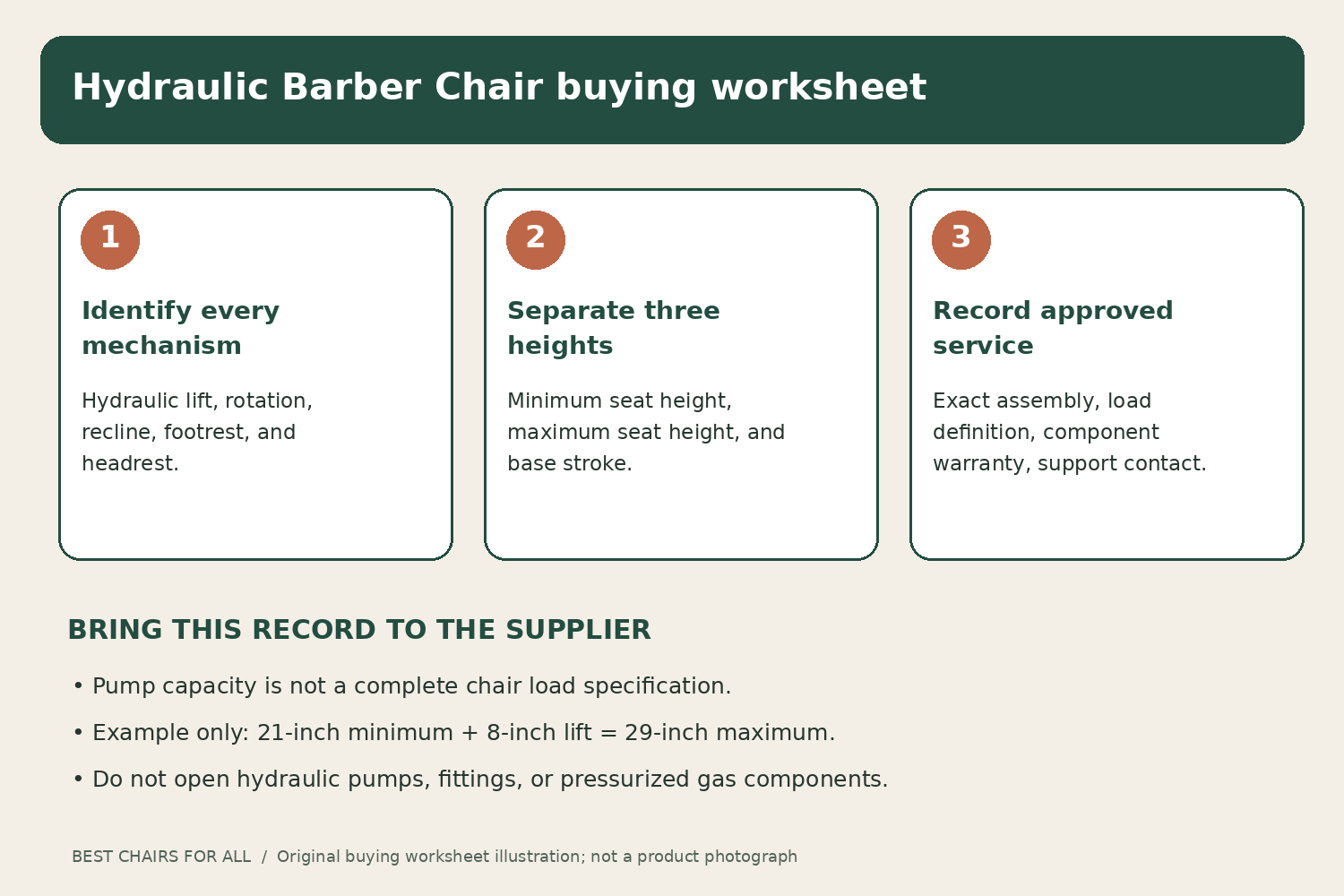
We checked the cited manufacturer sources on November 6, 2026. We have not operated the pumps, measured lift under load, or compared long-term reliability. Prices and availability need current supplier confirmation. This guide focuses on buying and documenting an approved hydraulic system; it provides no hydraulic, gas-cylinder, or powered-drive disassembly instructions.
Stop treating the pump as the entire chair
A chair contains several systems that may have separate controls and warranty terms. Height adjustment, rotation restraint, reclining back, headrest, and footrest should each be identified. A gas-controlled reclining back can coexist with a hydraulic lifting base. Calling the whole product hydraulic does not mean those mechanisms share a maintenance procedure or that one control secures everything.
The top, base, mounting arrangement, footrest, and accessories also need manufacturer compatibility. A replacement base advertised for barber chairs is not automatically suitable for any chair top. Ask the supplier to identify the complete approved assembly and provide its applicable instructions. Do not combine a higher pump rating with a different top and claim the resulting chair inherits that larger capacity.
Before comparing models, list the shop’s essential operating tasks. These might include moving between ordinary working heights, securing rotation, reclining for a supported grooming service, and returning to the approved entry position. Have the supplier demonstrate the tasks on the exact assembly being quoted. A showroom model with a different base cannot establish the behavior of the lower-cost package on the invoice.
Three models with the mechanisms kept distinct
| Model | Manufacturer-documented arrangement | Reason to investigate | Condition to verify |
|---|---|---|---|
| Collins Continental 9010 | Hydraulic base, gas-controlled recline, stationary footrest | Conventional hydraulic lift with separate recline system | Exact base and full operating specifications |
| Collins Commander II 9060 | Gas-controlled recline and synchronized kick-out footrest | Coordinated lower-leg layout | Approved base choice and moving-chair space |
| Takara Belmont Elegance BB-225 | K25 base listed; 8-inch base stroke | Clearly identified base in the manufacturer store | Assembled seat heights and load limit |
Collins Continental 9010: a straightforward system to document
The Continental 9010 manufacturer page describes a heavy-duty hydraulic base with a 27-inch baseplate, gas-cylinder-controlled recline, stationary footrest, and adjustable headrest. It lists 25 inches between the arms and a 23-inch height to the seat, while warning that the pictured base can differ from the default option.
Investigate it when that conventional layout fits the service menu and a separate stationary footrest is preferred. Its limitation is that the adjective heavy-duty does not replace the complete approved load and working-height specification. Ask the supplier to name the base and document the assembled low and high seat positions and the manufacturer’s ordinary control instructions. The baseplate diameter also does not establish the chair’s full reclined or occupied footprint.
Check matching Collins Continental 9010 hydraulic barber chair listings on Amazon (paid link)
Collins Commander II 9060: the lift and synchronized supports need separate entries
The Commander II 9060 page identifies a synchronized kick-out footrest, gas-controlled reclining back, adjustable removable headrest, and oversized base. It gives 22.75 inches between the arms and 29 inches outside. Several base choices can appear in supplier packages, so the full quoted assembly needs confirmation.
This model is relevant when the supported reclined arrangement is a defined service requirement. Its limitation is the temptation to focus on the hydraulic pump while ignoring moving supports and their inspection needs. Ask the dealer to demonstrate all ordinary controls and the approved positions with the selected base. Record each mechanism independently. A longer pump warranty should not be assumed to cover every recline component, upholstery problem, labor charge, or service visit.
Check matching Collins Commander II 9060 hydraulic barber chair listings on Amazon (paid link)
Takara Belmont Elegance BB-225: base stroke is useful but incomplete
The Elegance BB-225 manufacturer listing identifies the K25 base, a 24-inch base diameter, and an 8-inch base stroke. It also lists a 19-inch inner arm width and an adjustable removable headrest. The 225 hydraulic configuration is distinct from motorized variants shown elsewhere in the range.
Consider it when its seat and supported barber layout fit the shop and the specified hydraulic base meets the operating requirement. The limitation is that base stroke is not the same measurement as minimum or maximum occupied seat height. Ask the supplier to document those assembled heights and the complete approved load limit. Do not combine the store’s base height with a guessed cushion thickness to create a working-height claim. Verify the exact model and manual for the delivered assembly.
Check matching Takara Belmont Elegance BB 225 barber chair listings on Amazon (paid link)
Original artifact: the hydraulic-system identity card
Create a card with separate rows for chair top, base, lifting control, rotation control, recline mechanism, footrest, headrest, and approved accessories. For each row, record the manufacturer’s model or part identity, normal operator control, applicable instruction page, and service contact. If a row is missing from the quote, ask the supplier to complete it. The card turns a vague equipment name into an identifiable operating asset.
Add three measurement fields beneath the rows: minimum assembled seat height, maximum assembled seat height, and base stroke. Keep the terms distinct. For an invented example, a hypothetical chair might have a 21-inch minimum seat height and eight inches of usable lift, producing a 29-inch maximum under that stated measurement convention. That is arithmetic for the example, not a specification of any reviewed product. Actual assembled values must come from the manufacturer or supplier.
A fourth field records the complete chair’s approved load definition and any configuration conditions. It should not say only “pump capacity.” Ask what the manufacturer includes in its load definition and whether accessories alter the approved arrangement. Keep the confirmation with the quote. If the supplier offers an alternative base, treat the card as a changed specification requiring review, not a cosmetic substitution.
Finally, attach the component warranty schedule. The card should make clear which provider handles the pump, recline, controls, upholstery, and installation work. A service provider can respond more effectively to “this base model has this observed symptom” than to “the barber chair is broken.” The record does not require opening any component or attempting a repair.
A demonstration should follow a service sequence
Ask the supplier to show the normal height, rotation, recline, headrest, and footrest functions in the applicable order and permitted conditions. Include the barbers who will use the equipment and make sure the correct manual is available. The objective is to establish that the ordinary controls suit the work, not to stress-test the chair or test an undocumented load.
Record practical problems immediately. A control may be difficult to reach from the position where a particular barber works. A pedal may conflict with a trolley or floor mat. A chair may meet the height range but occupy too much space when the supports move. These are reasons to change the station or quoted configuration before purchase, even if the hydraulic lift itself performs normally.
Do not generalize the control pattern from a previous chair. The same-looking lever or pedal can have a different intended role across models. The Takara Belmont US hydraulic-chair instructions identify these as professional products requiring trained users to read the operating documentation. Obtain the correct instructions for every supplied base and have the dealer resolve any ambiguity in the demonstration.
Footprint includes the operator’s feet
Plan the floor around both the base and the ordinary control access. A base diameter describes one component, not the area needed for the chair, footrest, client, barber, and trolley. Mark the approved operating envelope and the location of controls on the station drawing. The supplier should identify any required clearances and the correct floor or mounting arrangement.
Ask whether the selected mat and other floor accessories are compatible with the base and control movement. Do not trap a pedal under an improvised platform or alter the base position to compensate for a layout problem. If the station cannot accommodate the approved arrangement, the solution belongs in equipment selection or room planning. Hydraulic convenience does not override installation requirements.
Recognizing a service issue without dismantling equipment
Unexpected lowering, fluid leakage, binding, unusual movement, a failed restraint, or an unsecured support deserves removal from service and a call to the authorized provider. Note the model, time, operating condition, and visible symptom. Keep the description factual. This article does not diagnose whether a symptom comes from seals, valves, mounts, controls, or another component.
Do not loosen a hydraulic fitting, open a pump, remove a pressurized gas unit, or substitute a seal kit based on a generic video. Do not continue seating clients in a chair that is behaving abnormally while waiting to see if the problem improves. Ask the manufacturer or authorized provider for the approved service route and any return-to-service requirements. Record the action on the system card.
A replacement base is also a compatibility decision, not an opportunity to upgrade by guesswork. Have the manufacturer or supplier confirm the exact approved replacement and installation procedure. Preserve the original and replacement identities in the record so later warranty or parts questions remain traceable. A matching mounting appearance alone does not establish an approved combination.
Compare lifecycle costs with an explicit example
The purchase total should include the full chair, base, approved supports, freight, assembly or installation, and any necessary station changes. Then ask about out-of-warranty travel, labor, and replacement-part availability. We have not verified a current price for these products, so compare written quotations for the exact configurations instead of treating an old starting price as the whole cost.
For an invented business example, a service call could involve a parts charge plus labor and travel, while downtime could require moving appointments to another station. Those are different cost categories and should be recorded separately. We do not estimate failure rates or assign a lifetime cost without evidence. The useful result is knowing which costs the salon would bear and what service support is actually available locally.
Read component warranty exclusions and the process for freight damage or an installation mismatch. Ask whether proof of professional setup or routine care is required under the applicable terms. Custom upholstery and special configurations can have restrictive returns. Resolve the terms before payment and keep them with the completed system identity card rather than relying on a salesperson’s general assurance.
Choosing a hydraulic barber chair
Start with Continental 9010 when a conventional hydraulic base and stationary-footrest arrangement suit the work. Investigate Commander II when the synchronized support layout adds value for the actual services. Consider Elegance BB-225 when its specific K25-based assembly and seat format fit the shop. Make the final choice only after documenting the complete operating range, approved load, controls, compatibility, and authorized service route for the exact purchase.
Something unclear or out of date? Send a correction with this article’s title and the detail to check.
Sources, research & corrections policy ↗