As an Amazon Associate, we earn from qualifying purchases. Read our affiliate disclosure.
A tall gaming chair needs to match three separate dimensions: lower-leg height, thigh length, and seated torso height. Our shortlist is Secretlab TITAN Evo XL for tall users within its recommended size range, AndaSeat Kaiser 3 XL for an alternative larger padded back, and IKEA MATCHSPEL for a conditional fit when extra seat height matters more than an extra-large frame. These recommendations are based on manufacturer specifications checked online on November 6, 2026, not our own comfort tests.
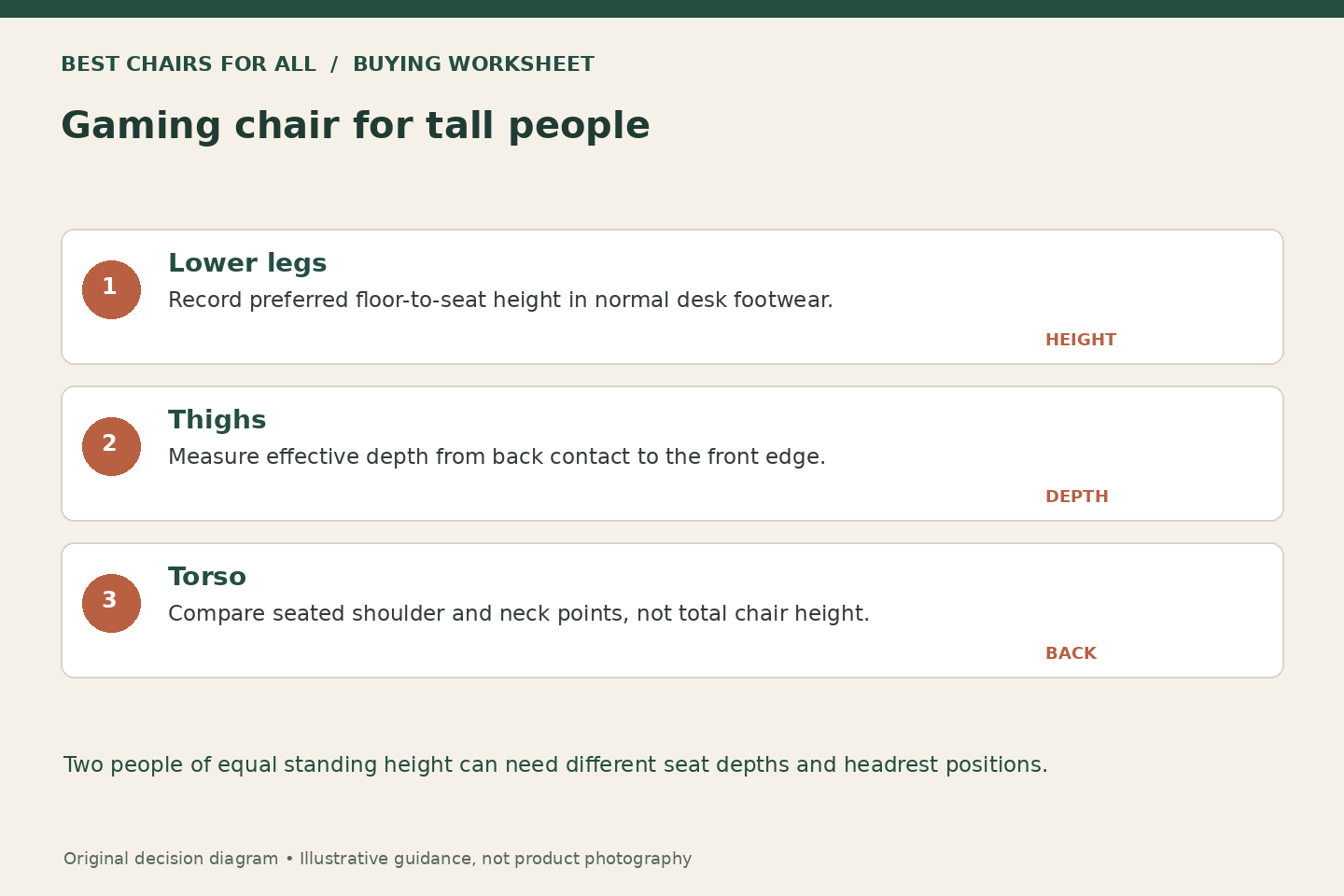
Height alone cannot identify the winner. Two people who both stand six feet three can need different seat depths and headrest positions. One may have long legs and a shorter torso; the other may need a much taller back while sitting at an ordinary seat height. The measurement worksheet below separates those problems so you can shortlist a chair without relying on a dramatic “big and tall” label.
The shortlist by tall-person problem
| Model | Published tall-user clue | Best starting use | Do not assume |
|---|---|---|---|
| Secretlab TITAN Evo XL | Recommended height 181–205 cm | Tall padded gaming-chair search | Recommended height guarantees headrest fit |
| AndaSeat Kaiser 3 XL | XL height guidance 5′11″–6′11″ | Compare a second XL back and lumbar shape | L-size retailer diagrams describe XL |
| IKEA MATCHSPEL | Seat rises to 23¼ inches | Longer lower legs with moderate seat-depth needs | High seat means long seat or tall torso fit |
Secretlab TITAN Evo XL: start with its stated fit range
Secretlab’s official TITAN Evo specification gives the XL a recommended height range of 181–205 cm and recommended weight range of 80–180 kg. It lists built-in four-way lumbar adjustment, four-direction arms, and a magnetic head pillow. The XL uses its own larger-size hardware configuration. These details make it a relevant tall-user candidate while still leaving the actual contact points to verify.
The manufacturer’s recommended weight range deserves attention even if height is your main concern. A very tall, light adult may land inside the height guidance while below the preferred weight range. That does not automatically establish a failure, but it is a reason to ask how the tilt and cushion are intended to work for that combination. Do not use the maximum load as a substitute for all other sizing advice.
Its lumbar adjustment is useful for a tall torso because the lower-back contact needs to sit in a usable place rather than wherever a fixed cushion happens to end. The head pillow adds another adjustment to check, but a pillow cannot lengthen the backrest. During a trial, sit naturally against the back before placing the pillow. Then check whether its supported positions meet your neck without pushing your head forward.
Choose the XL for further evaluation when your height, build, and preference for a padded gaming chair align with the size guide. Reconsider if you are buying it only because it is the largest size, especially when your main complaint is simply that an existing seat will not rise high enough. A larger torso shell may add bulk without solving the lower-leg issue in the most practical way.
Check matching Secretlab TITAN Evo XL listings on Amazon (paid link) (search results; verify the exact model and seller).
AndaSeat Kaiser 3 XL: compare the support geometry
The Kaiser 3 official product page gives XL height guidance of 5 feet 11 inches to 6 feet 11 inches and identifies a 175–395-pound size range in its selector. It describes integrated four-way lumbar adjustment, four-direction arms, and a magnetic head pillow. The L and XL share the product-family page, so identify XL explicitly when requesting dimensions or comparing retailer listings.
Kaiser 3 XL is a useful second candidate because tall fit is not one number. A different shoulder-wing shape, lumbar contact, or arm position may suit you better even when two brands quote similar height ranges. Treat the manufacturer guide as permission to investigate, then compare the backrest’s actual dimensions and the placement of each adjustment against your seated measurements. A broad shoulder section can matter as much as total back height.
The biggest online-shopping trap is a mixed size diagram. A retailer may show an XL title beside a gallery containing L-size measurements. Ask for the current XL specification sheet and check the labels before copying measurements into your comparison. If the selected color is on pre-order, also ask whether its specifications match the current displayed model rather than assuming a delivery date means a different generation.
We observed a starting manufacturer price of $449 during research, but that does not establish the cost or availability of every XL upholstery combination. Compare the exact configured total and shipping terms. There is little value in choosing an attractive larger chair that cannot arrive when you need it or that would cost too much to return if the backrest misses your proportions.
Check matching AndaSeat Kaiser 3 XL listings on Amazon (paid link) (search results; verify the exact model and seller).
IKEA MATCHSPEL: a high-seat option with clear limits
The current US MATCHSPEL specification lists a seat-height range of 18½–23¼ inches, seat width of 21¼ inches, and fixed depth of 18⅞ inches. The page describes an adjustable headrest, adjustable arms, and a mesh back; the listed tested load is 276 pounds. Bomstad black showed $229.99 at the research date, before tax or delivery, on a promotion while supplies last.
MATCHSPEL belongs here for a tall person whose lower legs require a higher seat but whose thighs do not require a very deep cushion. The published upper seat setting is a concrete reason to investigate it. A tall person with a moderate torso may also prefer a chair that occupies less visual space than an XL padded shell. The mesh back provides a material alternative without changing the requirement for a correct fit.
Its fixed 18⅞-inch seat depth is the reason this is a conditional choice. A long-thighed user may want more support than it offers, even though the seat rises high enough. Likewise, an adjustable headrest still has a finite reach and cannot guarantee neck contact for an unusually long torso. Try it in a store if possible, at the intended desk height rather than the most convenient display setting.
Pick it when the actual seat and headrest trial works, especially if your issue is height rather than overall body bulk. Pass if you need a documented deeper seat, a larger weight rating, or a headrest beyond its adjustment range. Its comparatively accessible price cannot compensate for unsupported thighs or a neck pad that meets the wrong part of your back.
Check matching IKEA MATCHSPEL listings on Amazon (paid link) (search results; verify the exact model and seller).
The three-segment tall-fit worksheet
First record your familiar usable seat height while wearing the shoes you normally use at the desk. Measure from floor to the top of a seat that allows comfortable foot support. A chair’s unloaded specification and compressed cushion will not be identical, so use this as a screening reference rather than an exact prescription. Write down whether your current desk forces you above or below that preferred height.
Second record effective thigh support. Measure from the place where your back meets the chair to its front edge, and note whether you would prefer the seat longer or shorter. Do not measure the entire shell if a lumbar cushion pushes your sitting position forward. A tall person often gets drawn toward a high back while overlooking that the actual problem is a short seat under long thighs.
Third measure seated back height. With a helper, note the approximate distance from your sitting surface to shoulder level and to the neck contact point you want from a headrest. Compare those points with manufacturer diagrams, allowing for seat compression and natural posture. Total chair height includes the base and lift, so it is a poor proxy for how much backrest sits above the cushion.
A worked example: equal standing height, different chairs
Imagine two users who are each six feet four. The first already finds a 21-inch seat height comfortable but needs more thigh support and a higher neck contact. An XL padded model with documented torso geometry is the sensible starting comparison. The second has especially long lower legs but sits comfortably on a moderate-depth seat and has no need for a larger shoulder shell. A high-seat model such as MATCHSPEL may deserve a trial. These are hypothetical profiles, not predicted fits.
Now consider what happens if both simply select the largest chair. The second user may gain unnecessary seat depth, wider arm spacing, and more bulk around the desk. The first may still need to verify the headrest because a broad XL seat does not establish its location. The worksheet prevents both people from paying for size in the wrong dimension. Use the same approach when a store employee asks only for your standing height.
Tall-chair fit can expose a desk problem
A higher seat brings your knees, armrests, and elbows closer to the desk’s underside. Measure the clear opening under the front edge, including drawers and crossbars. Check your knee position when turning rather than only when sitting still. A chair that puts your legs at a good height can still force you too far from the keyboard if the desk structure blocks the arms or thighs.
The monitor relationship changes too. After setting a chair for foot support and keyboard access, check whether the screen can move into a comfortable viewing position. Do not choose a low chair solely to keep an immovable monitor at eye level if that compromises the whole desk interaction. Adjust the workstation as a system where possible. A chair upgrade cannot by itself fix a desk bay that is physically too small for a tall user.
Trial the back support with your real input device
Bring your hands into your normal mouse-and-keyboard position, then switch to a controller near your lap. Notice whether you leave the backrest in either position. If reaching the desk pulls your whole torso forward, inspect the desk clearance before increasing lumbar pressure. If the headrest pushes your head forward when you look at the screen, adjust it within the documented range or reconsider the model rather than assuming all head contact is beneficial.
Compare a slightly upright position with a supported recline, using only normal controls. You should be evaluating usable options rather than trying to achieve the largest advertised angle. Tall users also need enough space behind the chair; a high back may meet a shelf or sloping ceiling in a loft room. Measure the movement envelope in the actual location before committing to a large upholstered model.
The final tall-user choice
TITAN Evo XL and Kaiser 3 XL are the first candidates when your entire seated frame needs a larger platform. MATCHSPEL is the narrower alternative when a high seat and moderate fixed depth fit your particular proportions. Ask for missing dimensions in writing, preserve the exact size selection, and understand return freight before ordering. The best tall gaming chair supports the dimensions you actually have, rather than simply carrying the tallest-looking back in a photograph.
Something unclear or out of date? Send a correction with this article’s title and the detail to check.
Sources, research & corrections policy ↗