As an Amazon Associate, we earn from qualifying purchases. Read our affiliate disclosure. Amazon buttons below search for matching listings; they do not confirm stock, an exact seller, or a current price.
The best folding electric wheelchair has to be appropriate while occupied and practical while folded. A compact package does not compensate for unsuitable seating, inaccessible controls, or an empty lifting task the owner cannot manage. Our researched shortlist is the QUICKIE Q50 R Carbon for a low published chair weight, Pride Jazzy Carbon for a different compact folding package, and WHILL Model F for buyers investigating its folding geometry and controller arrangement.
This guide uses manufacturer sources checked on November 6, 2026. We have not folded, weighed, driven, or flown with these models. No current price, insurance outcome, or airline acceptance is established. A qualified mobility assessment should determine whether this class of portable chair meets the user’s needs before transport convenience decides between models.
What does folding need to accomplish?
Choose the specific problem: fitting a car trunk, sharing an apartment with limited storage, using a taxi, or taking an occasional flight. A chair that solves one problem can create another. A low folded package may fit under a cargo cover yet require more horizontal floor space. A taller folded chair may suit a closet but not pass through the trunk opening. Obtain all three folded dimensions and the defined folded orientation.
Then decide who folds and loads the empty chair. “Folds in seconds” is a mechanism claim, not a complete journey plan. The process also includes parking appropriately, preparing the chair according to its instructions, securing the folded form, handling permitted removable components, and stowing everything. Ask the supplier to demonstrate the whole manufacturer-approved empty-chair process with the intended helper and vehicle.
If the user needs powered positioning, significant postural support, or an alternative control system, a basic folding travel chair may be the wrong starting category. That is a reason to discuss the assessed requirements with the seating team. Do not remove necessary supports or fit unapproved components merely to preserve the appealing fold.
Manufacturer comparison
| Chair | Published weight definition | Relevant folding detail | Question before ordering |
|---|---|---|---|
| QUICKIE Q50 R Carbon | From 32 pounds without batteries | 30.2 by 22.4 by 14.6 inches folded | Does the quoted US configuration match? |
| Pride Jazzy Carbon | 39.6-pound base plus 4-pound battery | Compact folding base | Can the actual loader manage the package? |
| WHILL Model F | 58.9-pound device figure | 18.3-inch folded device length in US brochure | How do all folded dimensions fit the vehicle? |
QUICKIE Q50 R Carbon: investigate the published low chair weight carefully
The Q50 R Carbon US product page distinguishes the chair’s starting 32-pound weight without batteries from its 3-pound single battery. It lists a 17-inch seat width, 16.5-inch seat depth, and a folded package of 30.2 by 22.4 by 14.6 inches. Published maximum range differs between one battery and the optional additional battery.
This is a relevant candidate when an assessed user fits the seating format and the folded geometry solves a real storage problem. Its limitation is that a very low starting figure does not establish the weight of every supplied accessory or configuration. Ask for the actual package and the applicable US order form. A quoted extended range should identify the additional battery; do not assume it describes the base package. Request a supervised seating and controller demonstration before deciding.
Check matching QUICKIE Q50 R Carbon wheelchair listings on Amazon (paid link)
Pride Jazzy Carbon: assess the complete folded package
Pride’s Jazzy Carbon specifications give a 39.6-pound base, a 4-pound battery, and 43.6 pounds total. The standard seat is 17 by 17 inches. The page describes a quick-disconnect joystick, front suspension, and a folding carbon-fiber base. These features provide a useful demonstration brief, not proof that the chair suits every traveler.
Consider it when the seat and control requirements align and loading one folding base is preferable to managing several structural components. It is less useful if the required seating setup falls outside the portable format. Ask whether the demonstrated chair includes the exact cushion and accessories on the quote, and request the folded dimensions for that setup. The original Jazzy Carbon should not be confused with similarly named Carbon variants; model identification belongs on the order.
Check matching Pride Jazzy Carbon folding wheelchair listings on Amazon (paid link)
WHILL Model F: a different folded shape deserves its own trial
The WHILL Model F US brochure lists an 18-inch seat, two positions for width between the arms, a 58.9-pound device weight, and a 250-pound maximum capacity. Its folded device length is 18.3 inches. The brochure also states that the controller can be positioned on either side.
Investigate it when that controller arrangement and folding layout meet the assessed need and the complete package is manageable. The weight is an obvious reason to test the actual empty loading task instead of treating all folding chairs as equally liftable. Ask for the remaining folded dimensions and their orientation; length alone cannot prove trunk compatibility. A different arm position also changes the dimension question, so the quote should state the setting that was evaluated.
Check matching WHILL Model F folding power chair listings on Amazon (paid link)
Original worksheet: the folded-envelope test
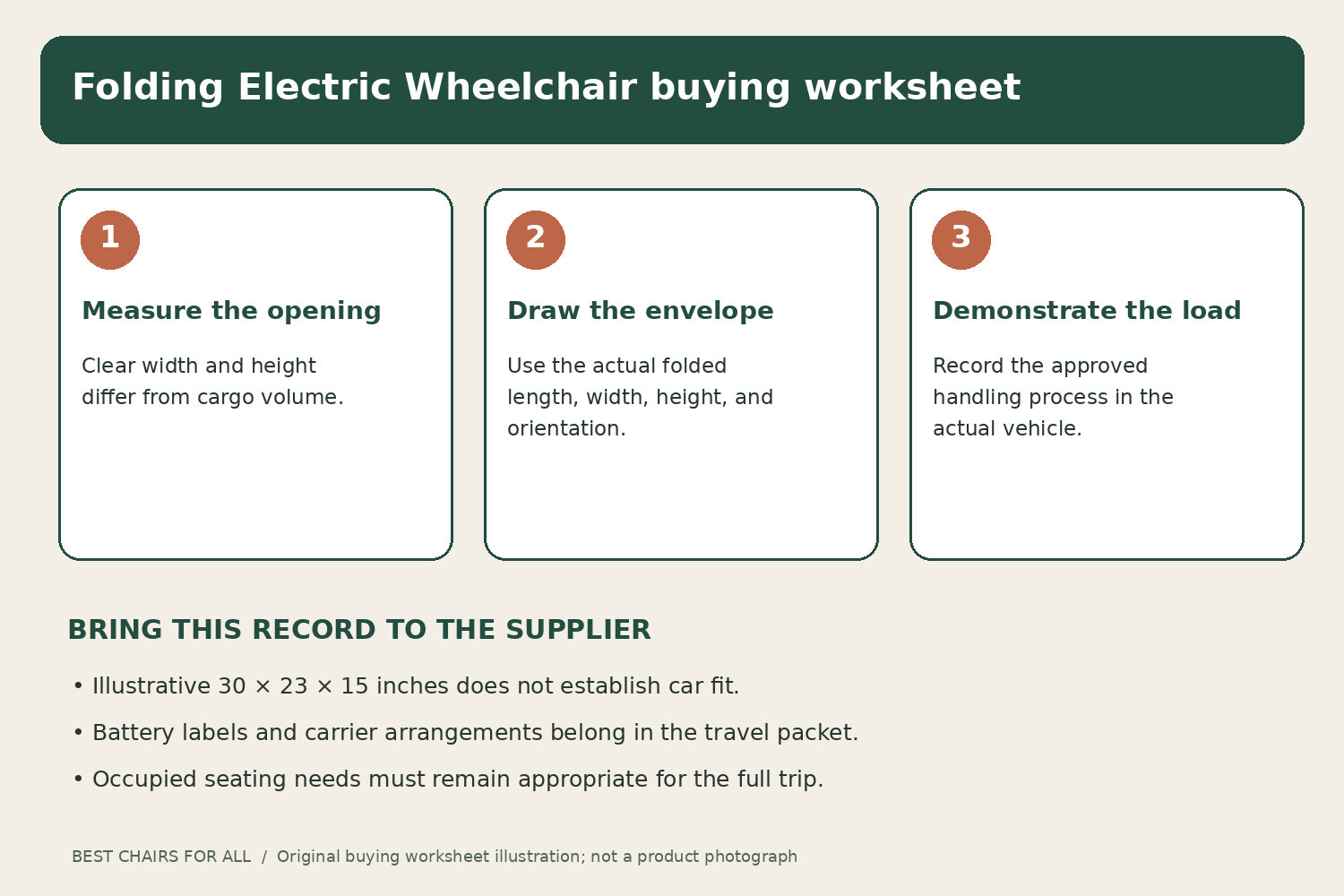
Draw the vehicle opening as a rectangle and record its measured clear width and height. On a second sketch, draw the usable cargo floor and note the lip, wheel housings, and sloping hatch. Write the chair’s folded length, width, and height beside the sketches. Do not reduce this to cargo capacity in cubic feet: an opening can reject a package even when the interior volume seems ample.
Use an imaginary example to understand the difference. Suppose a folded package measures 30 by 23 by 15 inches and a vehicle opening measures 29 by 19 inches. That information alone does not establish fit or failure, because the package orientation, depth behind the opening, handling clearances, and manufacturer-permitted handling must be considered. It does establish that laying the largest face squarely across the opening will not work. Arrange a supplier demonstration rather than assuming diagonal loading will solve it.
Add four boxes below the drawing: permitted handling points, battery transport state, folded retention method, and loose accessories. Have the supplier complete them from the exact manual. These are documentation boxes, not instructions to improvise a folding technique. If the manufacturer’s process requires a strap or latch, confirm it is supplied and demonstrated; if a component is removed, give it a secure place in the cargo plan.
Finally, mark the result “demonstrated with actual vehicle” or “unverified.” An online photograph of a chair in somebody else’s trunk is unverified for your vehicle. Keep that result with the quotation. If the seller substitutes a different cushion, battery arrangement, or accessory that affects the fold, ask whether the demonstration remains applicable.
Battery arithmetic and air travel documentation
Watt-hours and chair weight answer different questions. Battery identification matters to travel rules; it does not establish clinical suitability or practical lifting. Use the battery’s actual label and the manufacturer’s documentation, not an estimated capacity copied from a marketplace description. A spare battery is a separate item in the travel plan and needs its own compliance discussion.
The FAA wheelchair and mobility-device guidance explains that battery-powered mobility devices are subject to specific battery and handling rules. The carrier needs the relevant device and battery information for the actual trip. Arrange this in advance and follow the airline’s current process. A manufacturer’s broad airline-compliance statement is not a booking confirmation or a guarantee that every aircraft and itinerary will accommodate the chair.
For air travel, check power wheelchair airline battery documentation and confirm the exact chair and battery with the carrier before booking.
Ask who will provide instructions to handlers, what information should accompany the device, and how you will protect any components the manufacturer identifies. Record the chair dimensions, battery type and rating, and manufacturer contact details in the travel packet. Request professional help with any unresolved transport question. Do not open a battery pack, modify a connector, or improvise an electrical isolation method to satisfy an assumption about travel rules.
Folding convenience has operating limits
Evaluate the chair on the ordinary home and community route in its approved operating configuration. The ability to collapse the frame does not predict how well the user can reach a table, enter a bathroom, or control the chair on the intended surfaces. Record every essential destination and have the supplier compare it with the model’s operating instructions.
Do not use a manufacturer’s incline or obstacle figure as a challenge. Some routes will require another path or different equipment. Wet conditions, charging location, and storage temperatures also deserve model-specific questions. Avoid a generic claim that a travel chair is suitable for “all terrain.” The demonstration should focus on the actual permitted environment rather than the most dramatic promotional scene.
A second chair used only on trips still needs appropriate seating. Ask the assessment team how it will be used alongside the primary wheelchair, how long the user expects to remain seated, and which support requirements cannot be compromised. If those requirements are incompatible with a compact fold, the travel arrangement should change instead of the prescribed support disappearing.
Ownership details that belong on the order
Ask the seller to identify the exact model, country configuration, seating, batteries, charger, and included transport accessories. Request a total quotation and a clear statement about configured-equipment returns. We have not verified a current price for these chairs, so the shortlist is based on documented design distinctions rather than a budget promise. Coverage needs separate confirmation from the relevant payer and supplying provider.
Specify who handles setup, fitting, battery faults, and frame service. Folding joints and ordinary user controls should be demonstrated from the correct manual; drive units and battery internals are service work. Ask what assistance is available if a fault occurs away from home and whether the dealer supports the model locally. Keep those contacts accessible during travel.
Search the FDA medical-device recall database by manufacturer and model and ask the supplier to verify the individual device against current notices. This guide is not a recall clearance for any serial number. Used chairs need particular attention to identity, prior modifications, charger compatibility, and documentation. A low asking price cannot resolve missing information.
The practical choice
Investigate Q50 R Carbon when low published chair weight and its low folded envelope address a defined need. Consider Jazzy Carbon when its complete folding package and seating format make sense for the assessed user. Trial Model F when its geometry and control arrangement are the better match and the heavier cargo package is workable. Select the chair only after both the occupied-use assessment and the folded-envelope demonstration have satisfactory answers.
For hotel stays, record where the unfolded chair will be parked and charged overnight. A chair that fits the vehicle can still obstruct the room’s usable route when unfolded. Request actual room-access information and discuss the intended setup with the accommodation provider before relying on a compact folded photograph.
Something unclear or out of date? Send a correction with this article’s title and the detail to check.
Sources, research & corrections policy ↗