Before flying with a power wheelchair, request manufacturer documentation for the exact battery and handling configuration, then obtain the operating airline’s requirements for every flight. “Airline approved” in a product description is not a universal acceptance decision. Battery type, installed protection, removal design, capacity, device dimensions and travel date all matter.
Identify the battery that is actually installed
Photograph the manufacturer’s battery label using the chair’s permitted access procedure, or ask the supplier to obtain the information. Record the chair model and serial, battery manufacturer, exact part number, chemistry, number of packs and the electrical ratings shown. A wheelchair may have been fitted with a replacement battery different from the one described in its original brochure.
Keep the charger information in a separate row. A charger’s output rating is not the battery’s capacity, and the chair’s marketing range does not identify its battery chemistry. Do not open a sealed pack, remove covers not intended for user access or disconnect unfamiliar wiring to find a label. The supplier or manufacturer can provide the correct data and safe access instructions without turning the document request into electrical disassembly.
Request a manufacturer battery statement
Ask for a dated document connecting the battery part number to its chemistry and capacity. For lithium-ion equipment, request the manufacturer’s watt-hour rating and relevant test documentation requested by the carrier. The IATA 2026 mobility-aid guidance includes lithium battery UN Manual of Tests and Criteria subsection 38.3 requirements and an operator-approval process. A seller’s generic claim or an unrelated safety data sheet does not establish the identity of the installed pack.
If the manufacturer supplies a test summary or transport information, check that the part or battery family matches. Ask the airline what it needs rather than assuming every document must be printed in full or that one certificate settles all handling questions. Preserve original documents and labels. Do not create a substitute manufacturer label, alter a capacity marking or attach an online certificate belonging to a different battery.
Separate installed protected batteries from removed batteries
The FAA PackSafe wheelchair page has separate entries for lithium-ion batteries installed and protected by the device’s design, and for inadequately protected batteries that must be removed. Its 300-watt-hour statement in the removed or unprotected category should not be applied as a universal maximum for every installed power-chair battery. Read the complete category conditions and confirm the carrier’s policy.
A battery being technically removable does not establish that a passenger should remove it in every situation. The device’s design, manufacturer instructions and airline arrangements determine the handling plan. Other chemistries, including non-spillable or spillable batteries, have different conditions. Do not import ordinary phone power-bank rules into a wheelchair discussion or assume that the word sealed identifies every relevant requirement.
Get the exact isolation and handling instructions
Request the manufacturer’s air-transport or travel sheet for the selected chair and battery. It should explain the authorized way to prevent unintended activation, identify any permitted battery removal and describe the correct handling configuration. Ask for clear diagrams of approved lifting points, freewheel or drive-mode instructions and any controller protection needed. Do not write your own wiring procedure from an online video.
A joystick power button, a freewheel lever and a battery-isolation method are not automatically interchangeable. Staff need the exact manufacturer’s directions for this equipment. If removal is required, confirm who performs it, what tools or trained service are necessary and how the battery and chair are protected afterward. Do not dismantle a powered seating system to meet a guessed aircraft dimension.
Check the policy for the date of travel
As researched on November 6, 2026, American Airlines’ battery-requirements page announces a change effective March 31, 2027 for its lithium-ion mobility devices: removable batteries carried in the cabin, a rating of 300 watt-hours or less and an original manufacturer label showing that rating. It says the announced requirements do not apply before that effective date. This is a carrier-specific dated change, not a rule to impose on all airlines or earlier travel.
That example shows why both the travel date and the operating carrier belong on the document packet. A ticket bought before a change may cover travel after it. Review outward and return legs separately if they cross an effective date. Save the carrier’s written response for the actual itinerary and check again if the booking or equipment changes.
Confirm each operating airline and connecting flight
A booking can include a marketing airline, a codeshare partner and a different company operating a connection. Ask the operating carrier for its mobility-device acceptance process on each leg, including any restrictions arising from aircraft size, cargo-door dimensions or handling arrangements. Do not assume approval on the first flight carries over to every subsequent operator.
Provide the same exact battery and device information each time. Record the case reference, contact date and any approved configuration or packaging instructions. If a reservation changes to a different aircraft or carrier, return to those questions. An approval email can be useful evidence for staff, but it should describe the equipment and journey rather than a general statement that all products from a brand are acceptable.
Capacity arithmetic is a cross-check, not a new label
When the manufacturer provides nominal voltage and ampere-hours, multiplying those values gives watt-hours for that stated battery rating. A hypothetical 24-volt, 12-ampere-hour pack gives 288 watt-hours. Use that calculation to spot a question or verify a document, not to create a replacement manufacturer marking or declare eligibility.
Multiple packs require particular care. Do not infer how capacities combine from the chair’s voltage or assume two packs count as one because they share a housing. Ask the manufacturer to identify the pack arrangement and the airline to state the applicable installed, removed and spare-battery conditions. FAA public guidance and IATA’s 2026 operator framework contain category-specific provisions; do not mix selected allowances from different frameworks to construct a more permissive rule.
Give the airline the complete device envelope
US DOT’s assistive-device guidance encourages sharing device size, weight and battery information to support handling. Provide the dimensions and weight in the exact manufacturer-authorized transport configuration, with the usual supports and any permitted detached parts identified. A chair’s stripped frame weight is not its cargo-handling weight, and an upright height may differ from an approved lowered seating state.
Ask how fragile or removable controls, cushions and supports will be handled and returned. Label the device as directed and keep a copy of the handling sheet with it, while retaining another copy yourself. Arrange the passenger’s assistance needs separately from the equipment documents. The chair’s battery acceptance does not establish an individual transfer technique or suitable temporary seating.
Make a short airport packet and a complete backup
Put a one-page handling summary at the front: passenger and flight reference, chair identity, battery identity, approved transport state and the manufacturer’s handling contacts. Attach the exact label photographs, relevant manufacturer instructions and carrier correspondence behind it. Keep accessible electronic copies as well as any printouts the carrier requests. Avoid burying the actual isolation diagram inside a large unrelated product catalog.
Before departure, confirm that no equipment change has invalidated the packet. On arrival, inspect the device and its restored configuration with the appropriate assistance before relying on it. Record damage or a handling concern promptly through the carrier’s process and seek the responsible provider’s help for unsafe equipment. A good packet cannot prevent every problem, but it gives each handler accurate, consistent information instead of requiring guesses about a complex chair.
Airline battery and handling document packet
| Check | Evidence and decision |
|---|---|
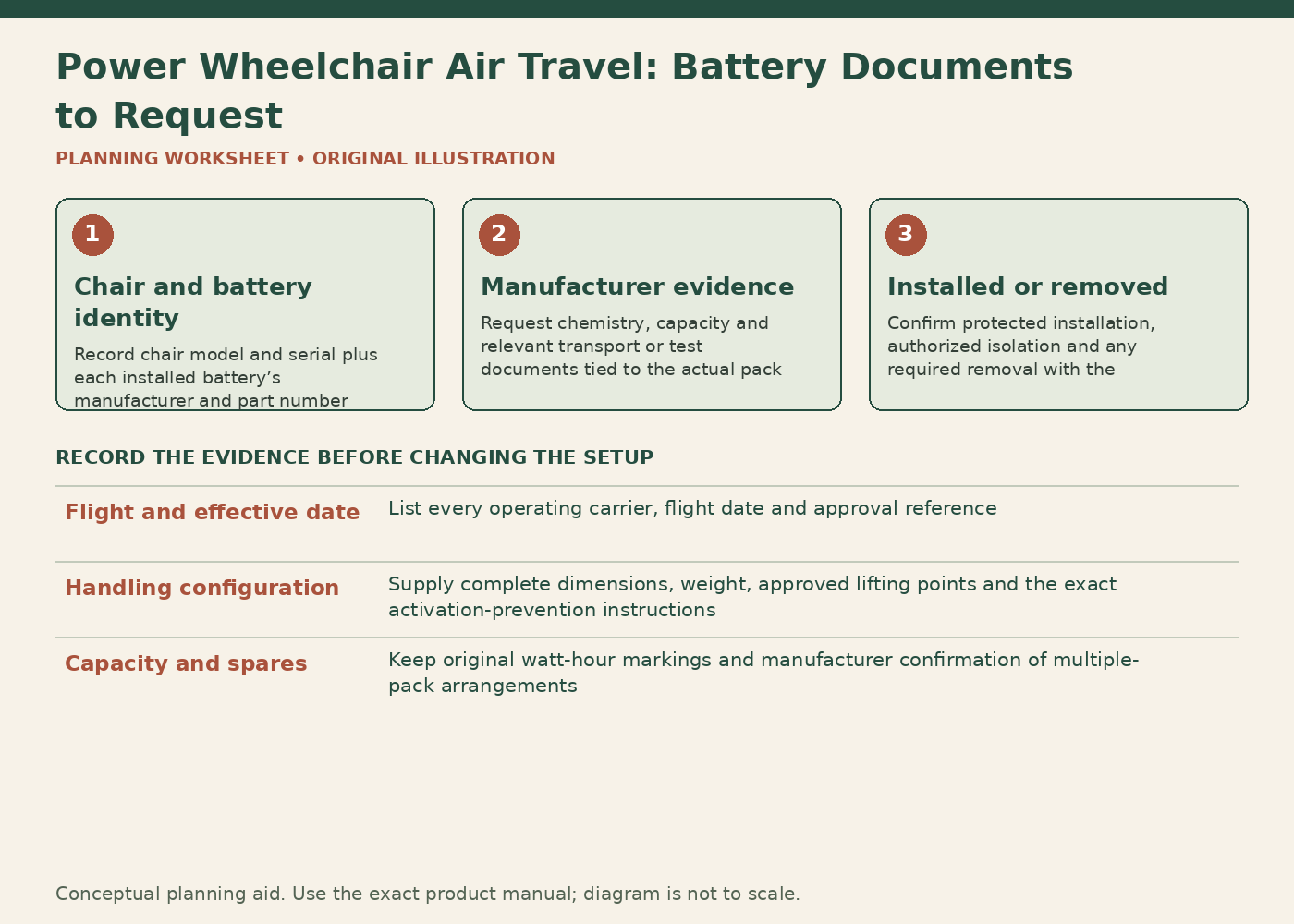
| Chair and battery identity | Record chair model and serial plus each installed battery’s manufacturer and part number. Photograph the original labels through approved access. Do not substitute charger specifications or the original brochure for a changed battery. |
| Manufacturer evidence | Request chemistry, capacity and relevant transport or test documents tied to the actual pack. Ask the carrier which evidence it requires. A generic airline-approved claim cannot replace an itinerary-specific decision. |
| Installed or removed | Confirm protected installation, authorized isolation and any required removal with the manufacturer and carrier. Preserve the category distinction. Do not treat a removed-battery capacity statement as a universal limit for all installed equipment. |
| Flight and effective date | List every operating carrier, flight date and approval reference. Check future policy effective dates and both directions of travel. A codeshare booking or aircraft change may require another review. |
| Handling configuration | Supply complete dimensions, weight, approved lifting points and the exact activation-prevention instructions. Identify detached pieces and their return plan. Do not improvise disassembly or a wiring procedure to satisfy a guessed handling requirement. |
| Capacity and spares | Keep original watt-hour markings and manufacturer confirmation of multiple-pack arrangements. Ask for the carrier’s installed, removed and spare conditions in writing. Arithmetic can identify a discrepancy but cannot create a manufacturer label or approval. |
Worked example
A traveler’s hypothetical wheelchair uses a pack labeled 24 volts and 12 ampere-hours. The 288-watt-hour arithmetic helps organize the inquiry, but the traveler still requests the original manufacturer rating, confirms the battery’s chemistry and asks whether it remains installed or must be removed under the carrier’s plan. They do not print a homemade 288 Wh label and assume the task is complete.
Now suppose an American Airlines itinerary departs before March 31, 2027 and returns after that date. The announced change makes the two travel dates worth checking separately with the airline, even though the same chair and reservation are involved. A connection operated by another carrier adds its own confirmation. The completed packet records the approved equipment arrangement for each leg, the manufacturer’s handling instructions and any packaging requirements. It makes the decision traceable without claiming that one calculation or product brochure guarantees acceptance.
Sources checked November 6, 2026
Use the current document for the exact model, market and production revision. These sources establish the cited instructions and distinctions; they do not certify an individual chair or replace a personal assessment where one is needed.
- FAA PackSafe: Wheelchairs and mobility devices
- IATA: Battery-powered wheelchairs and mobility aids guidance, 2026 regulations
- American Airlines: Mobility device battery requirements and March 2027 change
- US DOT: Assistive device stowage, damage and delay guidance
Something unclear or out of date? Send a correction with this article’s title and the detail to check.
Sources, research & corrections policy ↗