As an Amazon Associate, we earn from qualifying purchases. Read our affiliate disclosure. Amazon buttons below search for matching listings; they do not confirm stock, an exact seller, or a current price.
The best esthetician chair is the client treatment system that supports the salon’s actual services, appropriate client access, practitioner working position, and required care process. Our manufacturer-researched shortlist compares Silverfox 2246EBN, Silverfox 2219B, and Oakworks ProLuxe Electric Salon Top. The Oakworks is a salon-top treatment table with adjustable sections, so it should be considered only where that format matches the service brief. A rolling practitioner stool is a separate equipment category.
Manufacturer sources were checked on November 6, 2026. We have not performed treatments, operated motors, or evaluated client comfort on these systems. We do not claim medical benefit, suitability for an invasive procedure, or safety approval from marketing language. Current prices, delivery, and complete installed totals are unverified. Qualified suppliers and relevant professionals should establish the appropriate equipment and permitted use for the actual practice.
Translate the service menu into equipment requirements
List each service before choosing a motor count: facials, brow work, lash appointments, or another activity within the professional’s scope. For each, identify the intended supported client position, the practitioner’s access, the required head or leg support, and any equipment that must remain nearby. A chair with several powered movements may still block access at the head or sides. A simple system may be adequate if it already supports the required work.
Distinguish a movement of the whole top from an independently adjustable backrest or legrest. Product descriptions sometimes place these features together, but they are different. Ask the supplier to identify each actual motion and its controls on the quoted model. If a service requires a feature not documented in the manual, do not infer it from a photograph or from another model in the range.
Client access deserves a separate assessment. A low minimum height can be relevant, but it does not establish that every person can use the system. Discuss individual needs respectfully and obtain appropriate professional advice where support or access is uncertain. This article does not prescribe transfers or client positioning, and it does not treat powered movement as a substitute for necessary assistance.
Three systems with their differences preserved
| Model | Verified manufacturer feature | Reason to investigate | Important limitation |
|---|---|---|---|
| Silverfox 2246EBN | Four powered movements, memory functions, hand and foot controls | Frequent supported configuration changes | Exact US configuration and full movement envelope need confirmation |
| Silverfox 2219B | Powered height and backrest; manual seat inclination and footrest | A simpler mixed-control arrangement | Manual tasks must suit the actual workflow |
| Oakworks ProLuxe Electric Salon Top | Powered 22–40-inch height range with 4-inch padding | Salon-top table format for a matching service plan | Manufacturer identifies ProLuxe as not a whole-top tilt table |
Silverfox 2246EBN: powered movements need a clear practical purpose
The 2246EBN manufacturer page describes powered adjustment of height, backrest, seat, and footrest, plus two memory functions, hand and built-in foot controls, and 240-degree rotation. It also identifies removable armrests and detachable upholstery. Confirm the exact supplied version and its current manual rather than mixing details from 2246BN or another related model.
Investigate it when the additional powered movements solve documented service tasks. Its limitation is the number of controls and moving components to understand, inspect, and service. Ask the supplier to demonstrate the intended configurations and the applicable operating conditions. We do not repeat medical-position or approval claims as evidence of appropriateness for a salon. The practice must establish that the actual services and client-support requirements match the equipment’s intended use.
Check matching Silverfox 2246EBN esthetician chair listings on Amazon (paid link)
Silverfox 2219B: fewer powered movements can still fit a defined brief
The 2219B manufacturer description identifies independently powered height and backrest adjustment, with manual adjustment of seat inclination and the footrest. This is a different operating arrangement from the four-motor 2246EBN. Do not infer that every section is electrically controlled because the product is called an electric facial chair.
Consider it when those mixed controls support the service menu and the ordinary manual tasks are practical for the trained operator. Its limitation is the work involved in changing configurations and the need to confirm missing dimensional information. Request the complete height range, support dimensions, approved load definition, controls, and current manual. A basic model can be the right choice, but only when the simplified arrangement actually meets the brief rather than leaving a required task unresolved.
Check matching Silverfox 2219B facial chair listings on Amazon (paid link)
Oakworks ProLuxe Electric Salon Top: choose the top as carefully as the lift
Oakworks’ current stationary-lift range lists the ProLuxe Salon Top with a 22–40-inch height range using 4-inch padding and explicitly states that ProLuxe is not a tilt table. The manufacturer user manual distinguishes powered backrest and footrest movement and gives a 550-pound capacity for client and accessories.
Investigate it when a salon-top table is the appropriate treatment format and the selected width and supports match the practice. Its limitation is the large table envelope and the difference between section articulation and whole-top tilt. Confirm the exact Electric Salon Top version, padding, width, accessories, and manual. Do not import the lower height range of a flat-top ProLuxe into this comparison. A related product name is not an equivalent configuration.
Check matching Oakworks ProLuxe Electric Salon Top listings on Amazon (paid link)
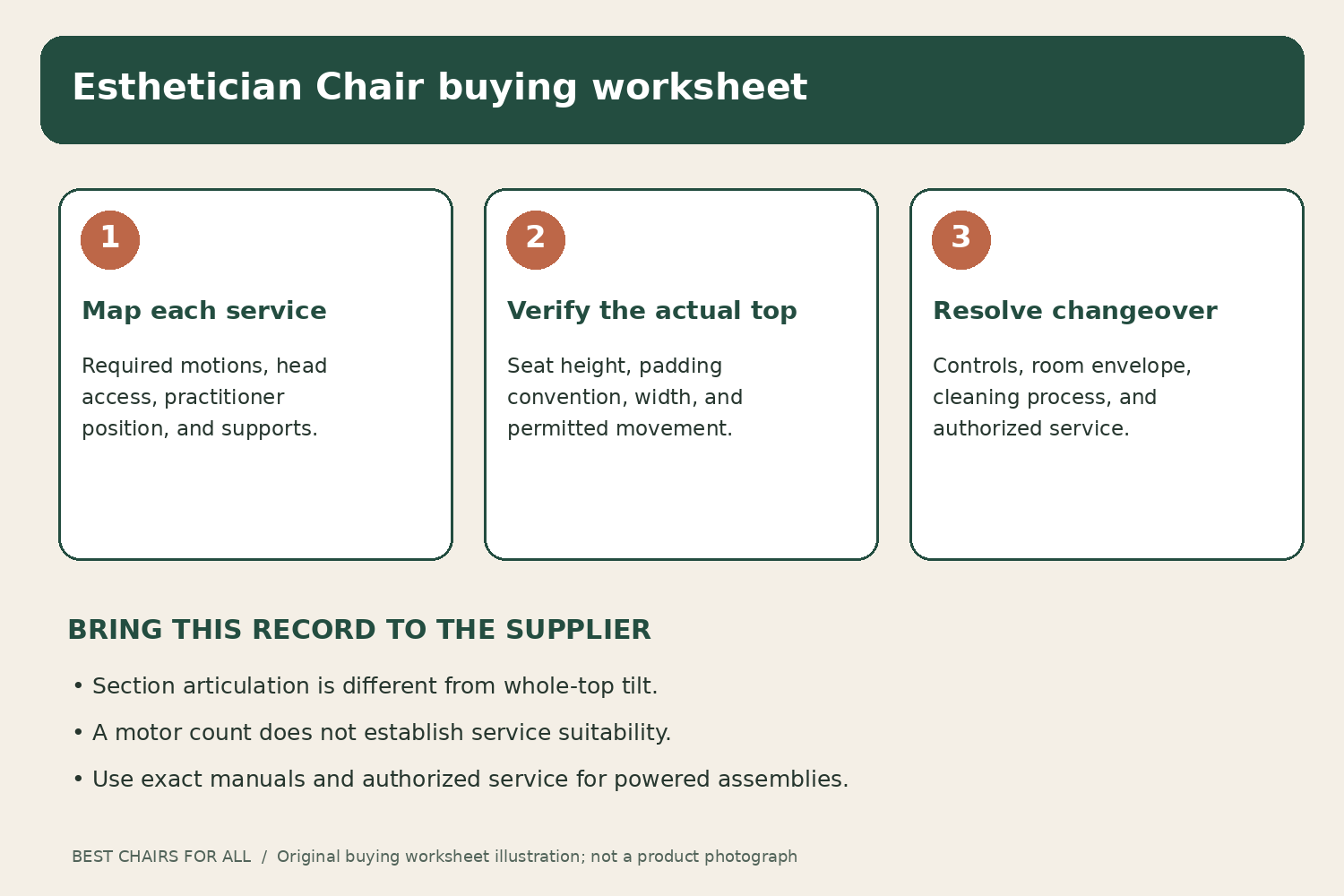
Original artifact: the service-to-motion map
Make a sheet with one row per service and separate columns for height, backrest, leg or foot support, seat or whole-top movement, head access, and practitioner position. In each cell, write the actual required equipment function and whether it has been demonstrated in the proposed configuration. Avoid scoring a product by the total number of adjustments; a nonessential motion cannot compensate for missing head access during an essential service.
For an invented example, a practice may need a supported recline for one service and clear head-end access for another. One candidate may provide every motorized adjustment but place a structural component where the practitioner needs to sit. Another may have fewer powered movements but better access in its approved setup. The demonstration should resolve those specific tasks instead of assigning a universal premium-model winner.
Add a separate “changeover” row showing how the station returns to the next approved service configuration. Record who operates the controls, where the hand or foot controller is located, and whether trolley or cable positions create a conflict. The supplier should demonstrate the current manufacturer’s process. The map is not a sequence of instructions for moving an occupied client; those directions come from the exact manual and appropriate professional training.
The last column identifies missing evidence. Examples include an unconfirmed lowest seat height, a support width not published, or an optional headrest that was absent from the demonstration. Keep each item open until the supplier provides a current drawing or demonstrates the actual package. A complete purchasing decision can be postponed when essential evidence is missing without forcing a choice among the three models.
Minimum height and working height are different questions
A low setting may help establish an appropriate access arrangement, while the practitioner may need a higher setting for some services. Both ends of the range matter, but the occupied surface and selected padding need to match the manufacturer’s measurement convention. A thick optional cushion can affect the height comparison. Keep the exact upholstery and padding version attached to every number on the quote.
An arithmetic example illustrates the convention issue. If a manufacturer’s stated top height includes four inches of padding, adding that padding again creates an incorrect figure. Conversely, comparing a bare structural height with another system’s cushioned surface mixes definitions. Request the actual supported surface height for the selected configuration rather than calculating it from unrelated brochure parts.
Have the practitioner evaluate the necessary working positions with the real stool, light, trolley, and client support accessories. A treatment chair cannot by itself establish an appropriate occupational setup. Where persistent discomfort or individual access concerns exist, seek suitable professional advice and use the motion map to show what the equipment can and cannot do.
The treatment-room envelope includes open supports
Draw the chair or table in each intended approved position, with leg section, head support, arms, controller, and any accessory extensions included. Then add the practitioner and other equipment. A small floor base can support a much longer moving top. Do not select a system using base dimensions alone or assume the same space works after optional arm supports are attached.
Mark the route into the room and the delivery route separately. A product that fits the final room may arrive in a package that cannot pass through a doorway or turn. Ask the supplier about approved delivery, assembly, placement, and electrical arrangements. Do not plan to remove drive units or dismantle powered mechanisms yourself to fit the equipment through the building.
Service access matters after installation. A cabinet placed tightly around a base can make an approved inspection or repair difficult. Ask the supplier which clearances must remain and put them on the room plan. Keep cables and controls in the manufacturer-permitted arrangement throughout movement; have unresolved electrical or facility questions handled by appropriately qualified personnel.
Cleaning and material compatibility precede color choice
Request the current care instructions for the exact upholstery, head support, arms, covers, controls, and base. The practice’s required cleaning and disinfection process must be compatible with those materials and the relevant product labels. A stain-resistant finish or detachable cushion is not a complete hygiene protocol and does not establish suitability for every treatment setting.
Ask how ordinary cleaning reaches seams, removable sections, and accessible frame surfaces. Follow the manufacturer’s permitted removal procedure. If a material instruction conflicts with the required professional disinfection process, resolve it with the supplier and responsible professional before ordering. Do not shorten a required contact time or use an unverified chemical mixture to avoid damaging the surface.
Confirm the replacement route for damaged upholstery and worn supports. A torn surface or an unsecured component may need repair before the equipment can return to service. Keep exact model and accessory identities so replacements are approved for the system. An aftermarket pad that physically covers a surface is not automatically an appropriate substitute.
Controls and repairs require a model-specific handover
Have the supplier demonstrate normal controls, permitted adjustments, inspection points, and the correct secured state with the matching manual. Memory functions should be understood in the actual configuration, not treated as permission to move equipment without checking its surroundings and the client’s support arrangement. The operator must follow the manual’s conditions rather than relying on a generic control diagram.
Unexpected motion, electrical damage, failure of a support, or an unexplained operating fault should prompt removal from service and contact with authorized support. Do not open electrical drives, hydraulic pumps, gas components, or control boxes to troubleshoot. Record the model, symptom, and current configuration for the provider. Know how the practice will manage appointments if a key system is unavailable.
Complete the quotation before selecting a winner
Ask for the exact model and version, top, width, padding, upholstery, approved accessories, controls, electrical configuration, delivery, setup, and service terms. Confirm custom-order cancellation and return rules. Current price is not verified here, so compare complete written proposals rather than a base-model starting price. Component warranty, labor, travel, and parts availability deserve separate questions.
Choose 2246EBN when its powered configuration and controls solve demonstrated requirements, 2219B when the mixed manual-and-powered arrangement is sufficient and practical, or ProLuxe Electric Salon Top when the treatment-table format is the appropriate choice. The strongest esthetician-chair purchase completes the service-to-motion map and resolves individual support, room fit, material care, and service responsibilities for the actual practice.
Something unclear or out of date? Send a correction with this article’s title and the detail to check.
Sources, research & corrections policy ↗