As an Amazon Associate, we earn from qualifying purchases. Read our affiliate disclosure. Amazon buttons below search for matching listings; they do not confirm stock, an exact seller, or a current price.
The best dental assistant chair is the assistant’s stool that fits the professional, the operatory, and the team’s actual workflow. A torso support, foot support, seat height, and control layout need to be evaluated together. Our manufacturer-researched shortlist is A-dec 522 Assistant’s Stool, Brewer 3145L or 3145R, and Midmark 153812 Assistant’s Stool. These are staff seating systems, distinct from a patient’s dental chair and from a dentist’s operator stool.
Manufacturer documentation was checked on November 6, 2026. We have not used these stools during treatment, measured occupational outcomes, or tested durability. We do not prescribe clinical positioning or promise relief from pain. Current prices, stock, and configuration totals need supplier confirmation. An appropriate ergonomic or occupational assessment is valuable when the team cannot establish a workable arrangement or a staff member has symptoms.
Write the assistant’s brief separately from the dentist’s
A stool chosen for a dentist does not automatically meet an assistant’s requirements. The assistant may need a different seat-height range, torso-support arrangement, foot support, and access to equipment. Identify the role and operatory configuration before comparing a manufacturer range that contains several similar-looking products. Retain the assistant model number throughout the order.
List which operatories and team members the stool must serve. A stool that works in one room can meet different equipment or space constraints in another. Include the delivery system, patient chair, cabinetry, instrument access, foot controls, and the assistant’s ordinary professional tasks in the evaluation. This guide does not instruct the team how to perform those clinical tasks; it identifies what the equipment demonstration should accommodate.
Then decide whether the stool will be dedicated or shared. Shared equipment benefits from understandable controls and a documented reset process, but one adjustment range may not suit every user. Do not assume that the highest or most expensive model eliminates individual fit questions. A professional assessment should preserve the requirements of each staff member rather than forcing a single generic setting.
Three assistant-specific starting points
| Model | Verified manufacturer distinction | Reason to investigate | Potential mismatch |
|---|---|---|---|
| A-dec 522 | Adjustable foot ring; optional foot pedestal and backrest | Assistant-specific configuration within A-dec 500 seating | Confusing 521 operator details with 522 equipment |
| Brewer 3145L/R | 23–31-inch height range; left or right ratcheted body support | Clearly identified support-side variants | Ordering the wrong support orientation or height range |
| Midmark 153812 Assistant’s Stool | Standard and short height configurations in its technical specification | A distinct integrated-support format | Mixing standard and short configurations |
A-dec 522: specify the assistant configuration and options
The A-dec 500 stool page distinguishes the 521 doctor’s stool from the 522 assistant’s stool. For the assistant format it identifies a height-adjustable foot ring, an optional foot pedestal, and optional back support. The manufacturer lists a 350-pound maximum user weight for the 522 and links its own instructions for use.
Investigate 522 when its supported configuration suits the actual professional and room. Its limitation is the potential for operator-stool features and optional components to be mistaken for included assistant equipment. Ask the dealer for the exact seat-height range, torso-support arrangement, foot support, upholstery, and complete package. Have a trained representative demonstrate the selected stool in the operatory and provide the current 522 instructions, rather than using a general A-dec 500 adjustment video as the full specification.
Check matching A dec 522 Assistant Stool listings on Amazon (paid link)
Brewer 3145L/R: support orientation belongs in the part number
Brewer’s 3100-series specifications identify 3145L and 3145R assistant models with a 23–31-inch pneumatic height range, adjustable foot ring, and left or right ratcheted body support. Related operator models in the same range have different heights and support arrangements. Preserve the complete assistant part number and upholstery variant.
Consider this model when the documented height range and selected support layout match the assessed working arrangement. Its limitation is that left or right support should not be selected from a casual assumption about the user’s dominant hand. Have the supplier and team evaluate the actual operatory and intended support role. Ask for the approved load definition, full seat and base dimensions, applicable instructions, and current configuration details. An attractive feature on another 3100 stool should not enter the quote unnoticed.
Check matching Brewer 3145 dental assistant stool listings on Amazon (paid link)
Midmark 153812: distinguish the standard and short configurations
Midmark’s dental-assistant seating information is a useful starting point, but the exact ordered model needs its own specification. The 153812 technical-library page lists a 350-pound rating, a 21.7–27.5-inch standard seat-height range, and a 17.8–20.8-inch short range. The seat is 16.25 by 16 inches, with a 24-by-24-inch base.
Investigate 153812 when the documented configuration matches the professional and operatory. Its limitation is that similarly named Midmark stools and different cylinders should not share specifications by assumption. Ask the supplier to confirm the exact part number, cylinder, support orientation, foot-support assembly, upholstery, manual, and current supply status. Do not import a newer product’s optional features or an operator stool’s height range into the 153812 order. Demonstrate the exact approved assembly before selecting it.
Check matching Midmark 153812 Assistant Stool listings on Amazon (paid link)
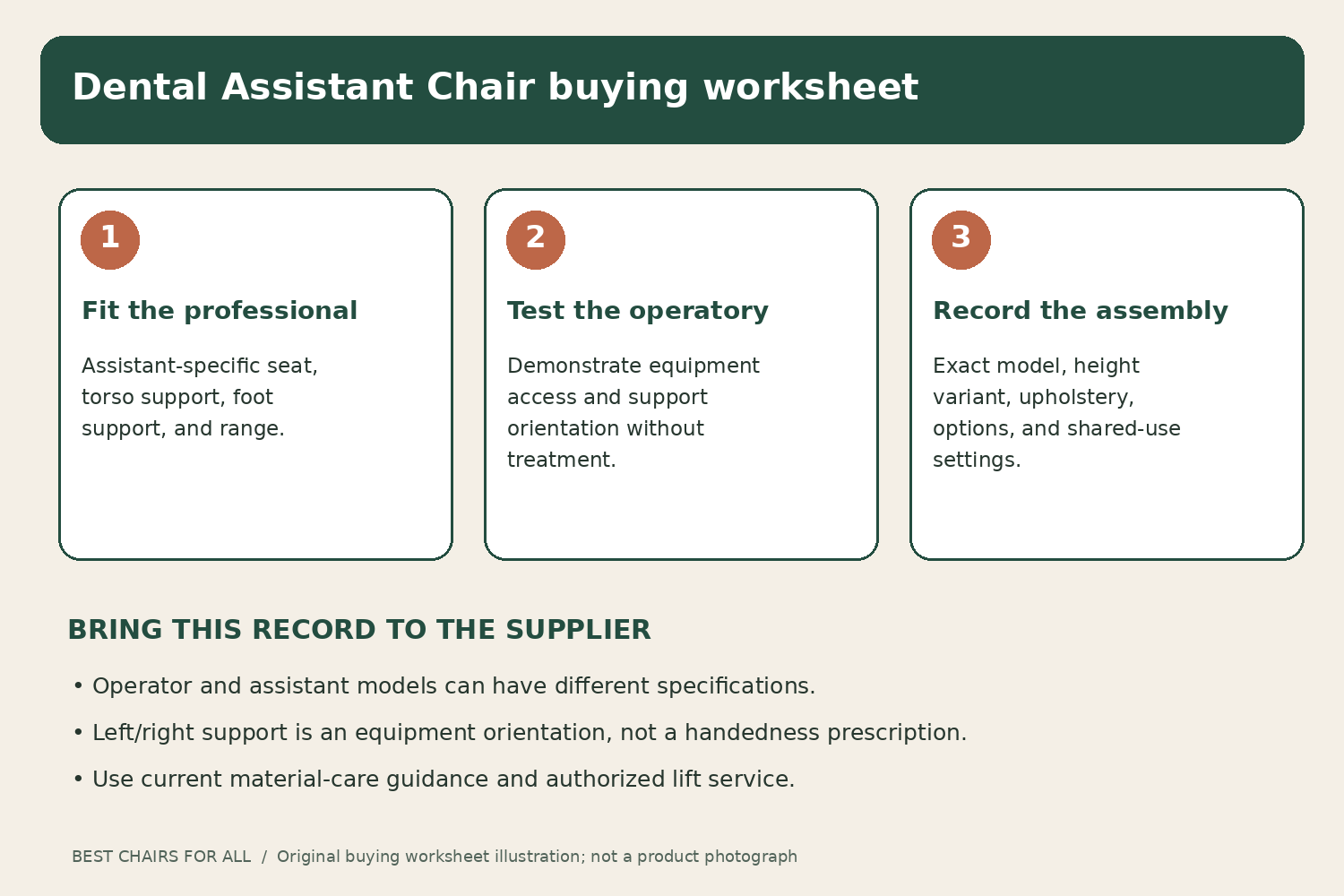
Original artifact: the operatory compatibility record
Create a record with three sections: professional fit, room compatibility, and shared-use settings. The professional-fit section records the user’s required seating and support needs as established by appropriate assessment, the candidate model, and the configuration demonstrated. Keep observed task fit separate from the manufacturer’s nominal measurements. A list of adjustments alone does not show how the stool fits the professional.
In the room section, draw the patient chair, delivery equipment, cabinetry, assistant stool base, support arm, and foot controls. Have trained team members and the equipment representative assess a non-treatment demonstration of the ordinary working arrangement. The purpose is to identify equipment interference and control access, not to conduct a clinical procedure or invent a treatment-position prescription.
For an invented example, a torso-support arm may be appropriate for the staff member yet contact an operatory component before the stool can occupy the required position. A higher cylinder will not necessarily resolve that collision. The record should identify which component interferes, whether another approved support configuration was demonstrated, and who must resolve the question. Do not remove the support or alter clinical equipment by guesswork.
The shared-use section records how each regular user identifies their own approved settings and which controls are involved. It should not publish private health information. If two users need different configurations beyond ordinary adjustment, acknowledge that limitation rather than assuming a universal compromise. The purchase may require dedicated stools or another assessed solution.
Seat height is necessary but insufficient
Check the lowest and highest settings for the exact stool and cylinder. A nominal range can exclude the position needed for a particular professional or room. Compare the stated measurement convention, including upholstery, with the actual demonstration. Do not calculate one stool’s seat height by adding a guessed cushion thickness to a cylinder measurement from another source.
Foot support also affects the complete arrangement. A ring or pedestal should be evaluated in its approved role with the actual user and stool. The existence of a foot ring does not establish that any seat setting will be appropriate. Ask the representative to explain the manufacturer-permitted adjustments and obtain professional advice for personal positioning questions rather than following a generic internet angle formula.
A torso support, backrest, and operator armrest are not automatically equivalent. Identify which component the manufacturer supplies and what role it is intended to serve. During the demonstration, record whether the required support and equipment access can coexist. If an optional backrest or pedestal is needed, include it in the quoted dimensions and configuration rather than adding it after the fit trial.
Handedness and operatory layout need a real conversation
A left-support part number tells you where a product’s support is located under the manufacturer’s convention; it does not by itself determine which user should order it. Room design, team workflow, equipment arrangement, and individual need all matter. Have the supplier identify the orientation physically and record it on the compatibility drawing so there is no ambiguity at delivery.
If a stool must serve different operatory arrangements, demonstrate each essential configuration. Do not assume a support that swings or ratchets automatically clears every room. Ask which movements and secured positions are permitted and whether any component change is an approved user task or service work. A shared stool should not depend on undocumented modifications between rooms.
When a support orientation cannot be made compatible with necessary equipment access, take that result to the practice’s equipment and ergonomic professionals. The solution may involve a different approved configuration, another stool, or room planning. It should not be a forced posture chosen solely to preserve a furniture purchase.
Upholstery care must fit the practice protocol
Ask for the manufacturer’s current upholstery and equipment-care documents for the exact materials selected. The practice’s infection-control process and the product instructions must be compatible. A dental-specific stool is not a complete disinfection protocol, and a generic vinyl cleaner can be inappropriate for a particular upholstery. Have the responsible practice personnel resolve any conflict before the order is finalized.
For A-dec, the stool page directs readers to its upholstery maintenance and equipment asepsis guidance. Use the applicable current documents rather than transferring a cleaning recipe between brands. The disinfectant label and required professional process must also be followed. Do not shorten a required contact time, mix unverified chemicals, or assume a decorative cover restores a damaged surface.
Record how ordinary cleaning accesses the support, controls, seat underside, foot support, and base according to the instructions. Ask the supplier how damaged upholstery and worn components are replaced. Approved replacement parts should be identified by model; an office-chair caster or cylinder is not automatically a suitable substitute because it appears to fit.
Commissioning and support
At delivery, compare the full model, height configuration, torso-support orientation, foot support, upholstery, and accessories with the compatibility record. Have the supplier demonstrate ordinary controls and model-specific inspection points using the matching manual. Resolve missing components, unexpected movement, or a dimensional mismatch before the stool enters clinical service.
Do not open pneumatic lifts, gas components, or sealed mechanisms to diagnose lowering or adjustment problems. Remove abnormal equipment from use and contact the authorized service provider. Record the symptom and part identity without dismantling the assembly. A practice depending on shared seating should also know what alternative is available while a stool is repaired.
Ask for the written warranty and service process, including labor, travel, shipping, upholstery exclusions, and replacement-part availability. A long headline warranty does not identify every covered cost. Current price is not verified here, so compare itemized quotations for the exact tested configuration. Confirm return restrictions before ordering a special color or support option.
Select the demonstrated operatory match
Choose A-dec 522 when its assistant-specific supports and options match the assessment and room. Investigate Brewer 3145L/R when its documented higher range and selected support orientation are appropriate. Consider Midmark 153812 when its confirmed support assembly and documented standard or short height configuration work better. The strongest purchase is supported by a complete operatory compatibility record and a model-specific fitting, care, and service handover.
Something unclear or out of date? Send a correction with this article’s title and the detail to check.
Sources, research & corrections policy ↗