Beach chair recline positions describe a set of supported backrest settings, not a standardized scale of angles. One maker’s four-position chair may offer a different range from another maker’s five-position design. ‘Lay-flat’ also needs verification: find the actual model instructions, any required rear support, and the approved adjustment sequence. The position count alone does not tell you how upright the first setting is or whether the last one creates a level lying surface.
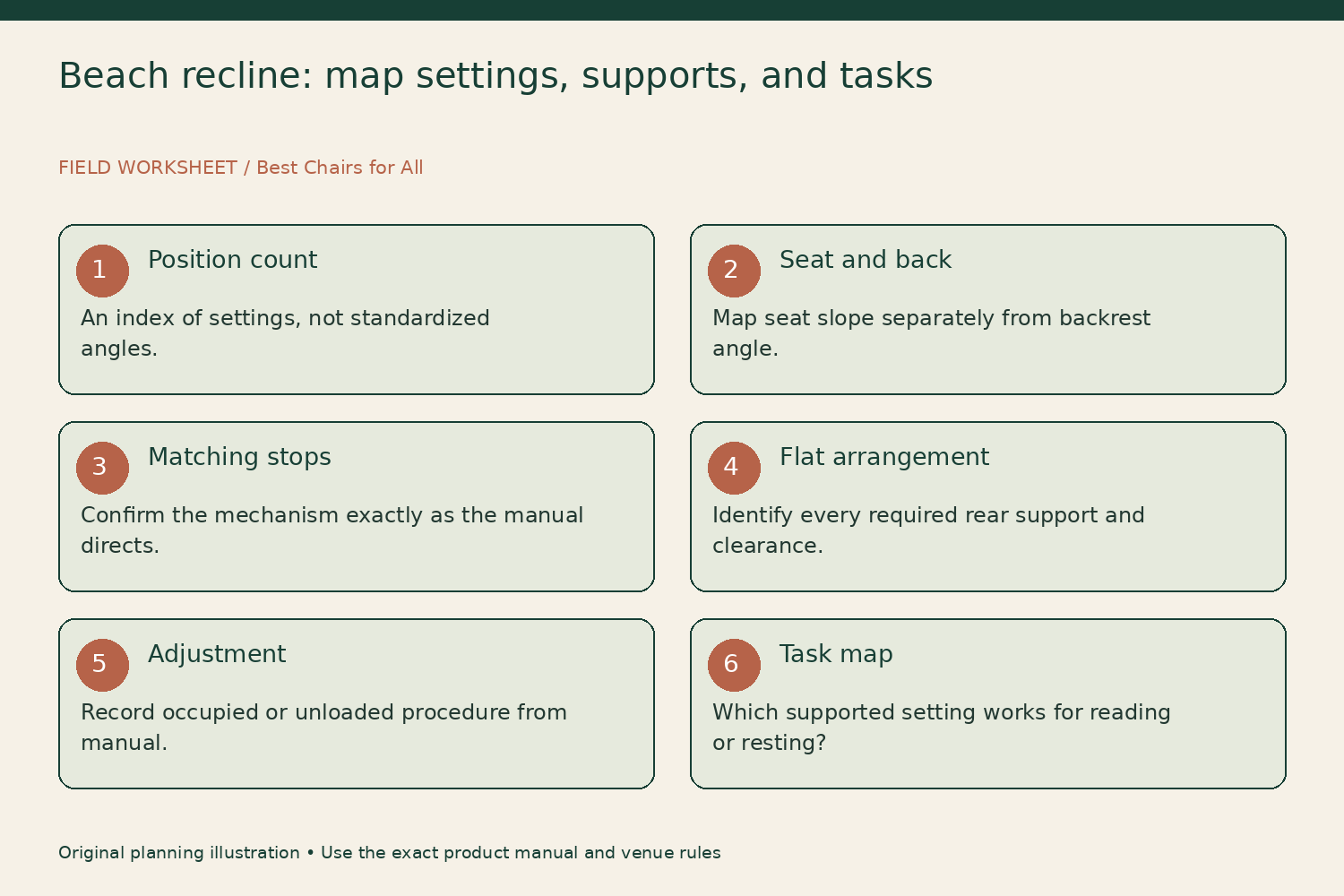
This guide gives you a position map for comparing chairs and understanding the one you own. It separates the backrest angle, the seat’s slope, the support arrangement, and the space each setting occupies. It does not provide a universal adjustment maneuver. Follow the exact manual, especially its instructions about whether adjustment is permitted while occupied and where hands must stay away from moving parts.
Read the position count as an index
A four-, five-, or seven-position label tells you how many discrete settings the maker advertises for that model. It does not establish equal spacing between settings. Do not divide ninety degrees by the number of positions to calculate the angles. A mechanism can have uneven stops, and a marketing photograph may show a chair tilted by the ground or camera rather than a measurable backrest angle.
Write the settings as position one, two, three, and so on until you have a manufacturer diagram giving them other names. Record ‘angle not supplied’ when necessary. A named upright or lounge position may describe an intended use rather than an exact degree value. Keeping the count separate from angle prevents an attractive ‘more positions’ claim from becoming an invented precision specification.
Distinguish back angle from seat slope
Draw the seat and back as two lines. The angle between them is different from the angle of the back relative to the ground. A chair with a sloping seat can have a relaxed feel even when its backrest appears similar to another chair’s. Fabric sag and occupied position add further differences that a simple published position count cannot capture.
During a permitted trial, note where you naturally settle, how the front edge feels, and whether the back meets you where you want support. These are observations about the actual chair and user, not measurements of clinical posture. Avoid estimating medical benefits from the drawing. If a particular body position is necessary for a health reason, obtain appropriate advice and product-specific confirmation rather than choosing by the largest recline number.
Compare a current product description with a manual
The GCI Backpack Beach Chair page describes four backrest positions, but a position count is not a complete operating procedure. Obtain the instructions for the actual chair version before adjusting it. A description such as leaning fully back does not by itself establish a precisely horizontal surface or the same support arrangement as another brand’s lay-flat design.
A contrasting document is the Westfield BC-1019 seven-position lay-flat chair manual. It labels positions A through G and shows the opening and adjustment arrangement, including raising its towel bar during opening. That is model-specific evidence. Read the original drawings and match the model; do not transfer its arm movement or support-bar instructions to a different beach chair.
Make a position map
Draw one small side view per permitted position, using the manual as the starting reference. Add the manufacturer’s name for the setting, any angle it actually provides, the required support components, and the overall footprint if known. If you record a home observation, label it separately from manufacturer data. A map can be useful without inventing exact angles or claiming to have tested stability.
Add a task under each drawing: reading forward, conversation, looking at the horizon, or resting. Those are preferences to assess during ordinary use, not promises about comfort. You may find that two middle settings cover everything you want while the last position adds little value. Conversely, the availability of a specifically documented flat position may be central to your intended use. Let the tasks determine which settings matter.
Verify both sides of the mechanism
Some chairs have separate arm brackets that must occupy matching settings. The Cape Cod Beach Chair use guidance explicitly directs owners to keep each arm bracket in the same recline position and explains that mismatching them stresses its frame. Follow that requirement for the applicable chair. Do not assume one audible click establishes that both sides of every design have engaged.
Use the visual or tactile confirmation described by your own manual. If one side will not reach the intended stop, stop using the chair and inspect only as permitted. Sand, damage, misalignment, and the wrong operating sequence are different possibilities; do not diagnose the cause by forcing the arm down. Never file a stop, bend a bracket, or create an intermediate setting to make the sides appear even.
Understand what lay-flat requires
Find the maker’s explicit lay-flat instructions and drawing. Identify whether a rear bar, support leg, or other component must be positioned before the back is lowered. The component may also serve as a towel bar in another configuration, so its casual name does not establish that its position is optional. Ask the manufacturer if the instructions leave its function unclear.
Measure the space required for the complete permitted configuration, including the rear support. Do not place the chair where the back can reach a wall before the mechanism completes its intended travel. Likewise, do not use an improvised stool or cooler to support a backrest beyond its designed range. A chair that reclines far back is not necessarily designed to become a chaise or support lying in every orientation.
Follow the occupancy instructions exactly
Some products specify an adjustment sequence while seated; others require unloading or another arrangement. Read that instruction directly instead of borrowing a familiar maneuver from an old chair. The same-looking armrest can release a different mechanism. Keep hands and fingers at the locations the manual identifies and away from pinch points during the entire movement, not just at the final click.
If the manual does not explain whether the chair should be occupied during adjustment, ask before experimenting. Do not ask someone to hold a partly released backrest while you move into position. A controlled manufacturer procedure is more useful than an improvised two-person technique. Include the documented occupancy condition on your position map so another household member does not infer it from the final photograph.
Account for the ground and clearance
Use the surface conditions specified by the maker and make sure the chair is fully opened. Reclining does not correct an uneven support arrangement. If a chair shifts or settles unevenly on sand, leave it carefully and reassess placement according to the instructions. Do not keep lowering the back in the hope that a different position will make an unstable setup feel settled.
Consider the entire reclining envelope when arranging bags, tables, and neighboring chairs. A backrest can sweep through space that is clear in the upright position. Keep people, pets, straps, and loose objects out of the mechanism and movement area. Do not wedge equipment beneath the frame as a substitute for choosing a suitable location or following a required support-bar arrangement.
Separate headrest adjustment from recline
A pillow, sling, or headrest can change where your head meets the chair without altering the backrest mechanism. Adjust it only through the method the maker supplies. A chair can have several back positions but a headrest that does not suit your preferred posture. Try the actual combination rather than assuming a higher back or extra pillow guarantees a good fit.
Record whether the pillow is removable, repositionable, or intended to fold behind the back. Do not add bulky padding where it obstructs a latch or changes the folding arrangement. If you use a towel, keep it away from moving parts and follow any product restrictions. The goal is to assess the chair’s supported positions, not create a new cushion arrangement that masks a poorly matched shape.
Compare position quality instead of quantity
Create a table with columns for model, supported settings, documented range, adjustment sequence, required rear support, and installed footprint. Add a final column for the tasks you actually prefer in each setting. Write ‘not published’ for an angle or dimension you cannot verify. This makes the research limitation visible without turning missing data into a guessed specification.
Consider two hypothetical chairs: one has four positions covering your upright and relaxed tasks, while another has seven stops concentrated in a range you rarely use. The second is not automatically better because seven exceeds four. Similarly, a claimed flat mode may be irrelevant if you lack the space to use its documented support arrangement. Compare usable results and constraints rather than counting notches as a quality score.
Respond to an unexpected release
If the back drops, a bracket fails to hold, or the sides no longer match, stop using the chair. Record the model, selected position, ground conditions, and visible mechanism state without recreating the incident. Contact the manufacturer about inspection, repair, or replacement. Do not continue testing each stop with an occupant to decide which settings still seem dependable.
Before using an older or secondhand chair, identify its model and check the current CPSC recall database for the brand and seating type. Search results for surgical ‘beach chair’ equipment concern a different category; match the actual recreational product and label. An unmatched search does not certify the chair, and routine cleaning does not remedy a recall or a failing recline mechanism.
Keep the map with the chair
A useful position map names the supported settings, task preferences, required supports, adjustment conditions, and clearance. Keep the original manual beside it digitally. Update the record if the maker supplies revised instructions or an approved replacement part. Avoid sticking an unofficial angle label on the frame that another user might mistake for manufacturer guidance.
Beach chair recline positions become easier to understand once the count is separated from the mechanism and usable shape. Choose the positions you can document and actually want, operate them through the specified sequence, and leave uncertain settings unused until the manufacturer answers the question. Upright, lounge, and lay-flat are useful descriptions only when tied to the exact chair and its complete supported arrangement.
Something unclear or out of date? Send a correction with this article’s title and the detail to check.
Sources, research & corrections policy ↗