Adjust beach chair backpack straps with the chair folded and secured in its intended carrying configuration, using the adjustment hardware supplied for that model. Aim for an even, controlled package that clears your stride and does not press a hinge or arm into your back. There is no universal strap length or body position that works for every chair. First remove unnecessary cargo and check the strap system; adjustment cannot compensate for damaged anchors or an unsuitable package.
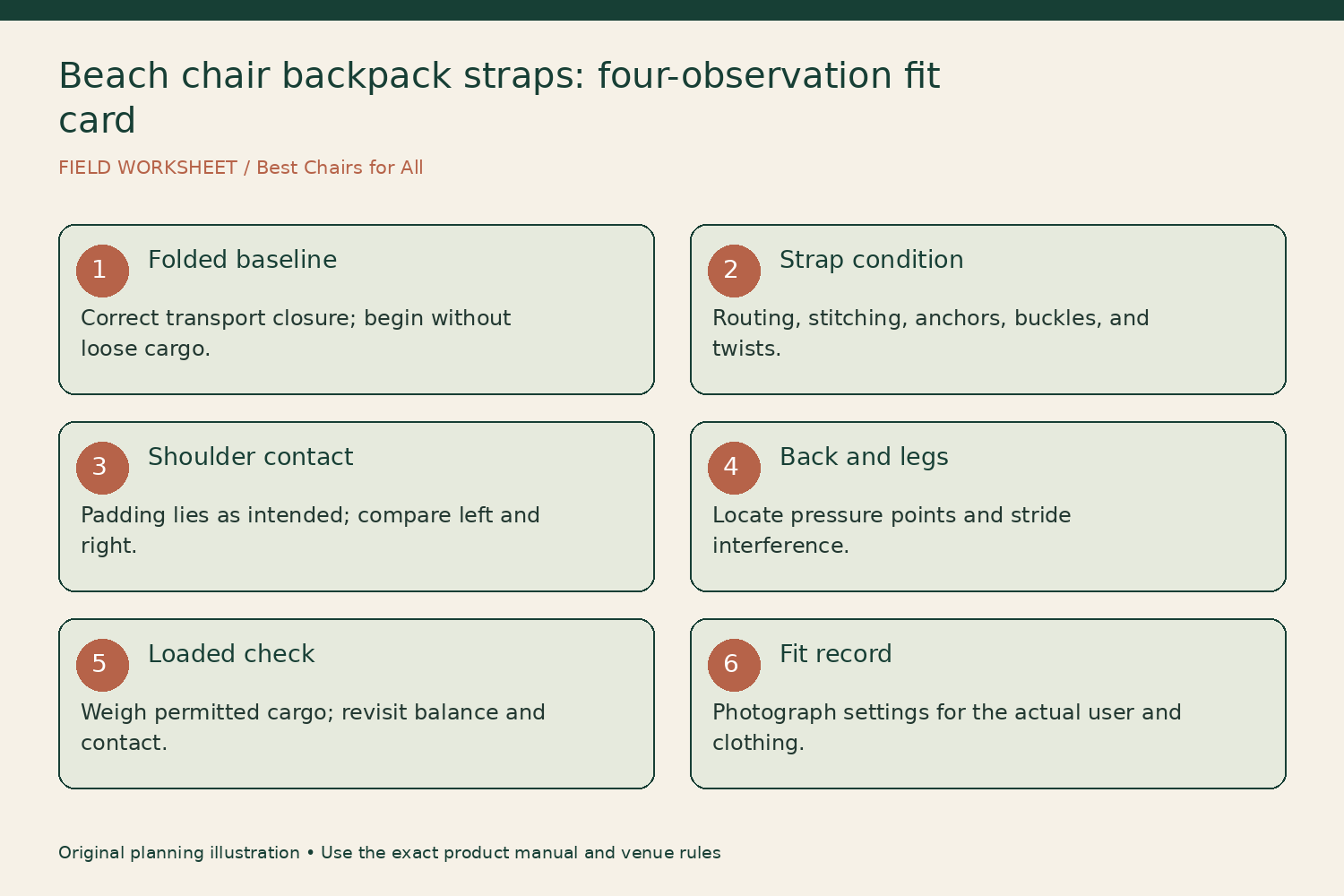
The process below is a fitting worksheet, not a replacement for the chair’s folding and transport instructions. It focuses on what to observe and which variables to change one at a time. A backpack chair is also not necessarily a hiking pack: it may lack a padded back panel, waist belt, or documented cargo allowance. Judge it as the particular piece of furniture it is.
Identify the actual carrying system
Find the maker’s instructions and confirm which straps are intended to go over your shoulders. Some seats also have closure straps, back-angle straps, and accessory loops. Trace the shoulder straps to their anchor points without undoing factory attachments. Photograph the arrangement so you can compare it after folding and avoid accidentally using a strap intended for a different purpose.
Check whether the system is permanently attached, removable, or part of a detachable backpack. ShelterLogic’s backpack-chair guide describes several arrangements, including models with removable backpacks and adjustable padded straps. That variation is the reason to identify the model before copying a fitting procedure from another chair. The same brand name can cover different frames and carrying systems.
Fold before fitting
Open chairs have moving parts and a very different shape from the package meant to be carried. Follow the exact folding sequence, place accessories in their specified transport positions, and engage any documented closure. Do not assume the backpack straps themselves are intended to hold a partly folded chair shut. A frame that opens while on your back creates a problem no amount of shoulder adjustment will solve.
Lay the folded chair down on an appropriate surface and check for loose hooks, projecting arms, a towel bar in the wrong position, or a strap caught in the hinge. Keep fingers away from the folding points named in the instructions. If the chair does not close as described, identify the obstruction or ask the manufacturer. Do not press it flat by force or tie the frame together at an arbitrary point.
Begin with an empty-chair baseline
Remove loose contents from storage pockets, following the product’s instructions. Fit the chair itself first so you can distinguish frame contact from cargo pressure. Weigh the empty folded package, then record any bag or accessory that remains attached. This baseline gives later adjustments a clear reference. Without it, a strap change and a new load can alter the package at the same time.
The GCI Backpack Beach Chair page lists padded shoulder straps, an 8.6-pound chair weight, and a broad fold-flat shape. These details illustrate why a chair can feel different from a soft backpack of similar weight: rigid parts and the outline remain present. Check the received model’s specifications rather than transferring those figures to another beach chair.
Inspect before changing the setting
Look along each shoulder strap for twists, fraying, cuts, loose stitching, damaged buckles, and abnormal movement at the anchors. Check that the adjustment path matches the manual. A buckle that slips or webbing that has pulled out of its intended route needs assessment. Do not use extra knots, staples, or tape to make a damaged carry system hold for one more walk.
Compare the two sides. One may be adjusted longer, routed differently, or caught beneath a frame component. Record the visible difference before altering it. If the straps cannot be made to match the documented arrangement, ask for the correct replacement or routing diagram. Fitting begins with an intact known system, not with discovering how much tension an improvised repair can tolerate.
Make small paired adjustments
Put the chair on in the orientation shown by its maker. Adjust through the intended buckles in small increments, keeping both sides balanced unless the product instructions say otherwise. Set it down when necessary to work on the hardware. Do not reach blindly around a sharp fitting or try to change a trapped buckle while the frame is pressing against your back.
Check the resulting position with a mirror or another person’s observation. Is the chair tilted? Does one shoulder strap bear noticeably more tension? Does a lower corner hit your leg? These are fitting observations, not measurements of injury risk. Change one variable, recheck, and record the result. Large simultaneous changes make it difficult to tell whether length, cargo, or orientation caused an improvement.
Use a four-observation fit card
Divide a page into four boxes: shoulder contact, back contact, lower clearance, and side outline. Under shoulder contact, note whether padding sits where intended and webbing lies flat. Under back contact, identify exactly which frame or fabric section touches you. Under lower clearance, note whether the chair interferes with your normal stride. Under side outline, record what extends beyond your body.
Keep the notes concrete: ‘left lower arm touches coat seam’ or ‘bottom corner brushes thigh on turning.’ Avoid vague labels such as ‘ergonomic’ that do not explain what to adjust. If a rigid part presses into you throughout the permitted adjustment range, that may be a poor fit rather than a strap-setting problem. Consider another model or approved transport method instead of adding a homemade cushion over moving components.
Trial the actual clothing
Fit the chair over the beach cover-up or other clothing you expect to wear. A thick layer changes how a strap lies, while bare shoulders or wet fabric can feel different from a T-shirt. Do not assume yesterday’s setting will be identical for another person or a winter coat. Keep adjustments reversible through the supplied hardware so the chair can be fitted again without cutting webbing.
Try an ordinary short walk in a clear area, including a gentle turn and the kind of step you expect on the route, only if you can do so comfortably and safely. Stop if the package feels unstable or painful. This is a practical fit check, not an endurance test. There is no need to prove that a poor fit becomes acceptable after a longer distance.
Add cargo deliberately
If the manufacturer permits storing items during transport, add only the equipment you need and remain within any stated pocket or carrying limits. Do not confuse the chair’s seated weight capacity with a cargo rating for the backpack straps. When no transport allowance is given, ask the supplier rather than filling a large pocket because it has space. Volume and permitted load are different specifications.
Use a scale to record the loaded package. A hypothetical nine-pound chair with four pounds of added items weighs thirteen pounds, nearly forty-five percent more than the chair alone. This arithmetic explains why a comfortable empty-chair fit can change after packing. It does not establish an acceptable load for you or the straps. Compare the actual package with the manufacturer’s limitations and your own manageable route.
Diagnose movement without inventing hardware
If the chair swings, first verify the correct folded closure, cargo security, and strap routing. Then reassess the intended adjustments. Do not automatically add a sternum strap, waist belt, or bungee cord through frame members. Those additions may load points that were not designed for them or interfere with opening the chair. An available hole or crossbar is not necessarily an accessory anchor.
If the chair includes a proprietary accessory, use its instructions and exact compatibility list. Shibumi’s chair design explanation, for example, describes its own padded straps and two-chair carry clips. That is model-specific equipment, not permission to clip any two chairs together. A documented manufacturer arrangement should remain tied to the models and conditions for which it was designed.
Include dunes, stairs, and tight routes
A beach-chair package can be wider than your shoulders and taller than an ordinary daypack. Plan for railings, gates, narrow boardwalks, and people behind you. Look before turning in a queue. Use the appropriate access route and keep a hand available where needed. Backpack straps free hands from holding the chair; they do not eliminate the space occupied by the folded frame.
If the route includes a long soft-sand section, reduce unnecessary cargo before assuming another strap adjustment will solve the challenge. Consider whether an approved alternative carry method or a different chair shape would suit the route. Do not carry another person or attach extra equipment to the chair’s straps based on a marketing image. The actual transport instructions and your ability to manage the complete load remain decisive.
Preserve the setting without marking structural parts
Once a setting works, record a simple photograph of the buckle positions and note the user and clothing. Use only a manufacturer-approved marking method if you want a physical reference; do not notch, drill, or cut straps or frame members. A photograph is often enough to restore the approximate setting while leaving the adjustment system intact for another user.
Recheck after washing, storage, borrowing, or changes in carried contents. Follow the strap and fabric care instructions rather than using a frame cleaner on padded webbing. Sand caught at a buckle can affect how it operates, so clean it as directed instead of forcing the adjustment. Store the chair with the straps arranged as the maker recommends, away from pinch points and unnecessary tension.
Know when adjustment has reached its limit
A usable fit has flat intact straps, the intended closure, manageable contact points, sufficient walking clearance, and a complete load you can control along the actual route. If one of those conditions remains unresolved, shorter straps are not automatically the answer. Ask about an approved replacement or choose another chair or carry arrangement that fits your needs more directly.
Keep the fit card with the model information so future adjustments begin from observed results. The point of adjusting beach chair backpack straps is to make the intended transport system work for you, not to turn furniture into a different kind of pack. Careful folding, a realistic cargo load, and small documented changes usually reveal whether the chair itself is an appropriate match for the walk.
Something unclear or out of date? Send a correction with this article’s title and the detail to check.
Sources, research & corrections policy ↗