Bar-stool footrest height matters relative to the seat and the sitter, not just relative to the floor. A stool can have the right seat height for a counter while its rail sits too far away, too far behind, or too close beneath the seat for a particular person. Measure the seat-to-footrest relationship, check horizontal reach, and try both feet in a normal dining position before deciding that the stool fits.
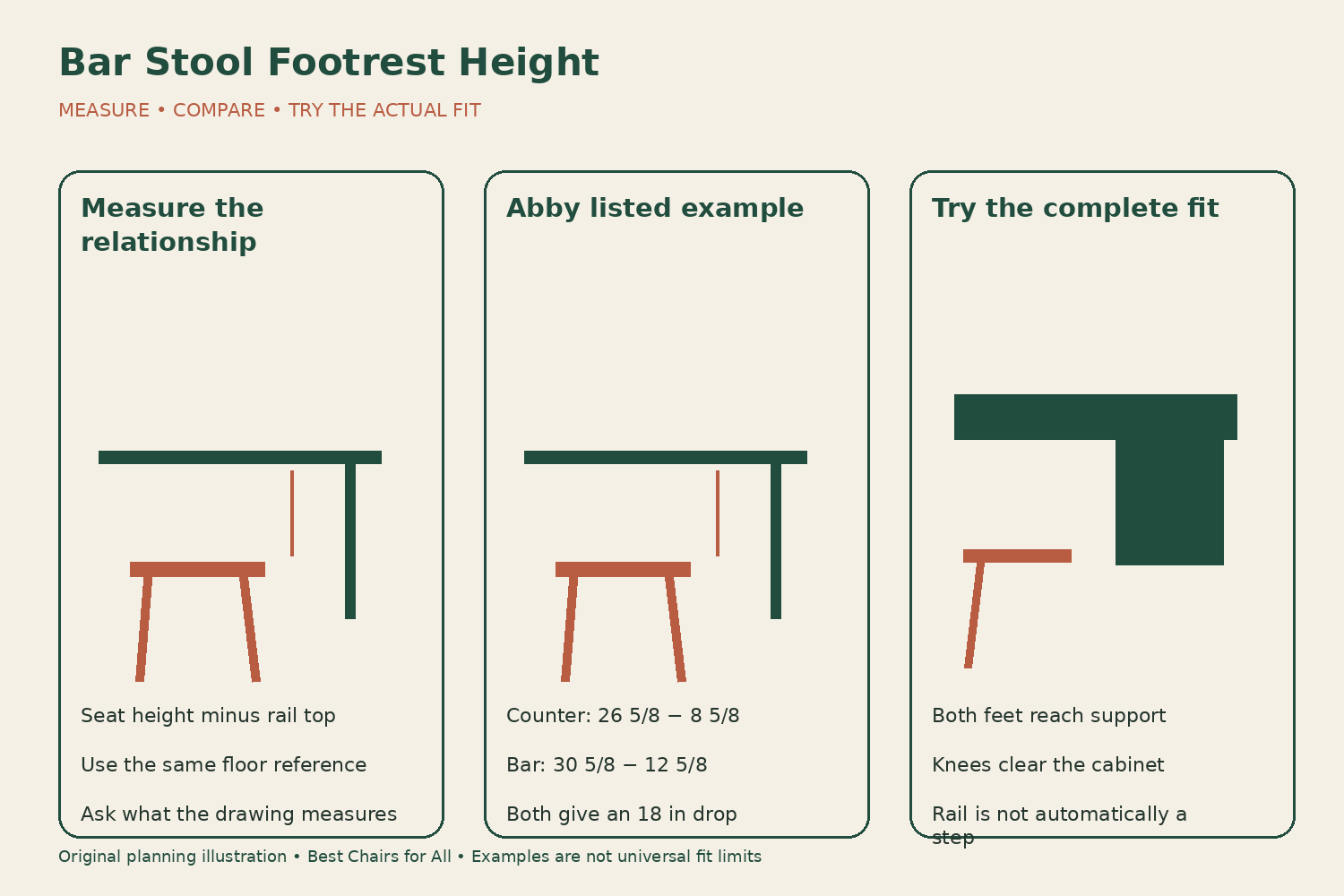
Measure two heights and their difference
Record the seat height from the floor and the height of the intended foot-contact surface from the same floor. Then subtract footrest height from seat height. This gives a vertical seat-to-footrest drop. Use the top of the surface where the foot rests, not the center of a thick tube, unless the manufacturer defines its dimension differently.
The resulting number helps compare products, but it does not establish comfort by itself. A footrest behind the sitter, a narrow rounded bar, or a ring with a small usable area can feel different from a broad forward support at the same vertical drop. Keep the vertical measurement separate from the horizontal distance and contact shape.
Ask the seller which height a specification describes. A drawing may show the bottom of a ring, a tube centerline, or the top contact point. If two listings use different reference points, their numbers are not directly comparable. Obtain clarification rather than treating a fraction of an inch as meaningful precision when the underlying measurement method is unknown.
A documented two-height example
The Chair Source listing for the Amisco Abby provides seat and footrest heights for counter and bar versions. Its counter figures are 26⅝ inches at the seat and 8⅝ inches at the footrest, giving an 18-inch difference. Its bar figures are 30⅝ and 12⅝ inches, again giving an 18-inch difference. These are listed product dimensions, not our physical measurements.
This example shows why footrest height from the floor alone can mislead. The bar version’s footrest is higher, but the seat is higher too. The listed vertical relationship stays the same. That does not prove either version fits every user; it simply shows the value of calculating the difference before comparing the two.
Use the same method for a shortlist. Write each exact model and height version beside its two heights and the calculated drop. If a product omits the footrest dimension, mark it unknown and ask. Do not estimate it from a photograph or assume the counter-height and bar-height versions preserve the same relationship.
Check horizontal reach
Sit in the position you intend to use, with your back at its normal contact point. Find whether both feet can reach the intended support without sliding forward, tucking a leg behind, or rotating sideways. A front rail can be too far away even when its vertical drop seems plausible. A ring may offer several possible contact positions, which should be tried normally rather than inferred from the word “ring.”
Measure the horizontal relationship when helpful. Note whether the support projects in front of the seat edge, lies beneath it, or sits toward the rear. Do not describe a rear stretcher as a footrest unless the maker intends it for that use. Some structural crosspieces are not designed as accessible foot-contact surfaces.
At the counter, check where knees and lower legs go while the feet use the rail. A support that works away from the island may push the knees into a cabinet face once the stool approaches the surface. Footrest fit therefore belongs with overhang depth and underside clearance, not in a separate cosmetic-features list.
Consider the contact surface
Look at the width, shape, texture, and finish where the feet rest. A narrow tube, a flat bar, a wood stretcher, and a broad platform offer different contact conditions. Try the footwear normally used in the kitchen. A support that feels acceptable in firm shoes may feel different in socks or house footwear, and the household may use several types.
Do not add a loose pad or wrap that can move into a swivel or folding path. Ask whether a manufacturer-approved footrest protector or accessory exists if one is needed. A cosmetic cover should not change the support’s function, hide damage, or interfere with the feet entering and leaving their normal position.
Check ordinary cleaning too. Foot contact can leave soil on the rail, but its coating may differ from the seat material. Follow the maker’s instructions rather than using the strongest floor cleaner nearby. A worn or damaged coating is a finish question, while a loose rail is a connection question; neither should be concealed under an improvised wrap.
Try support as part of the whole seat fit
OSHA’s workstation-chair guidance emphasizes supporting the feet on the floor or a footrest and trying chairs before purchase. It addresses workstations, not a universal bar-stool dimension. The general fit principle is useful, but it does not turn one seat-to-footrest drop into an approved dining specification for everyone.
Try the stool with a place setting at the intended counter height. Notice whether you can reach the eating surface, use the back if present, and rest the feet without straining to maintain the position. These observations work together. A footrest should not be used to excuse a seat that is plainly too high for the counter or too deep for the sitter.
If the support feels uncomfortable or symptoms develop, stop the trial. Individual pain, pressure-management, or mobility needs warrant appropriate professional assessment. A shopping measurement can identify a mismatch but cannot diagnose a condition or promise that a particular rail height will treat it.
Distinguish seated support from a climbing step
A footrest is intended to support the feet while seated unless the manufacturer explicitly gives it another use. Do not stand on it or use it as a step merely because it looks sturdy. Elevated seating already requires an entry and exit routine, and a decorative or structural rail is not automatically a climbing aid.
Try approaching and leaving the stool in the intended manner, following its instructions. A swivel changes the route, while a fixed stool may need to be pulled out. Keep neighboring furniture and the counter clear during the trial. If the seat is difficult to access, choosing a reachable footrest does not necessarily solve the mounting problem.
A lower dining place may suit a user better than elevated seating. That can be a practical choice without requiring the island setup to accommodate every need. Do not modify the frame, move a welded rail, or add an unapproved step to force a stool into a role it was not designed to serve.
Adjustable stools need a range check
On an adjustable stool, the seat and footrest may move together, move independently, or have a changing relationship. Inspect the actual mechanism description. Raising the seat can improve reach to the counter while making the footrest less suitable if the support does not rise with it. Test the seat position you will actually use, not only the lowest showroom setting.
Record minimum and maximum seat heights and footrest positions where the maker provides them. If a footrest is separately adjustable, follow the specified method and confirm it is secured as instructed. Do not loosen an unidentified collar or dismantle a lift assembly to discover whether it can move farther.
An adjustable range should be understood as a range within the product’s design limits. Do not exceed it, remove a stop, or alter a threaded or pressurized mechanism. If the available positions do not create a usable relationship for the counter and person, choose another stool rather than extending the mechanism at home.
Fixed stools still need individual measurement
A fixed-height stool may offer a repeatable relationship with fewer adjustment decisions, but its suitability is still personal. The IKEA FRANKLIN counter-height listing identifies a 24¾-inch seat and a built-in footrest. The feature’s presence does not provide the missing footrest-to-seat measurement; ask or measure rather than assuming all stools with rails share the same geometry.
Compare height versions separately. A manufacturer may change both seat and rail, change only one, or use another frame altogether. Keep the exact version in your notes. A successful trial of a bar-height display model cannot establish the footrest fit of the counter-height version without checking the relevant dimensions and sitting position.
Build a footrest fit card
For each user and stool, record seat height, footrest top height, calculated vertical drop, horizontal location, contact shape, and normal footwear. Add three observations: both feet reach comfortably, knees clear the counter structure, and entry and exit work as intended. Leave unknown dimensions visibly blank until clarified.
Photograph the intended foot-contact point if a drawing is ambiguous. Record whether the trial used a padded seat and whether it had settled under the sitter. Occupied cushion compression can change the effective drop, so do not subtract an assumed amount from the listing. Describe what you observed rather than inventing a precise adjusted specification.
The useful choice is a stool whose seat, foot support, counter, and access route work together. Footrest height from the floor is only one measurement. Calculating the relative drop and trying the complete position reveals far more than checking that the product includes a rail.
Compare household observations without averaging them
If two users describe different results, keep separate entries rather than assigning the stool an average comfort score. One person may reach the rail comfortably while another slides forward to find it. That difference is useful information about the shared setup. A second stool design, a separate dining position, or an assessed seating solution may be more practical than expecting everyone to use the same unsupported position. Repeat the trial after adding any permitted seat cushion, because its occupied height can change the relationship to the rail.
Something unclear or out of date? Send a correction with this article’s title and the detail to check.
Sources, research & corrections policy ↗