A director chair is usually a type of folding chair, so the useful comparison is between folding structures rather than between mutually exclusive categories. A conventional quad-fold camp chair gathers into a long narrow bundle; many director-style chairs retain a broad frame and fold flatter. Their seats, arms, accessories, and carrying shapes can feel quite different. Compare the actual models and your intended tasks instead of assuming the category name determines comfort or portability.
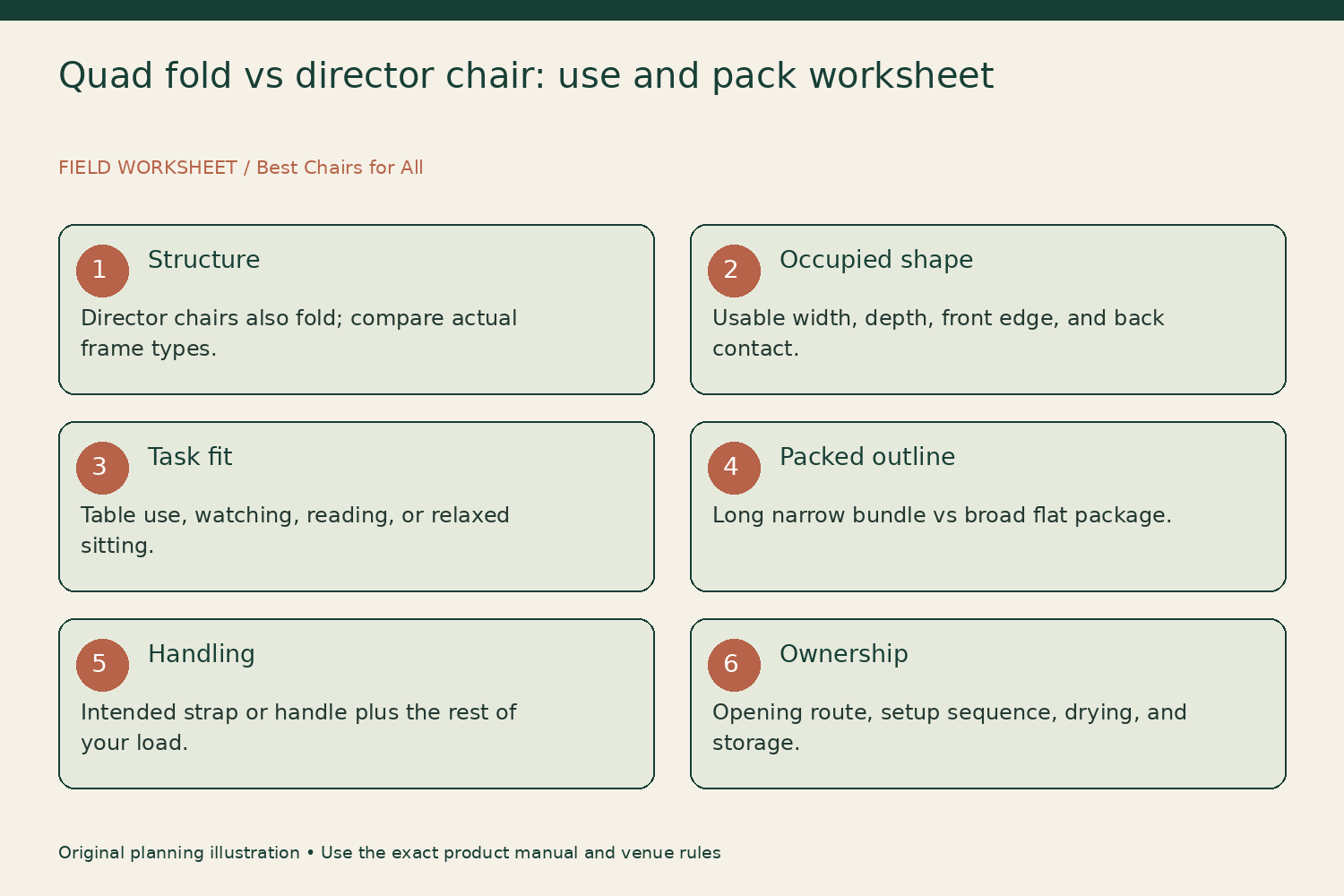
This guide provides a seat-shape trial and a packed-shape worksheet. It does not rank every director chair above every quad chair or claim that one structure is medically better. Named products supply documentation examples, not evidence of hands-on testing. Check the current model, full specifications, and instructions before buying, particularly when a familiar name appears across different regional versions or product revisions.
Understand the quad-fold arrangement
A typical quad-style camp chair has several crossing frame members and a fabric seat that gathers as the frame closes. It commonly packs into a long sleeve. The usable seat can curve under the occupant rather than remain a flat board, and soft arms may adjust separately. These features vary by model, so identify the actual frame and fabric arrangement rather than treating every chair in a drawstring bag as identical.
The Coleman Cooler Quad Chair page is a named example of this category, including its integrated cooler arrangement. Check the exact version’s dimensions and capacity rather than borrowing figures from an older retailer entry. Accessories built into a soft arm also need to be included in the packed and loaded comparison, even when the empty frame seems simple.
Understand the director-style arrangement
Director-style chairs often provide a more defined seat outline, rigid arms, and a frame that folds laterally. Some include a fold-out side table. The director label does not guarantee a wooden frame, canvas seat, particular seat height, or one folding sequence. Modern versions may use steel or aluminum and proprietary mechanisms that create a different packed shape from a traditional director chair.
The GCI Slim-Fold Director’s Chair XL page, for example, describes a steel frame, padded arms, a side table, and a built-in carrying handle. Its listed folded dimensions remain broad and relatively thin. Those details explain an ownership arrangement; they do not establish that every director chair folds the same way or that every user will prefer the seat.
Compare the occupied seat shape
During a permitted trial, note where your body settles, the feel of the front edge, and whether the seat encourages the position you want for the task. A gathered sling can feel enveloping, while a more defined frame can feel different at its sides. Neither sensation is automatically good or bad. Record your actual observations instead of repeating a broad ‘upright support’ or ‘lounging comfort’ claim.
Measure usable width and depth separately from overall frame size. An arm gap can limit sitting space even when the chair looks wide outside. Likewise, a curved sling can have a different usable depth from a rectangular specification. If you cannot try the chair, ask for the maker’s measurement definition and treat personal fit as unresolved rather than claiming certainty from the product photograph.
Match the seat to the task
List whether you will eat at a table, watch a game, read, prepare small items, or relax away from a table. Then compare seat height, depth, back position, and arm arrangement in that context. A chair that feels pleasant for reclining can place you too far from a table edge for another task. A chair that works for an upright activity may not provide the relaxed position you prefer afterward.
Use ordinary task trials rather than a prolonged endurance test. Sit, settle against the back, reach the intended surface, and stand as the instructions permit. Keep any mobility or medical requirement separate and seek appropriate advice when necessary. A category-level comparison cannot determine how a particular person should sit or establish that a chair relieves a symptom.
Treat arms and tables as separate features
Rigid arms, soft arms, and no arms change both the seated experience and entry route. Identify what parts may be loaded when sitting or standing; a side table or cupholder extension is not automatically a push-off point. Read the instructions rather than assuming every visible support can carry body weight. A useful arm position should also leave enough usable seat width for your clothing.
For a side table, record its deployed outline, permitted load, and folding sequence. If no load limit is published, ask the manufacturer instead of assuming it matches the chair’s occupant capacity. Do not sit on the table or use it as a step. Compare whether you actually need the integrated surface or already bring an independent table that works with the chair.
Draw the packed shapes at one scale
Write folded length, width, and thickness for each complete package, including the case when specified. Draw the largest face on graph paper and label the third dimension. A narrow quad-chair bundle and a broad flat director-chair package can have similar bounding-box volume while fitting very differently beside a cooler or under a shelf. Shape is a practical constraint, not merely a storage statistic.
For a hypothetical comparison, a forty-by-seven-by-seven-inch bundle has a 1,960-cubic-inch rectangular envelope. A thirty-six-by-twenty-two-by-four-inch flat package has a 3,168-cubic-inch envelope. These invented examples show arithmetic, not named-product specifications. The larger envelope could still fit a shallow storage slot better, while the narrow bundle could fit a long side space the flat chair cannot enter.
Compare handling with the real package
A carry bag may make a quad chair easy to sling over one shoulder, while a built-in handle may keep a flat director chair controlled beside you. Try the intended carrying method and note ground clearance, leg contact, and the outline around you. Do not choose by weight alone. A lighter broad frame can be awkward through a narrow doorway even when a heavier compact bundle passes easily.
Include the other objects you carry. A chair handle occupies a hand that might otherwise hold a cooler, while a shoulder strap can compete with another bag. Use the manufacturer’s intended transport points and closure. Do not attach a homemade shoulder strap to an arbitrary brace or carry several chairs from one handle unless the maker permits that arrangement.
Check the vehicle opening, not just cargo volume
Measure the route into the trunk: opening width, opening height, narrow interior points, and usable depth with the vehicle configured as intended. Make a light cardboard outline if helpful and check the actual angle available for insertion. A broad flat chair may fit inside but fail at the opening, while a long bundle may pass the opening yet interfere with closing the lid.
Do not rely on a car’s advertised cargo liters to predict chair fit. Cargo volume and the dimensions of a particular opening answer different questions. Include space for the bag’s seams, handles, and any fixed protrusions. Secure the chair according to the vehicle’s cargo instructions and keep necessary visibility and access clear. Folding furniture should not become a loose object balanced where it can move into occupants.
Examine setup and closing requirements
Read the exact sequence for opening, locking, folding the side table, and releasing the frame. A director-style chair may require a particular handle movement, while a quad chair may use a positive lock or a specified fully open geometry. Do not assume a chair is ready because it resembles another chair you have owned. Identify the maker’s engagement check and keep hands away from its pinch points.
Practice in a clear suitable place before the outing. Note whether setup requires ground space, two hands, or accessory removal. A folding mechanism that is convenient in a garage may be less convenient beside a crowded sports field. Compare the tasks you can actually perform, not a generic claim that one category is always faster to deploy.
Match the ground to the design
Check the intended surface and foot arrangement for each model. A wider-looking frame does not automatically establish suitability for sand, mud, or a steep bank. Use approved accessories only where the maker documents them. Do not add homemade feet, blocks, or wedges to make a favorite chair work on an unsuitable site. Ground compatibility is a separate requirement from sitting preference.
If a chair settles unevenly or its frame is visibly unstable, leave it carefully and reassess the location and setup. Do not interpret a high weight capacity as permission to rock, lean on two legs, or use it beyond the intended conditions. Capacity wording, surface restrictions, and assembly instructions belong together in the comparison rather than being reduced to a single strength number.
Include cleaning and storage effort
A quad chair’s folds, padded arms, and cooler pouch can create different cleaning tasks from a director chair’s side table and rigid arms. Read care instructions for the actual materials. The ALPS Brands FAQ illustrates that outdoor furniture still needs appropriate cleaning, drying, and protection from prolonged exposure. Do not assume either folding structure is intended to remain outside permanently.
Plan where the chair will dry after rain and how it will be stored. A long bag may fit a vertical corner, while a broad flat frame may suit a wall space. Keep storage orientation and stacking permission tied to the manual. Chairs that happen to nest together are not necessarily designed to be stacked, and accessories should not be used as load-bearing storage supports.
Complete a use-and-pack comparison
Create two columns for the exact models and rows for occupied seat shape, task fit, arm access, useful table features, ground compatibility, packed outline, carry method, setup, and drying. Mark manufacturer facts separately from personal observations. Leave a blank where the information is missing and resolve any essential question before choosing based on a softer preference.
The practical choice may be a quad chair for a narrow transport slot, a director-style model for a particular seated task and storage arrangement, or a different chair entirely. The names are starting points. Your completed worksheet should explain how the selected chair fits your body, activity, route, vehicle, and care routine. That is more useful than choosing a folding category on reputation alone.
Something unclear or out of date? Send a correction with this article’s title and the detail to check.
Sources, research & corrections policy ↗