Choose a patio chair cover by measuring the chair in the exact arrangement you intend to cover, then checking the cover maker’s fit, ventilation and fastening instructions. The cover should shed water without forming avoidable pockets and remain clear of drainage or airflow paths the design requires. A large loose cover and a tightly stretched cover can each create problems for different reasons.
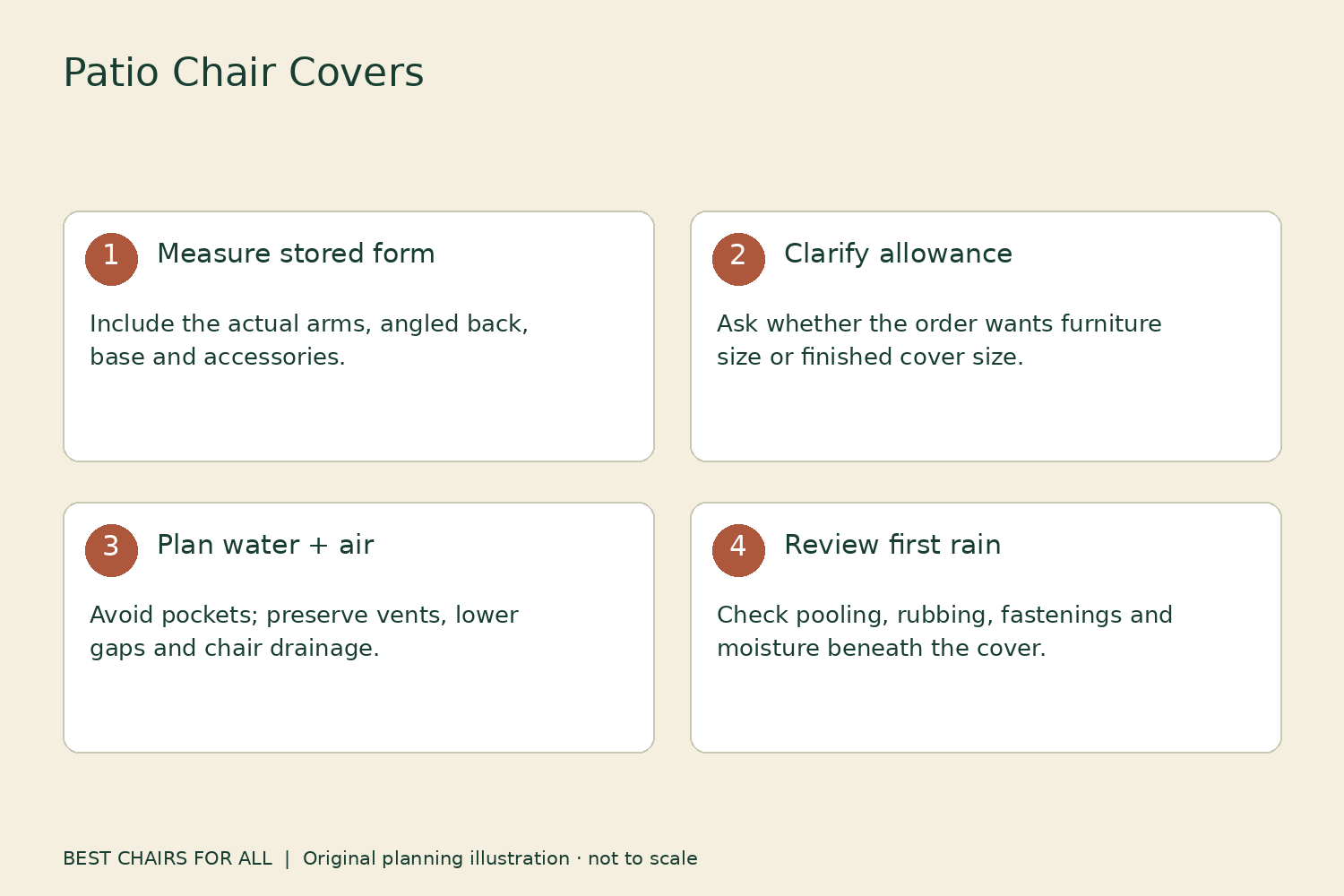
Do not choose only by fabric weight or the word waterproof. The complete cover has a shape, seams, openings and a fastening system, and the chair beneath it has protrusions and changing positions. Use the measurement and first-rain review below to evaluate the whole arrangement. Keep cushion storage decisions separate where their manufacturer recommends bringing them inside.
Decide what will be under the cover
Will you cover one chair, a stack of permitted stackable chairs, a chair and ottoman, or a complete table group? Make that decision before measuring. A cover that fits one open chair may not fit the folded chair or the same chair with its cushion removed. The highest and widest points can change when the arrangement changes.
Set the chair as it will actually be stored. Put reclining parts in the position the chair and cover instructions permit. Remove cushions if they will be stored separately. Do not add a tall object just to make the arrangement resemble a product photograph. Any support accessory should be suitable for the cover and furniture, stable and free of sharp edges.
Photograph the arrangement from the front and side. Mark the model and any accessories on your measurement sheet. This gives the cover supplier a clear reference if an angled back, extended arms or an unusual base makes a standard shape uncertain. A model name alone may not describe the assembled configuration you want covered.
Measure the outer envelope carefully
Record maximum width from the actual outermost points, not merely seat width. Include arms, side trays, protruding handles and any base that extends farther. Measure depth front to back through the chair’s outer envelope. An angled back can project behind the feet, so measuring only the base can underestimate what the cover must contain.
Measure the relevant height from the cover maker’s defined reference. Some designs ask for front and rear heights or other separate dimensions. Use those labels rather than collapsing everything into one maximum. Keep the tape straight and note which features set each dimension. A simple side sketch can prevent later confusion between the top of the backrest and the top of a cushion.
Coverstore’s custom chair cover page provides its own measurement fields and guide. Follow the instructions for the cover form you select. Another supplier’s dimensions or allowance can be different, even when the finished cover looks similar.
Clarify who adds the allowance
A custom cover maker may want raw furniture dimensions and add room itself. Another ordering process may ask you to select a finished cover size. Do not automatically add several inches to every measurement. That can produce unnecessary slack if the maker has already built in an allowance.
Dryboy’s measurement FAQ, for example, says it adds the relevant extra measurement rather than asking customers to enlarge their dimensions. It also explains why it shortens certain covers to preserve an air gap. Those are instructions for its products, not a universal allowance or hem height for all covers.
Write “furniture dimensions” or “finished cover dimensions” at the top of your sheet. If the order page is ambiguous, ask the supplier before purchasing. Include the photograph and a labeled drawing. A clear question about whether an allowance is already included can prevent more trouble than trying to predict the fit from customer-review photographs.
A worked fit example
Imagine a hypothetical chair with a 31-inch maximum width, 36-inch maximum depth and 38-inch overall height. A cover listed as 31 by 36 by 38 inches may be describing the maximum furniture it accepts, or it may be giving its own finished size. Those interpretations are not interchangeable. Verify the seller’s convention before deciding that the numbers match.
Next suppose the chair’s arms extend farther forward than the seat and its back slopes behind the rear feet. The outer measurements already include those features, but a strongly tapered cover could still fit poorly if its top and bottom shapes do not correspond. A rectangular size match is only a screening step for an unusual silhouette.
Make a labeled sketch showing the widest level and the back projection. Ask whether a standard chair cover, Adirondack pattern or custom shape suits it. The purpose of the example is to reveal the questions, not to prescribe an extra two inches or a universal cover length. The correct allowance belongs to the chosen maker’s design.
Understand where water will go
Look at the covered shape from several angles. A low area between the backrest and arms can become a collection pocket. Excess loose fabric can sag, while a tightly stretched panel can strain seams or rub sharp points. Ask the cover maker how its design manages those areas and whether it specifies a support accessory.
Use approved supports only in the intended position. Avoid putting a sharp bucket rim, unstable stool or heavy object under the cover as a makeshift roof. A support can shift and press against the chair or cover during wind. The result should not depend on balancing an unrelated object in the seat.
Coverstore’s cover-selection guide discusses measuring and the sizing problems that allow pooling. Use its guidance to review the actual fit rather than assuming a waterproof fabric can support a standing reservoir indefinitely. The cover needs a suitable shape and use routine as well as resistant material.
Leave ventilation and chair drainage available
A cover limits direct weather exposure but can also enclose moisture already present beneath it. Cover clean, dry furniture as the maker directs, and keep vents or designed lower openings clear. Do not tie the hem tightly against the ground simply to make the arrangement look sealed if the design relies on an air gap.
Ventilation at the cover does not guarantee every cushion inside will remain dry through a long damp season. Dryboy specifically discusses moving textiles inside during winter and airing under covers periodically. Follow the actual chair, cushion and cover instructions together. If their guidance differs, ask the makers about the intended combination rather than choosing whichever instruction allows the least effort.
Do not block drainage holes in the furniture or alter the frame to suit a cover. A chair placed in an unusual position may collect water inside components even when the cover sheds rain above. Use the chair’s permitted storage orientation. The cover should support that plan, not require an arrangement the furniture maker warns against.
Fasten according to the design
Identify straps, buckles, drawcords and attachment loops before the first use. Confirm where each belongs and whether it goes around a leg, beneath a seat or through another specified route. Do not attach a cover to a fragile cushion tie, thin weave strand or moving mechanism unless the instructions call for that connection.
Tension the fastenings as directed without distorting the cover or pulling the chair out of position. Excess slack may flap, while improvised tightening can overstress a seam. If the cover cannot be retained correctly on the chair, contact the supplier about fit. Adding random weights to the top is not a reliable substitute for the designed fastening arrangement.
Weather warnings create a separate decision. A cover is not a wind-rating upgrade for the underlying chair. Store lightweight furniture appropriately when severe conditions are forecast, following current weather and product guidance. Do not remain outside struggling to secure a flapping cover when conditions have become hazardous.
Use a first-installation record
| Checkpoint | What to confirm |
|---|---|
| Arrangement | Chair position, cushions and accessories match the measurement photo |
| Measurement basis | Raw furniture dimensions or finished cover size is clear |
| Outer fit | Arms, back and base fit without forced stretching |
| Water route | No avoidable sagging pockets or unstable supports |
| Airflow | Vents and intended lower gap remain open |
| Fastening | Every supplied strap or closure follows the instructions |
| Furniture condition | Dry, clean and in a permitted storage orientation |
Save the record with the cover size and order number. If the fit changes after cushions are removed for winter, review it again. A cover sized for a full upholstered arrangement can hang lower on a bare frame. That change can affect the intended gap and create new slack even though the cover itself has not stretched.
Review after ordinary rain
When conditions are safe, look at how the cover has behaved after normal weather. Check for accumulated water, displaced straps, rubbing at corners and dampness underneath. Follow the maker’s method for clearing pooled water rather than lifting a heavy pocket in a way that strains the cover or dumps water onto the chair.
If dampness persists, investigate the source. It could involve residual moisture, condensation, a leak, ground splash or an unsuitable fit. Do not assume every wet patch proves the fabric failed. Document the location and weather conditions, then ask the supplier for a specific remedy. Repeatedly sealing the bottom more tightly can make a ventilation problem worse.
Keep a spare photograph of the successful fastening arrangement, especially when buckles are hidden beneath the seat and another person will install the cover.
Clean and dry the cover before packing it away under its own care instructions. Keep closures intact and inspect damaged seams promptly. The right patio chair cover is the one whose dimensions, water path and fastening arrangement work with the actual chair, and whose routine is simple enough that you will use and inspect it consistently.
Something unclear or out of date? Send a correction with this article’s title and the detail to check.
Sources, research & corrections policy ↗