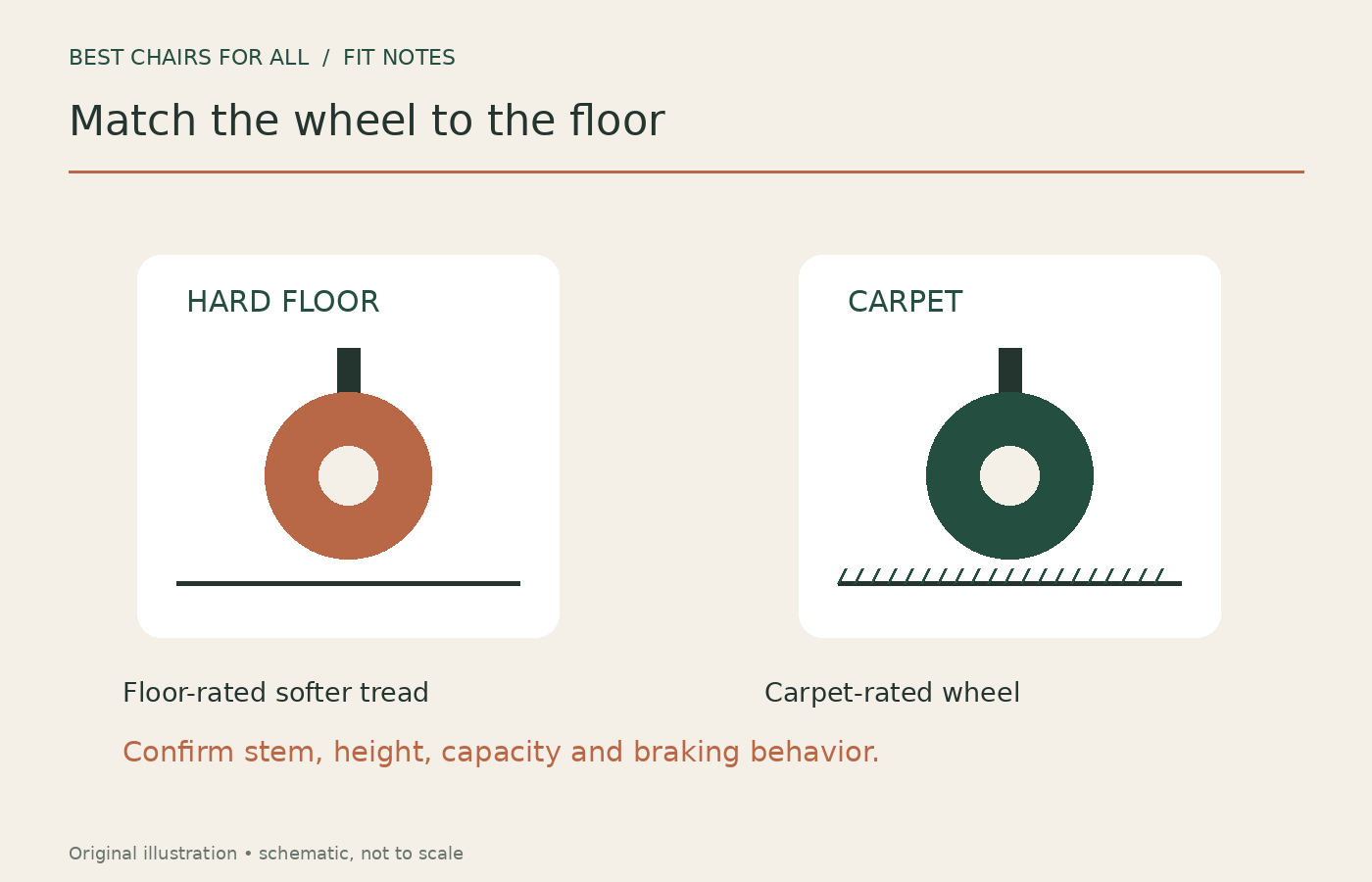
Choose chair casters by the surface they are rated to run on, then confirm they fit the chair. A common starting rule is softer tread for hard floors and harder wheels for carpet. The actual product specification takes priority: some casters are designed for both, and a wheel that fits its socket can still have the wrong height, load rating or braking behavior.
This guide explains what to record before ordering replacements and how to separate floor problems from wheel problems. It covers ordinary rolling office and gaming chairs, not wheelchairs or medical seating. The inspection worksheet is an editorial method based on manufacturer guidance; it is not a claim that we tested particular aftermarket wheels.
First identify what the chair is rolling on
Write down the exact rolling surface: wood, laminate, tile, vinyl, bare concrete, carpet or a chair mat. “Hard floor” is a broad category, and individual floor finishes have their own care requirements. Check the floor manufacturer’s chair-wheel and mat guidance, particularly for a new floor with a warranty.
Then note whether the chair crosses boundaries. A workspace with a rug partly under the desk may require movement over a raised edge on every entry and exit. A caster that works well on the main surface can still catch at that transition. Avoid treating a large wheel as permission to roll over cables, objects or thresholds.
For carpet, note pile depth and whether the chair leaves deep tracks. For a mat, record whether the mat itself moves, cups or dents. These observations help you ask the supplier a targeted question rather than buying a “universal” wheel and hoping it solves every part of the setup.
Understand hard wheels and soft tread
The words “hard-floor caster” usually describe its intended floor, not a hard wheel material. A caster for hard floors commonly has a softer contact tread. Conversely, a hard wheel may be intended for carpet. Product titles can make this terminology confusing, so look for the explicit surface rating.
Steelcase’s support guidance distinguishes its soft hard-floor casters from hard carpet casters and warns that reseller configurations can differ. This is a good reason to check the actual chair you receive rather than assuming the wheels match those pictured in a different store.
Soft tread is not a guarantee against every mark or scratch. A trapped particle, worn wheel, unsuitable cleaner, or damaged finish can change the result. Consider floor protection a system: floor-approved casters, a clean rolling path, and a suitable mat if the floor guidance calls for one.
Match the attachment before comparing style
Casters attach in several ways. A grip-ring stem, threaded stem and plate mounting are different interfaces. Do not pull on a wheel until you understand how your model is attached. The chair’s parts list or support team is the safest starting point for identifying the correct replacement.
Record the chair model, serial number if present, approximate purchase date and photos of the base. If removal is permitted by the manual, photograph an original caster and measure the attachment with an appropriate tool. Do not assume a common stem size from an online listing describes every chair from a brand.
Humanscale asks for identifiers such as serial numbers, order numbers and model information when helping customers locate parts. The same information makes a replacement request more useful elsewhere. A brief message with those details can prevent an order for wheels intended for a different chair generation.
Ask for written confirmation of compatibility if an aftermarket seller lists a family of chairs without exact models. “Fits most office chairs” leaves the important question unanswered. Also confirm the return terms before installing a wheel that may show wear during a trial.
Check installed height, not only wheel diameter
Wheel diameter is the size of the wheel itself. Installed height is how far the complete caster assembly places the chair base above the floor. Two casters with the same wheel diameter can have different yoke or stem arrangements and therefore different installed heights.
Changing that height changes the chair’s lowest possible seat height. Imagine a chair that just allows your feet to rest comfortably at its lowest setting. Taller replacement casters may remove that useful position even if they roll more easily. Record your present floor-to-seat measurement before buying and ask about the proposed height change.
The new height can also affect armrest clearance beneath the desk, head position relative to the monitor, and foot support. These are straightforward geometry checks, not reasons to reject all larger wheels. If the replacement is taller, include that difference in the fit worksheet and reassess the complete workstation.
Know what the brake does
Some casters roll freely; others respond to load or have a manual locking control. A load-sensitive design may resist rolling when the chair is empty and release when someone sits. Another design may brake under load. These behaviors should not be confused with a conventional foot-operated parking lock.
Gross Stabil’s technical guide describes several distinct braking arrangements. Ask the replacement supplier which behavior the proposed wheel has. A wheel that changes this function can change how the chair behaves when you approach it or stand up.
IKEA’s troubleshooting guidance explains that its pressure-sensitive chair casters may resist movement without a seated load. If an empty chair feels reluctant to move, check the manual before diagnosing a defective wheel. Do not remove brake components or force a locked caster across the floor.
Compare single-wheel and twin-wheel designs carefully
Single large wheels, including “rollerblade-style” products, are popular replacements. Twin-wheel casters are common original equipment. The shape alone does not settle which will suit your floor, chair or preferences. Compare the specified surface, installed height, attachment and supported load first.
Then consider the movement you want. A chair that glides readily may be convenient for reaching a nearby shelf, yet undesirable if it tends to move away as you sit or operate pedals. More effortless rolling is not automatically the best outcome. The appropriate amount of resistance depends on your task and the chair’s intended operation.
For sim-racing pedals, seek a manufacturer-approved solution to the chair moving backward. Do not assume every manual wheel lock holds both wheel rotation and swivel, or that a desk chair becomes a simulator seat simply by adding brakes. A fixed seating setup may be more appropriate for the activity.
Do not improvise a higher chair weight rating
Check the caster set’s documented capacity and the chair manufacturer’s permitted replacement. The chair’s original weight limit still applies. Installing wheels advertised for a higher load does not upgrade the gas cylinder, seat mechanism, base or other structural components.
Avoid calculating a chair rating by multiplying a single wheel’s capacity by five. Loads shift as a person moves, reclines or crosses a surface irregularity, and suppliers may specify capacities under particular conditions. Ask for compatibility with the whole chair and its intended load instead of creating your own rating.
Replace a damaged or mismatched set according to the manufacturer’s guidance. Mixing different heights or wheel designs can leave the chair uneven. If a socket, base arm or retaining part is damaged, new wheels alone may not address the problem; stop using the chair and obtain the appropriate repair advice.
A troubleshooting sequence before you order
- Read the original specification. Identify floor type, attachment and brake behavior. Keep the exact model code rather than a general product-family name.
- Clear the rolling path. Remove loose debris and visible material around the wheels using the care method the manufacturer permits. Avoid flooding bearings or spraying unidentified lubricants.
- Inspect for damage. Look for cracked parts, loose attachment, missing tread or a wheel that does not rotate as intended. Do not continue a seated trial if the base looks compromised.
- Observe the pattern. Does the problem happen only on a rug edge, only when empty, or across the whole floor? The pattern helps distinguish a transition, brake or wheel issue.
- Ask a focused question. Send the model, photos, floor details and symptoms to support. Request the correct part number or a confirmed compatible set.
This sequence can save an unnecessary purchase. For example, a wheel obstructed by hair needs a different response from an empty chair whose brakes are operating normally. Neither diagnosis should rely on appearance alone.
Use this ordering checklist
| Check | Record before checkout |
|---|---|
| Chair identity | Model, generation and serial number where available |
| Rolling surface | Floor finish, carpet pile, mat and transitions |
| Attachment | Confirmed stem or mounting specification |
| Height | Current and proposed installed height |
| Operation | Brake behavior and intended rolling resistance |
| Load | Approved set for chair and intended user load |
| Support | Installation instructions, return terms and replacement availability |
Save the completed checklist with your order. It is particularly useful if the same chair is later moved to another room. A caster choice that worked on carpet should be reassessed before rolling it across a different floor finish.
Installation and the first check
Follow the instructions for your chair and replacement set. They may require the chair to be supported on a protected surface and a helper to control its weight. UPLIFT’s Blade Chair Caster instructions are an example of product-specific installation directions; they should not be treated as a universal method for every attachment.
After installation, confirm each caster is fully secured, the chair stands level, and wheels swivel and roll as specified. Check any braking function before normal use. If a wheel falls out, binds against the base or leaves the chair uneven, stop and contact the supplier rather than modifying the socket.
Finally, reset seat height, arms and monitor relationship if the caster height changed. Keep the floor and tread clean and inspect periodically for wear. A successful replacement preserves the chair’s fit and predictable operation while matching the floor it actually rolls across.
Something unclear or out of date? Send a correction with this article’s title and the detail to check.
Sources, research & corrections policy ↗