A folding wheelchair frame usually reduces width through a folding structure, while a rigid frame keeps its main seating frame shape. Both categories can include removable wheels, folding backs and other transport features. Compare the exact configured chairs and the real loading task rather than assuming “folding” automatically means smaller or easier.
Distinguish the frame from parts that fold
The Permobil Panthera FAQ explains that a rigid wheelchair can reduce its transport size by removing parts such as wheels or folding its backrest, while the rigid main frame remains. A back that folds does not by itself make the wheelchair a folding-frame design. A folding frame, in contrast, has a structure that changes the main frame’s transport shape.
Ask the supplier to identify each operation on the candidate chair: frame fold, back fold, wheel removal and support removal. Record these separately. A product photograph showing a compact bundle cannot tell you which actions produced it or whether the configuration includes the prescribed back support. Follow the exact owner’s manual for the permitted operations, keeping the chair empty and fingers clear of the mechanisms.
Fixed front and folding frame are different choices
The Sunrise Medical QS5 X page describes a folding cross-brace design and offers both fixed-front and swing-away configurations. This illustrates that foot-support style and frame folding are separate variables. A fixed front does not automatically mean a rigid main frame, and a swing-away footrest does not necessarily identify every folding design.
For your comparison, put frame architecture in one row and foot-support arrangement in another. Ask which exact options work together and how they affect the assessed transfer approach, seating and transport plan. Do not choose a front end merely because it appears in a demonstration video for a different chair. The clinical team and supplier should connect the configuration to the user’s tasks and support requirements.
Compare transport envelopes in three dimensions
A folding frame may create a narrow upright bundle that remains tall or long. A rigid frame with its back lowered and wheels removed may create a wider but lower shape. Which fits better depends on the vehicle opening, interior volume, other luggage and the way the handler can reach. Neither “fits a trunk” nor “compact” is a useful dimension.
Measure the actual transport configuration’s width, height and depth, then identify the orientation in which it can be handled through the opening. Include any permitted separate wheels and supports. Do not assume that the manufacturer’s folded dimensions include a rigid back, bag or accessory that was added to the order. Obtain a configuration-matched demonstration with the supplier when space is close, rather than forcing the chair into a vehicle to test it.
Weight labels can reverse a casual comparison
The Nitrum rigid-chair page publishes standard and transport weight fields, while the QS5 X page also distinguishes configuration-dependent product and transport figures. This does not establish a universal weight ranking between every rigid and folding wheelchair. Options, frame size and the meaning of the published field affect the comparison.
Write the full in-use weight, the actual loading bundle and the heaviest separate part for both candidates. If one number excludes wheels and another includes them, resolve that difference before ranking the chairs. Never remove a prescribed support or required safety device merely to reproduce a low marketing figure. A slightly lighter piece may still be harder to load if its carrying points and reach do not suit the handler.
Evaluate the user’s experience in the complete setup
Frame design can influence how a chair responds, but the user should compare appropriately fitted complete chairs rather than an unfitted showroom model against a familiar prescribed one. Seat geometry, rear-wheel position, cushion, back support, tires and other components can affect the experience. Ask the assessment team to explain what is held constant during a trial and what differs.
Describe results as specific observations: approaching a work surface, turning on the intended floor or completing the assessed daily route. Do not claim that every rigid chair is faster or that every folding chair wastes a fixed amount of effort. Manufacturer performance claims concern particular products and test conditions. The practical question is how the proposed configuration supports this user’s function and preferences.
Transport routine includes reassembly
Count the steps the actual handler will perform each time, but do not treat fewer steps as the only goal. A permitted wheel-removal routine can be manageable for one person and unsuitable for another. A folded-frame latch may need a particular grip. A rigid back may require separate handling. Ask the provider to demonstrate all relevant operations and the secure return-to-use checks.
Plan protected storage for detached parts in the vehicle. Keep the manual available and do not lift the chair by components not designated for carrying. If reinstallation cannot be performed confidently, arrange the appropriate assistance or reconsider the transport plan. The chair must be restored to its complete documented configuration before occupation; a space-saving state is not a usable seating state.
Assess storage and building access as different tasks
A narrow folded chair may be convenient in a storage cupboard but still have the same occupied width when used through a door. A rigid chair with wheels detached may store on a shelf but require room for those wheels elsewhere. Record the occupied route, the empty storage route and the stored bundle separately.
Do not narrow the user’s seat to solve a cupboard problem or choose a frame solely because it fits under a bed while dismantled. The person’s fit and mobility goals remain central. For shared vehicles or temporary housing, document the range of actual spaces the chair needs to use. If equipment must be transported frequently by different people, the training and handoff requirements belong in the comparison alongside the dimensions.
Ask which changes remain possible after ordering
NSW wheelchair configuration guidance notes that frame shape and dimensions may have limited scope for later alteration. Ask the supplier which aspects of each candidate are fixed, adjustable or replaceable, and what service is required. “Adjustable” should refer to named features, not a promise that an unsuitable frame can always be changed.
Include planned supports or power-assist equipment in compatibility discussions before ordering. Confirm that transport features remain usable with those components installed. A suitable frame decision links the clinical assessment, exact option combination, everyday use and loading routine. Keep the final configuration sheet and manuals so a later accessory request does not reopen the decision using only a broad category name.
Frame configuration and transport comparison
| Check | Evidence and decision |
|---|---|
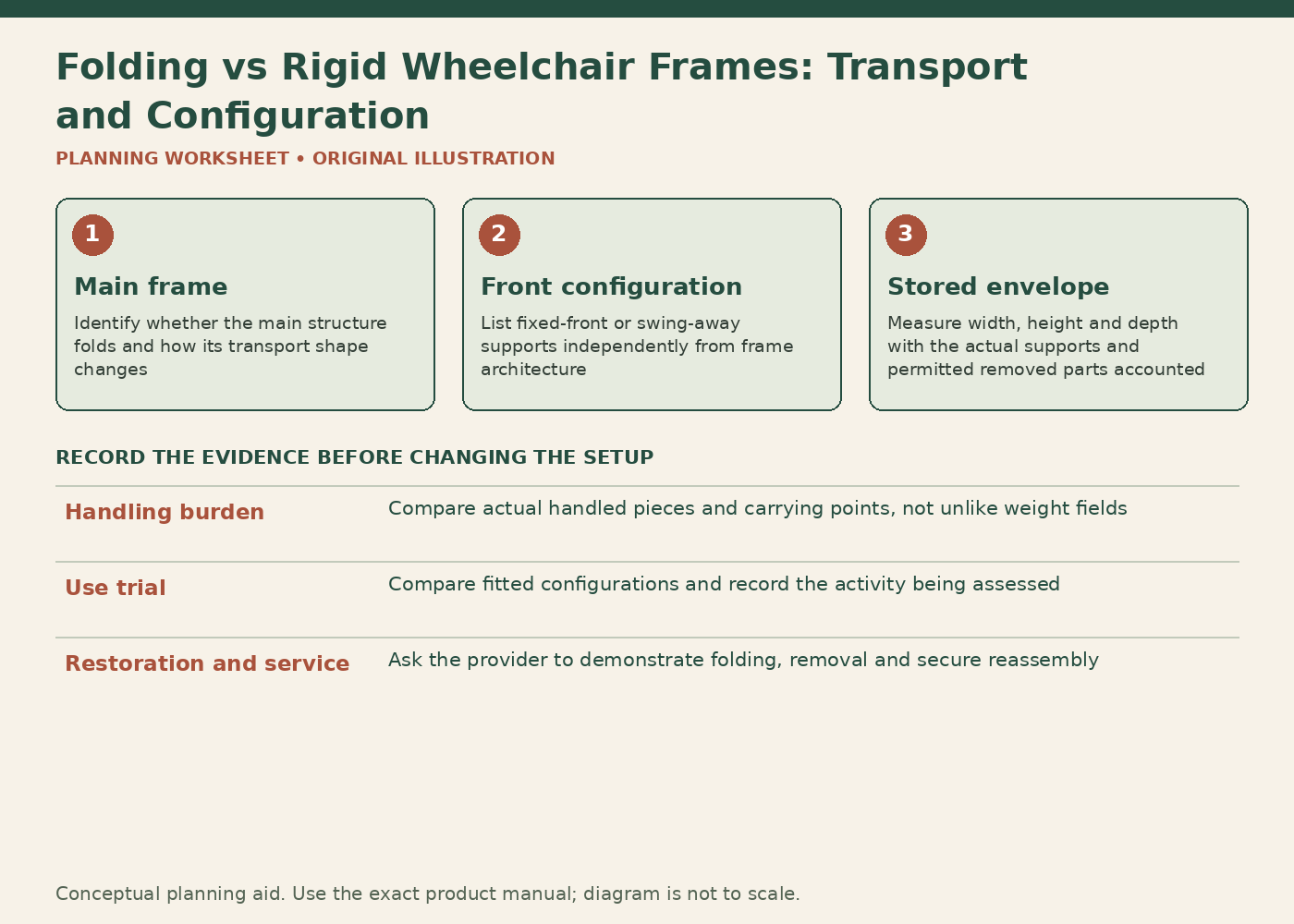
| Main frame | Identify whether the main structure folds and how its transport shape changes. Keep folding backrests and removable wheels in separate rows. A folded-back rigid chair remains a rigid-frame chair. |
| Front configuration | List fixed-front or swing-away supports independently from frame architecture. Confirm the combination with the supplier and assessment team. Do not infer permitted transfer arrangements from the product’s category label. |
| Stored envelope | Measure width, height and depth with the actual supports and permitted removed parts accounted for. Add separate wheel storage. A narrow folded width does not describe height, length or the vehicle opening. |
| Handling burden | Compare actual handled pieces and carrying points, not unlike weight fields. Include the handler’s reach and the loading location. A lower catalog number cannot establish an easy or appropriate lift for every person. |
| Use trial | Compare fitted configurations and record the activity being assessed. Identify major component differences. Avoid assigning a universal performance advantage to frame type when the rest of the seating and wheel setup also differs. |
| Restoration and service | Ask the provider to demonstrate folding, removal and secure reassembly. Confirm which later adjustments are possible and who performs them. Transport convenience depends on returning the complete chair to its intended usable condition. |
Worked example
A household has a hypothetical vehicle opening that accepts a narrow tall bundle but has limited depth behind it. A folding chair might suit that storage shape. Another vehicle has a low opening and broad shallow storage space; a rigid frame with its permitted folding back and removed wheels might fit better. The category alone cannot select the winner because the limiting dimension changed.
The supplier compares both candidates with the prescribed cushion and back support, demonstrates the approved transport operations and records the resulting envelopes. The user also completes the appropriate fitted trial, so the vehicle preference does not silently determine seating suitability. If one chair fits the car only after a support is removed that the handler cannot reinstall correctly, that transport routine remains unresolved. The outcome should be a workable complete equipment and handling plan, not a choice based on which product looks most folded in a promotional photograph.
For frequent loading, keep a record of any latch, wheel-release or support attachment that becomes difficult to operate as specified. Stop and seek service for damage or uncertain engagement rather than compensating with extra force. Repeated folding should follow the model’s maintenance schedule, and a rigid frame still needs its prescribed inspections. The absence of a cross-brace does not remove the need to check back latches, axles and other fitted components. Both configurations depend on their own complete service instructions.
Sources checked November 6, 2026
Use the current document for the exact model, market and production revision. These sources establish the cited instructions and distinctions; they do not certify an individual chair or replace a personal assessment where one is needed.
- Permobil: Panthera FAQ on rigid frames and transport reduction
- Sunrise Medical USA: QUICKIE QS5 X folding frame and configuration options
- Sunrise Medical USA: QUICKIE Nitrum rigid-frame documentation
- NSW Agency for Clinical Innovation: Wheelchair configuration and individual fit
- Permobil: The Wheelchair Handbook
Something unclear or out of date? Send a correction with this article’s title and the detail to check.
Sources, research & corrections policy ↗