A massage chair return can cost much more than the return label for an ordinary parcel. Before ordering, identify who authorizes the return, who packs and collects the chair, which freight charges are deducted, whether a restocking fee applies, and what happens if the original carton or pallet is missing. A money-back headline is incomplete until those details are known.
This guide uses direct-sale manufacturer examples checked on November 6, 2026. Your seller, order date, location, chair condition, and reason for return can change the applicable terms. It is practical consumer information, not legal advice. Save the policy attached to your order and obtain a written return quote before arranging transport. Do not ship a chair without the required authorization.
Identify the contract you actually bought under
The manufacturer, an authorized dealer, a marketplace seller, and a private seller can have different return arrangements. A brand logo on the chair does not make the manufacturer’s direct-store policy apply to every purchase. Record the seller’s legal name and the actual policy linked at checkout. Keep a copy of any special trial or exchange promise with the order confirmation.
Human Touch’s detailed direct-store return page describes returns within 30 days after receipt, an RMA requirement, original packaging and condition requirements, customer-paid prepaid return shipping, and a 15% restocking-and-inspection fee. Those terms apply to the direct purchases described on that page, not automatically to a dealer’s sale. Confirm the applicable version before relying on a trial headline.
Infinity’s direct-store return policy advertises a 30-day guarantee but states that the customer pays return freight and that original packaging includes the pallet. It describes pickup coordination and inspection before refund. The useful comparison is the full process, not whether one headline says 100% money back. Read the footnote and condition requirements alongside the headline.
Ask which event starts and ends the window
A return period may run from purchase, shipment, or delivery, and may require requesting authorization, dispatching, or receiving the return by a deadline. Those are different milestones. Copy the exact wording and ask the seller to clarify ambiguity in writing. Do not assume a support ticket or phone call automatically extends the eligibility period while troubleshooting continues.
Create a calendar with delivery date, initial inspection date, fit-decision date, RMA deadline, and any dispatch or receipt requirement. Leave time for a freight quote and collection appointment. A decision made on the final evening may be difficult to execute if the policy requires more than submitting a form. Keep the date record administrative; it is not a recommended medical or adaptation trial length.
If a replacement is offered instead of a refund, ask whether the original return clock changes and which policy applies to the replacement. An exchange can carry swap freight or new packaging obligations. Do not assume an informal offer resets all deadlines. Record the remedy, dates, and costs together so the decision remains reviewable after the conversation.
Treat packaging as a retained asset
Keep the carton, fitted foam, straps, protective materials, accessories, and pallet until you understand the return rules and accept the chair. Photograph how the chair arrived before unpacking, and store packaging dry where it will not obstruct exits or create other household hazards. Do not discard a pallet because the chair itself is no longer sitting on it.
White-glove delivery can create a conflict if packaging removal is part of the service. Human Touch’s Super Novo 2.0 product page describes a white-glove option that includes packaging removal, while its return policy requires original packaging. Ask before delivery how a potential return is handled if that service removes the carton. Do not assume the installer retains it or that replacement packaging is free.
If packaging is already gone, disclose that when requesting a quote. Ask whether the seller supplies approved replacement materials, arranges professional packing, or applies an additional charge. Do not improvise a carton from thin household boxes or wrap the chair loosely and hope freight handling will be gentle. Packaging requirements and transit-risk responsibility should be resolved before collection is booked.
Separate every possible cost category
Use separate lines for outbound delivery, optional white-glove service, return freight, packing labor, replacement packaging, restocking or inspection fees, condition deductions, and exchange charges. Some may be refundable, some excluded, and some unknown until inspection. Do not combine them into a single estimate without showing the assumptions. Ask which amounts are prepaid and which are deducted later.
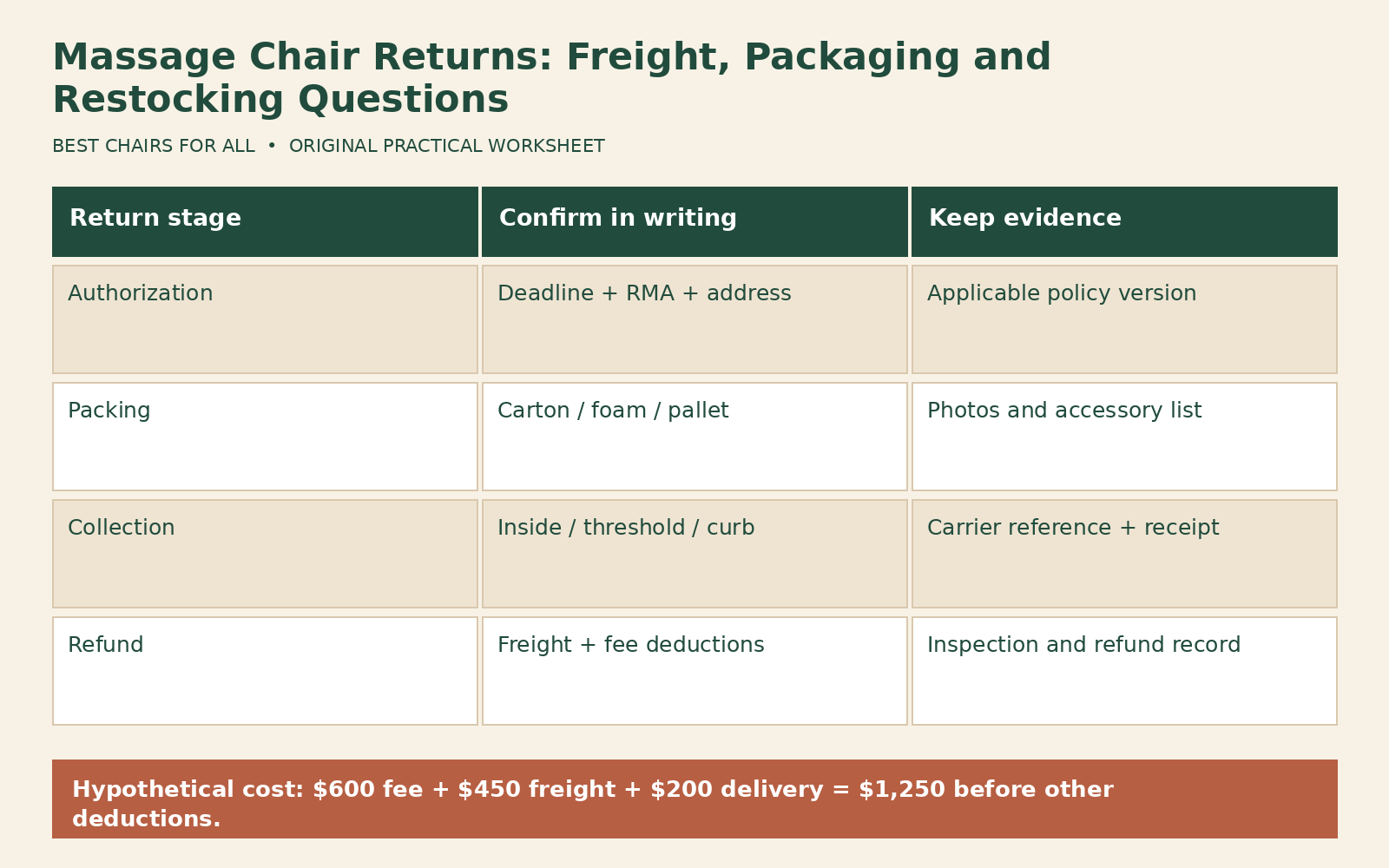
Here is a hypothetical arithmetic example using no actual freight quote. A $4,000 purchase has a 15% stated restocking fee, or $600. Confirmed return freight is $450 and nonrefundable delivery service is $200. The total known cost is $1,250 before any condition deduction, leaving a theoretical $2,750 recovery from the original $4,000 chair price if those categories apply as assumed. Taxes and other order components require their own seller-confirmed treatment.
The example demonstrates why a percentage fee and a freight fee need separate rows. It does not establish typical freight pricing or a final refund from any brand. For your order, replace every amount with a written quote and identify whether it includes residential collection, stairs, inside pickup, palletization, and insurance or declared-value terms. A low curbside quote may not cover the service you need.
Clarify pickup and handling responsibility
Ask where the carrier collects: inside the room, at the threshold, in a garage, or at curbside. Ask who moves the chair from its installed location, who packs it, and whether approved partial disassembly is required. Do not assume the return crew repeats the original white-glove service in reverse. A freight company may expect a fully prepared pallet at an accessible collection point.
Heavy-chair handling belongs to the manufacturer’s approved method and appropriate help. Do not move the chair by its footrest or arms, drag it down stairs, open mechanisms, or remove a gas or powered component to make it lighter. If the requested preparation is beyond your ability, tell the seller before accepting the arrangement and request an appropriate service quote.
Document the chair and package immediately before pickup, including accessible exterior condition, included accessories, and packaging as requested. Keep the RMA, carrier reference, collection receipt, and tracking information. Follow the seller’s instructions for identifying the shipment. A complete handoff record helps if the chair is delayed or its condition at collection is later questioned.
Keep damage, defects, and preference separate
Inspect the delivery promptly under the seller’s instructions and report visible damage with photographs and the relevant delivery record. A chair damaged in transit, a mechanism that does not operate as described, and a chair whose feel you dislike are different factual situations. Do not assume all use the same fee rules, and do not exaggerate a preference as a defect to seek a different outcome.
If the chair is damaged or operates abnormally, follow the manufacturer’s stop-use guidance. Do not continue sessions merely to decide whether the fault is tolerable. Ask whether the seller wants inspection, repair, replacement, or return, and request cost responsibility in writing. A warranty remedy and a voluntary return can involve different authorization and freight procedures.
Keep condition observations neutral and specific. “Scratch visible on left panel at unpacking” is useful; “the chair arrived ruined” may obscure the actual evidence. For fit, describe the limiting dimension or control rather than relying only on “uncomfortable.” Clear observations help the seller assess the request and help you compare a proposed repair or exchange with a refund.
An RMA-to-refund worksheet
Build a worksheet with stages: request, authorization, packing, collection, transit, inspection, and refund. For each, list the responsible party, required evidence, deadline, and cost. Add the policy URL and saved version at the top. Leave unresolved items marked as questions. Do not treat a general customer-service reassurance as a substitute for the actual return instructions.
At authorization, ask for the exact return address and whether the carrier is selected by the seller. At packing, confirm the required materials and approved handling. At inspection, ask which condition deductions can apply and how they are documented. At refund, confirm the payment method and stated processing timeline. This keeps a bulky return from becoming a sequence of disconnected phone calls.
If two pages on the seller’s site conflict, save both and request written clarification for your order. A generic storefront refund page may not contain the detailed chair-freight terms. Do not silently select the more favorable wording or assume an incomplete page overrides the specific policy. A concrete answer before purchase is more useful than a dispute after the chair is already packed.
Make the purchase decision with return exposure visible
Compare the known return exposure with how certain you are about fit, controls, room space, and ordinary use. A showroom demonstration, verified dimensions, and readable manual can reduce uncertainty, though they cannot guarantee future satisfaction. Do not call a chair risk-free solely because a return is available. A return can be possible and still require substantial cost and handling.
Ask whether a return-freight estimate is binding and how long it remains valid. Fuel charges, collection service, packaging, or a changed pickup address may affect a quote. Record the assumptions beside the amount so a later invoice can be checked against the agreed service. If the seller deducts freight from the refund, ask for the amount or calculation before collection rather than discovering it after inspection. Keep any carrier damage claim process separate from the seller’s ordinary condition inspection and confirm who is responsible for opening it.
The practical endpoint is a written plan showing what happens if the chair must leave your home. Keep the packaging decision, freight route, fee arithmetic, and deadlines together. If the seller cannot answer a material question, record that uncertainty before paying. A clear RMA-to-refund worksheet makes both keeping the chair and returning it more informed decisions.
Something unclear or out of date? Send a correction with this article’s title and the detail to check.
Sources, research & corrections policy ↗