A massage chair advertised with a five-year warranty may have a much shorter period for in-home labor than for structural components. Read the warranty as a timeline of separate obligations: diagnosis, parts, installation labor, travel, freight, and frame coverage. A free replacement part is not the same as a technician visit, and a technician visit may depend on authorization, location, and the type of repair.
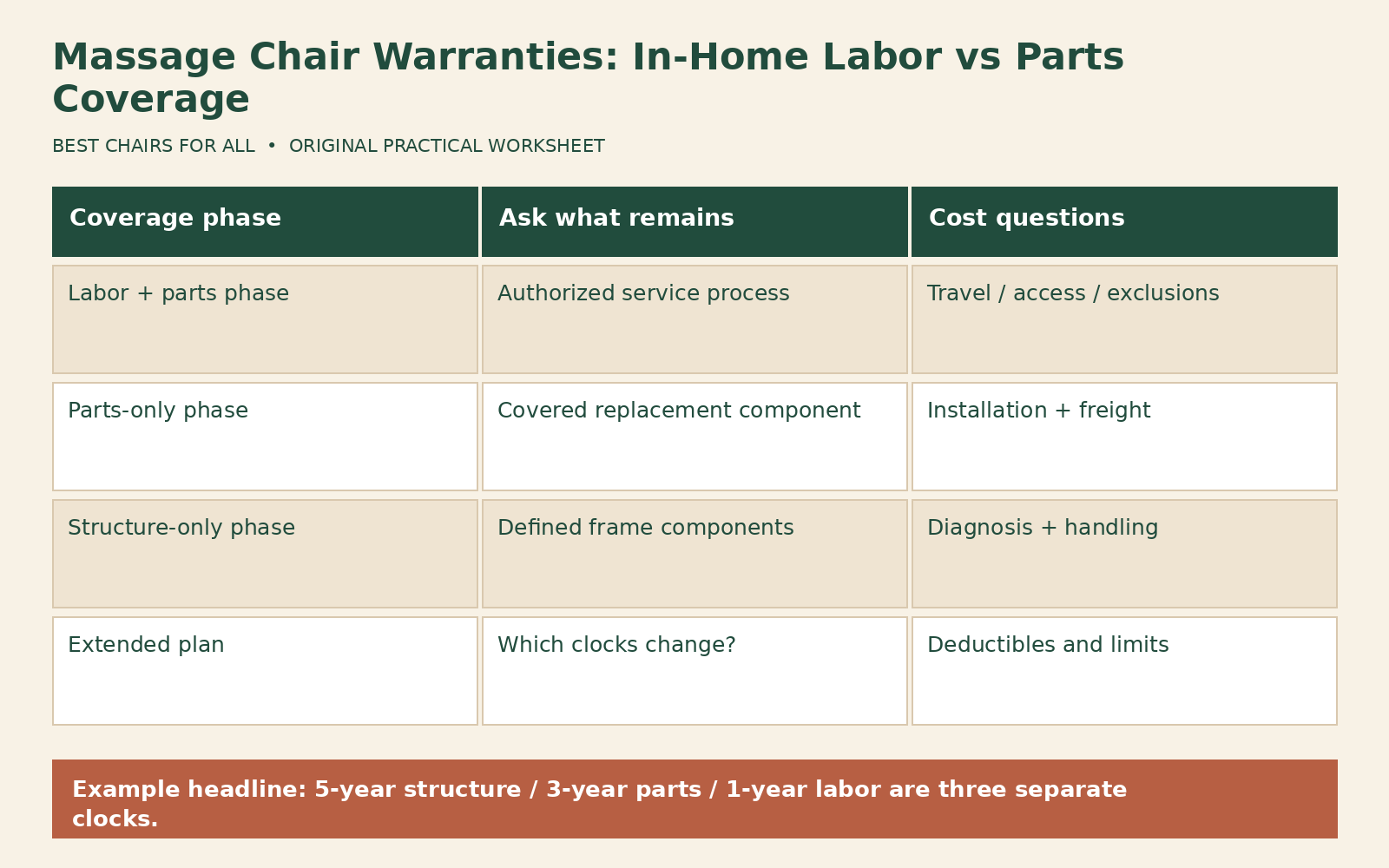
The manufacturer examples here were checked on November 6, 2026. Terms can depend on model, purchase date, seller, condition, region, and intended use. This is a practical reading guide, not legal advice or a promise that a particular claim will be accepted. Save the actual document that applies to your order and obtain written answers for any material uncertainty before purchase.
Translate the headline into three clocks
Start with structural, parts, and labor periods in separate columns. Human Touch’s consumer warranty page lists a five-year limited category that includes the Super Novo 2.0 with five years structural, three years parts, and one year labor. The current Super Novo 2.0 sell sheet also presents those three periods. The five-year headline therefore does not describe five years of every service.
Infinity’s Infinity Care residential warranty similarly lists five-year structural coverage, three-year covered parts, and one-year Complete Care with covered parts and labor in-home if necessary. Read that residential section, not the separate nonresidential or commercial terms on the same page. A search snippet can land in the wrong section and produce an apparently precise but inapplicable comparison.
Draw the timeline from the applicable start date. Do not assume it begins at assembly, registration, or first use. Copy the policy’s actual trigger and ask if unclear. Keep purchase and delivery records because those dates may differ. A replacement or repair may continue the original term rather than start a new clock; confirm that wording before treating a new part as a new warranty.
Understand what in-home labor means
In-home coverage usually concerns qualifying service under the manufacturer’s process, not an unconditional right to a visit whenever something seems wrong. The company may begin with phone or video troubleshooting. It may classify some parts as customer-installable and reserve technician visits for more complex work. Ask which tasks fall into each category and what happens if you cannot perform an authorized installation.
Human Touch’s current page names certain consumer self-install components and describes remote inspection as a possible prerequisite to service. Infinity’s residential terms distinguish simple plug-and-play parts from complex repairs for which an authorized provider may be sent. These are meaningful service-process differences to investigate. Do not translate the words labor coverage into a promise that every replacement is installed by a technician at home.
Check whether coverage includes diagnosis, repair time, return visits, and reassembly after an authorized repair. Ask whether a no-fault-found visit or an excluded condition can generate a charge. Get that answer before scheduling. Do not hire an independent repairer and assume reimbursement; preapproval and authorized personnel may be required. Unauthorized work can complicate both the diagnosis and eligibility.
Read the parts-only phase as a cost shift
After labor coverage ends, a qualifying part may still be supplied while installation becomes your responsibility. Ask for the process and an estimate of any paid service before approving it. A part that appears small on a diagram can require specialized access or significant handling. Do not assume you can install it safely because the manufacturer calls it a replacement component.
Infinity’s residential terms state that shipping, duties, and brokerage can be the consumer’s responsibility during parts coverage. Human Touch’s current terms also address possible shipping and import-related charges. Separate those costs from the part price. A “no-cost covered part” can still involve logistics or labor costs that matter to the owner. The exact approval message should identify what is included.
Do not open powered, hydraulic, or sealed assemblies to avoid a service charge. Ask for the permitted owner procedure or authorized technician option. If the chair must be moved for access, confirm the handling method and who provides assistance. Service coverage does not automatically include clearing furniture, navigating stairs, or preparing a difficult room. Those practical tasks belong in the cost worksheet.
Structural coverage is narrower than whole-chair coverage
Read the definition of structure. It may refer to a welded metal frame or specified structural materials, not upholstery, airbags, motors, rollers, electronics, or every part attached to the frame. A five-year structural period should therefore not be described as five years of mechanical coverage. Keep a list of the actual components assigned to each category.
A symptom does not reveal the covered category by itself. A chair that will not recline could involve a control, electrical part, actuator, or another cause. Report the symptom and let the authorized assessment identify the component. Do not assume “recline failure” means structural failure because the chair’s overall shape no longer changes. Precise classification matters when the coverage clocks differ.
Check exclusions for wear, upholstery changes, improper care, transport damage, electrical events, and unauthorized modifications. Do not treat the existence of an exclusion as an automatic answer to your claim; the facts still need assessment. Conversely, do not assume a long structural term covers ordinary cosmetic aging. Keep photographs and dates so a specific condition can be discussed clearly.
Location can change the service experience
Ask whether your ZIP code or postal code is inside the normal service area, whether travel surcharges apply, and whether coverage changes after a move. Human Touch’s current terms describe possible distance-based service charges. Infinity describes field-service availability and preapproval conditions. A nationwide marketing phrase should be checked against the actual location and applicable policy, especially outside major population centers.
Ask who schedules the technician and whether parts arrive first. Clarify whether the chair must be accessible from multiple sides and whether the owner must move it. A chair installed tightly in an alcove may fit during ordinary use but be difficult to service. Keep an approved access route and the model’s handling instructions with the installation plan. Do not pull a heavy chair by a footrest or arm to satisfy a service appointment.
If you plan to relocate, ask about the new region before the move. A warranty may be nontransferable, geographically limited, or dependent on authorized purchase. Moving the same chair is different from selling it to a new owner. Do not advertise remaining warranty to a buyer without confirming transferability in writing. A policy tied to the original purchaser may not follow the physical chair.
Build a year-by-year coverage worksheet
Use rows for year one, the remaining parts period, and the remaining structural period. Columns should list covered defect categories, who diagnoses, who installs, who pays freight, and potential travel or access costs. Add the document title and purchase-date applicability at the top. Write “manufacturer decision required” for a remedy that is discretionary rather than promising a full chair replacement.
Here is a hypothetical cost example. A covered component fails during a parts-only phase. The part is supplied without a part charge, while an authorized labor quote is $250 and confirmed shipping is $60. The owner’s quoted total is $310 before any other stated charge. These invented figures illustrate the categories, not typical service prices or a quote from either manufacturer. Replace them with written amounts for your case.
Compare an extended plan by filling the same timeline again. Ask whether it extends labor, parts, structure, or only selected services, and whether it changes travel, freight, deductibles, or exclusions. A plan labeled five years may simply align some shorter clocks with a longer one. Do not assume it adds five years after the standard term unless the contract explicitly says so.
Keep the claim process reviewable
Save the invoice, serial identifier, model, policy, and any extension confirmation. For a problem, provide a concise sequence of what happened, the active program or control, and safe exterior photos or video if requested. Do not repeatedly operate a chair that behaves abnormally to produce better evidence. Follow the manufacturer’s stop-use and troubleshooting instructions.
Before accepting a remedy, ask for the part, approved installation method, cost responsibility, and effect on remaining coverage in writing. If a replacement chair is offered, ask about delivery service, removal of the original, equivalent-model differences, and the continuing warranty period. Keep those answers with the claim thread rather than relying on an informal verbal summary.
Build two service scenarios before deciding on an extended plan. In the first, a simple authorized replacement is supplied during the initial service period. Ask whether the company sends a part with instructions or schedules someone. In the second, a complex fault appears after labor coverage ends but within parts coverage. Ask how diagnosis, a technician visit, and freight are charged. The purpose is not to predict a failure; it is to understand which responsibility changes when the labor clock expires.
For each scenario, keep the answer attributed to the specific policy and seller. A dealer may sell a separate service contract, while the manufacturer provides the underlying limited warranty. Record the administrator, claim contact, and whether approval from one is needed before the other acts. If two organizations are involved, ask who coordinates the repair so you are not left arranging parts, labor, and transport independently. Compare the written scope before paying for overlapping coverage that sounds broader than it is.
A useful warranty comparison ends with a concrete statement: which services remain available in each year, at your location, for the specific chair condition and use. It should also identify what you may need to pay or arrange. That is more informative than ranking headline durations alone. In-home labor and parts coverage solve different problems, and the timeline makes their practical limits visible before a repair is needed.
Something unclear or out of date? Send a correction with this article’s title and the detail to check.
Sources, research & corrections policy ↗