As an Amazon Associate, we earn from qualifying purchases. Read our affiliate disclosure. Amazon buttons below search for matching listings; they do not confirm stock, an exact seller, or a current price.
The best tattoo chair for clients is the one that supports the studio’s permitted working positions, gives artists practical access, fits the treatment area, and can be maintained within the studio’s infection-control system. Our manufacturer-researched candidates are TATSoul 370-S, TATSoul 570, and TATSoul Oros 680. This guide concerns client furniture; the tattoo artist’s own rolling chair is a separate purchase.
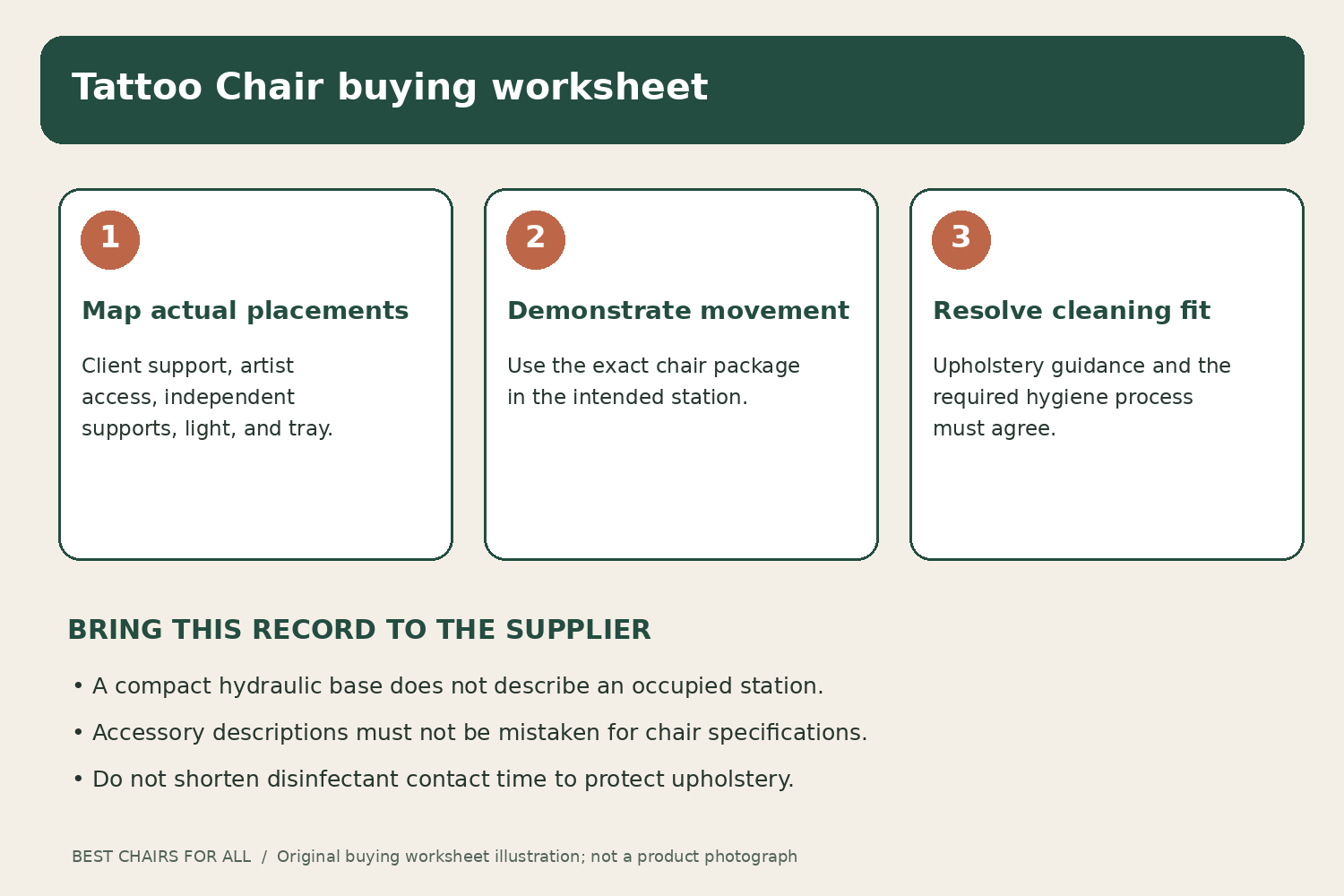
We checked the cited primary sources on November 6, 2026. We have not performed tattoo work on these chairs, evaluated client comfort, tested their locks, or verified a current delivered price. No upholstery or positioning claim is presented as clinical pressure management or an infection-prevention guarantee. Professional training, the applicable local requirements, and the studio’s documented procedures remain essential.
Specify the work before adding more adjustments
Make a list of the positions the studio actually requires, using the equipment manufacturer’s intended-use descriptions. A station focused on particular placements may value a different support layout from a studio handling a broad range of work. Do not assume that every chair which converts toward a flat surface provides identical access, support, or working height in every position.
Separate client support from artist reach. The client needs an appropriate supported arrangement and a clear way to communicate discomfort or request a break. The artist needs access to the work without equipment obstructing the required position. A chair can provide many adjustments yet still force an unsuitable relationship between the artist’s stool, armrest, tray, and work area. Evaluate that complete relationship in a demonstration.
An adjustment range describes the product, not permission to place every client in every available posture. Discuss individual access and support needs appropriately and seek relevant professional advice when they are uncertain. This article does not prescribe client positioning or transfer techniques. If the proposed furniture cannot support the intended use under its instructions, the answer is another arrangement rather than improvised padding, straps, or hardware.
Three manufacturer-documented candidates
| Model | Verified distinction | Useful reason to investigate | Question to resolve |
|---|---|---|---|
| TATSoul 370-S | 24–31-inch seat-height range; independently adjustable leg rests | Hydraulic multi-position client chair | Exact package, supports, and occupied layout |
| TATSoul 570 | 24–31-inch height; modular positioning and PVC upholstery | Its contoured seat and headrest format | Whether those differences help the studio’s actual work |
| TATSoul Oros 680 | Gas-assisted back and leg supports; adjustable seat tilt | A more adjustable hydraulic client-chair layout | Whether the additional controls help the intended work |
TATSoul 370-S: investigate a defined hydraulic multi-position layout
The 370-S manufacturer page lists a 24–31-inch height range, 29-inch width with armrests, 52–81-inch length range, independent leg adjustments, and a 400-pound capacity. It distinguishes Base, Pro, and Elite packages. Ask which components and accessories belong to the quoted package rather than assuming every pictured attachment is included.
Consider it when the hydraulic format and documented support arrangement match the intended work. Its limitation is that a compact base does not describe the entire occupied chair or all working positions. Ask for a demonstration with the actual artist seating and tray arrangement. Confirm controls, approved support settings, and package contents from the current manual, especially when comparing similarly named older 370 products.
Check matching TATSoul 370 S tattoo client chair listings on Amazon (paid link)
TATSoul 570: a different seat form needs a task-specific reason
The TATSoul 570 page identifies a contoured client seat, adjustable headrest, removable arms, and a hydraulic base. Its published height range is also 24–31 inches. The page includes unrelated travel-armrest material, so distinguish chair specifications from accessory descriptions when reviewing the offer.
Investigate the 570 when its seat and support form offer a useful demonstrated difference for the studio. Its limitation is that two models with similar dimensional ranges can still feel and function differently, while a higher package price does not prove better fit. Compare the exact included attachments and permitted positions. Do not turn the manufacturer’s cushioning language into a claim that long sessions will be comfortable for every client.
Check matching TATSoul 570 tattoo client chair listings on Amazon (paid link)
TATSoul Oros 680: evaluate gas-assisted supports and seat tilt
The Oros 680 manufacturer page identifies gas-assisted back and leg supports and a seat base with ten degrees of fore-and-aft adjustment. It lists a 24–31-inch height range, 29-inch width with arms, and separate weights for Base, Pro, and Elite packages. Heights are identified as measured in the flat position.
Investigate this model when those additional adjustments solve a demonstrated access or support requirement in the studio. Its limitation is the extra control and inspection work, rather than an automatic improvement for every service. Confirm the exact package, approved support positions, and complete manual. A gas-assisted support is a different mechanism from the hydraulic lift; neither should be dismantled to resolve an operating fault. Ask the supplier to demonstrate all ordinary controls using the actual accessories ordered.
Check matching TATSoul Oros 680 tattoo client chair listings on Amazon (paid link)
Original artifact: the placement-and-access matrix
Create rows for the studio’s principal categories of work and columns for client support, artist position, independent support equipment, light, tray, chair movement, and cleaning access. For each candidate, mark what has been demonstrated, what requires an approved accessory, and what remains unknown. Do not fill the matrix with generic checkmarks such as versatile or ergonomic; describe the actual equipment arrangement.
A worked planning example might concern a station where the artist needs to work from one side and the existing cabinet sits close to that side of the chair. A chair may offer the required recline yet place an arm mechanism between the artist and the intended working area. Removing an arm is relevant only if the manufacturer permits that configuration and the client’s required support remains appropriate. The matrix should record that as a question to resolve, not an automatic solution.
For another row, a longer flat configuration may extend toward the studio’s main circulation route. Published chair length provides the equipment dimension, while the occupied client and working space add further requirements. Ask the supplier for the actual envelope in the permitted position. If the room cannot accommodate it, moving the cabinet or choosing another system may be more useful than adding another adjustment feature.
Add the exact artist stool and armrest to the demonstration record. Their height ranges must be considered relative to the client chair’s working surface. This article does not prescribe joint angles or therapeutic postures. The purpose is to establish that the equipment can support the studio’s intended professional work without an unresolved access conflict.
Distinguish frame footprint from functional reach
The base can be much smaller than the occupied chair. A compact base measurement is therefore not a valid claim that the entire station fits a small room. Draw the supported chair at the longest and widest intended configurations, then add the light, tray, artist, and any required assistant. Maintain the relevant circulation and facility requirements identified for the premises.
Rotation also changes the relationship to fixed fixtures. Ask the supplier to demonstrate the approved range and securing mechanism with the proposed accessories. Do not test unverified load limits or use the chair as a general-purpose lifting device. If a lock, support, or control behaves unexpectedly, take the chair out of service and contact the authorized provider rather than making a mechanical adjustment during a session.
Gas-assisted and manually adjustable supports need the same careful relationship to the work area. Ask where the ordinary release controls sit, whether they remain accessible in the intended configuration, and how the secured state is identified under the current manual. Do not treat an additional movement range as a requirement to use it. A simpler approved arrangement may be the better choice when it already supports the studio’s work.
Cleaning compatibility is a buying requirement
A wipeable vinyl chair does not by itself make a studio compliant or eliminate contamination risk. OSHA’s tattoo-and-piercing interpretation addresses occupational blood exposure and the role of an exposure-control plan, work practices, and appropriate precautions. Consult current applicable requirements and the relevant local authority for the studio. A furniture listing is not a substitute for professional infection-control procedures.
Before purchase, ask the furniture supplier for written compatibility with the cleaning, disinfection, and barrier process the studio intends to use. The product instructions and disinfectant label must both be satisfied. If the permitted upholstery care cannot support the required process, resolve the conflict with the supplier and responsible professional before selecting that material. Do not shorten a required disinfectant contact time merely to protect a chair finish.
The 570 page, for example, warns against Cavicide and Caviwipes on its vinyl. That is a material-compatibility restriction, not a complete infection-control protocol. Keep the current product guidance with the studio’s approved procedure and obtain clarification where instructions conflict. Do not transfer the restriction or a cleaning recipe automatically to another brand’s upholstery.
Inspect the surfaces and the replacement route
Ask how seams, removable supports, release controls, and underside surfaces can be accessed under the manufacturer’s instructions. A protective cover must be compatible with the chair and the studio’s process. It should not conceal damage or an unresolved cleaning problem. Discuss replacement upholstery or damaged components with the supplier rather than assuming tape or an unrelated cover restores an appropriate surface.
Record ordinary inspection points and who is responsible before equipment returns to service. The relevant checks come from the actual manual and studio procedure. The buyer guide cannot certify a condition from a photograph or define every inspection interval. If the label, model history, or replacement parts of used equipment are unclear, establish them before considering it for professional use.
Compare the complete packages and service support
A quotation should identify the model, package level, upholstery, approved attachments, power arrangement if applicable, delivery, assembly, and training or demonstration. Keep the dimensions tied to that package. A product page can show several variants and accessories while presenting one starting price. We have not verified a current delivered total, so do not treat the shortlist as a budget ranking.
Ask which provider services hydraulic pumps, gas-assisted supports, electric drives, controls, and upholstery. Do not open sealed pumps, pressurized components, or powered assemblies. Record the proper support contact and what happens to appointments if the chair is unavailable. Component warranty terms, return restrictions, freight-damage procedures, and local repair access can materially affect the practical purchase.
Which client chair should you investigate first?
Start with 370-S when its hydraulic support layout and defined package meet the matrix. Investigate 570 when its contour and support format provide a demonstrated task advantage. Consider Oros 680 when its gas-assisted support and tilt arrangement provide a useful demonstrated difference within the approved configuration. Choose only after the placement-and-access matrix and material-compatibility questions have satisfactory answers for the actual studio.
Scope of this comparison
These three candidates come from one manufacturer whose current client-chair specifications and care instructions were readable during research. This is a bounded model comparison, not a claim that the whole market has been tested or ranked. Obtain comparable current documents from other suppliers if their systems meet the studio brief, and evaluate them using the same placement-and-access matrix. A previously considered InkBed listing was excluded after a direct recheck returned a maintenance page.
Something unclear or out of date? Send a correction with this article’s title and the detail to check.
Sources, research & corrections policy ↗