A recliner warranty can cover the reclining mechanism for much longer than the upholstery, electronics, labor, or transport. Read it as a collection of separate promises. The phrase lifetime mechanism warranty does not automatically mean a free repair visit for any fault, a lifetime motor replacement, or coverage for worn leather. The exact model, purchase date, buyer status, cause of damage, and claim process all matter.
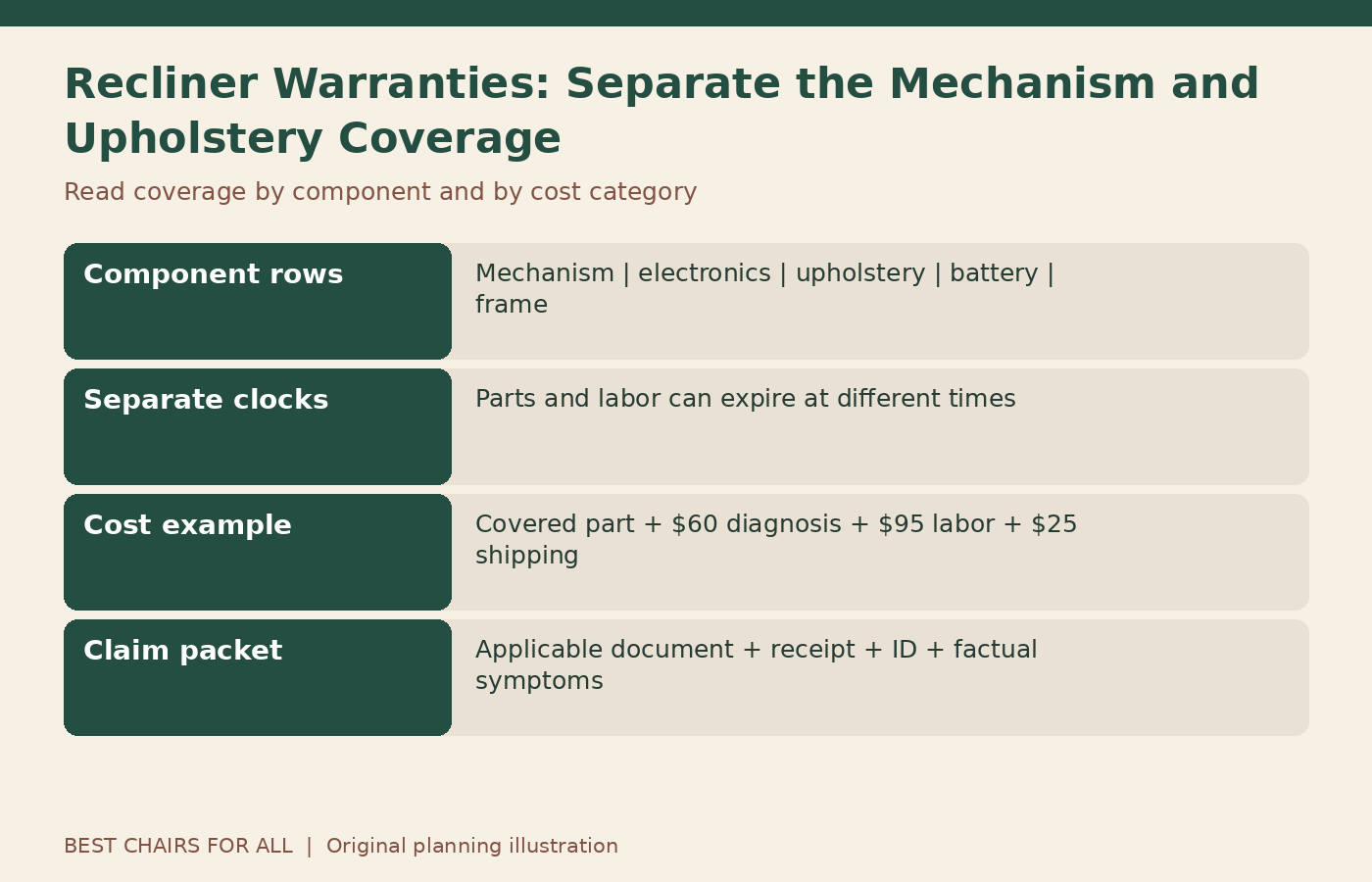
Build a component-and-cost matrix before purchase or before requesting service. This guide shows how to separate the covered component from diagnosis, labor, travel, shipping, and exclusions. Manufacturer examples were checked on November 6, 2026; they illustrate the reading method and should be confirmed against the warranty supplied with your own chair and purchase.
Identify the warranty that belongs to the chair
Start with the full model or style number, serial or product ID, receipt, purchase date, retailer, and country of purchase. A current website may show terms that differ from those supplied with an older chair or a regional version. Ask the retailer which written warranty applies and save that document rather than relying on a brief showroom claim.
Keep the original purchaser requirement and authorized-dealer conditions visible. Used, gifted, clearance, or display furniture may raise questions that need written clarification. Do not assume a warranty transfers with a chair simply because the original receipt is available. Likewise, do not assume every product bearing a brand name uses the same residential upholstery warranty.
Divide the chair into coverage categories
Create rows for reclining mechanism, lift mechanism if present, frame and base, springs, motor and controller, hand control, external power supply, battery, cushions, upholstery, and optional comfort features. Some manufacturers group several of these together; others separate them. Copy the grouping used in the actual warranty and note where a component is not clearly identified.
La-Z-Boy’s parts and warranty page separates mechanism, frame, and other coverage categories and lists style exceptions. Its reclining-mechanism table distinguishes parts from labor and identifies exceptions to the general lifetime-parts entry. That structure shows why the headline should never be read without the relevant row and its exceptions.
Separate parts coverage from labor coverage
A covered mechanism part can still require paid diagnosis or installation after the labor period ends. Ask who determines whether the part is defective and whether that examination creates a charge. A warranty can also allow repair or replacement at the manufacturer’s option rather than guaranteeing a complete new chair. Read the remedy language as carefully as the duration.
Build two duration columns, Parts and Labor, instead of one Warranty years column. If labor differs for mechanical and electrical work, add separate rows. A mechanism, motor, and hand control can involve different terms even though all contribute to a reclining movement. Do not let the service symptom determine the coverage category before the actual cause has been assessed.
Use a real product example carefully
The Golden Titan Medium product specification lists lifetime coverage for the chair frame, lift frame, and recline mechanism, while separately listing three-year electronics coverage, prorated years four through seven, three-year mechanical labor, and one-year electrical labor. That is a product summary, not the full set of exclusions or claim conditions.
The example demonstrates that one chair can have several clocks running at once. Ask for the complete warranty and how any prorating is calculated before estimating a future cost. Do not apply the Titan summary to another Golden model or assume its labor terms cover travel, pickup, or every type of service call. Product-specific confirmation remains necessary.
Treat upholstery as its own question
Fabric, leather, vinyl, stitching, surface finishes, and cushion materials can have different provisions. Some coverage concerns manufacturing defects, while optional stain programs may apply only to defined spills and require particular cleaning steps. Normal wear, fading, body-oil effects, scratches, or accidental damage may be treated differently. Read the exact definition rather than assuming any visible deterioration is a covered defect.
Ask the retailer to identify what happens if upholstery fails after mechanism coverage remains in force. A lifetime mechanism promise does not extend the upholstery term. Keep the cover code and approved cleaning instructions with the warranty. If a stain or finish problem arises, document it before applying unrelated treatments that could complicate assessment of the original condition.
Distinguish warranty, return policy, and protection plan
A return policy concerns whether the retailer will accept furniture back under stated conditions. A manufacturer’s warranty addresses defined defects and remedies. A separate protection plan may cover specified accidents or services through another company. These are different documents, and buying one does not automatically enlarge the others. Read each provider’s obligations and exclusions separately.
Best Home Furnishings’ FAQ explains that its independent dealers set their own return and exchange policies and that warranty service goes through the original dealer. This is a useful distinction when comparing promises. Ask who receives a claim, who approves it, and which document governs the problem you are trying to resolve.
Build a component-and-cost matrix
For each component row, add Parts period, Labor period, Other charges, Exclusions, and Claim route. Other charges should include questions about diagnosis, in-home travel, pickup, return delivery, and shipping. Use Unknown where the document is silent and obtain a written answer. A matrix with visible gaps is more useful than a single reassuring warranty label.
Add a source column containing the document title, revision or effective date if available, and the relevant section. This allows a salesperson or service agent to check your interpretation quickly. Do not compress a conditional sentence into a simple yes if doing so loses an exception. Keep the exact warranty text as the reference even when your matrix uses plain-language summaries.
A worked hypothetical claim-cost exercise
Imagine a chair whose mechanism part is confirmed covered, but whose labor coverage has ended. The provider quotes a $60 diagnostic visit, $95 installation labor, and $25 shipping. If all three charges apply and the part itself costs the owner nothing, the out-of-pocket amount is $180. Those figures are invented for arithmetic, not estimates of current market charges.
Now ask whether the diagnostic fee is credited toward repair, whether travel is included, and whether approval is required before work begins. A written quote could change the calculation. The lesson is that covered part does not equal zero-cost repair. Keep the diagnosis and coverage determination separate from the final itemized bill so each can be reviewed.
Read exclusions in relation to the actual event
Record what happened before the fault: normal use, moving, delivery damage, a spill, an obstruction, unauthorized modification, or another event. State facts rather than selecting the explanation that seems most likely to gain coverage. The manufacturer or authorized representative may need to inspect the chair to distinguish a defect from damage or wear.
Do not disassemble a powered mechanism or attempt an internal repair before asking about the claim process. Unapproved work can create additional hazards and may affect coverage under the actual terms. Even when an owner procedure is allowed, use the matching manual and document the action. A marketplace replacement part or improvised wire repair can make the original condition harder to establish.
Prepare evidence before the first call
Have the receipt, model and serial information, cover code, delivery date, warranty document, and a concise symptom description ready. Photograph accessible damage and the complete label without entering a mechanism area. If the chair moves unevenly or has electrical warning signs, stop use rather than repeatedly recreating the fault for a video. Ask support what further evidence is needed.
Write when the issue began and which functions still work. A service request saying footrest retracts halfway, headrest works is more useful than motor broken unless a technician has diagnosed the motor. Accurate evidence helps identify the component and applicable coverage row. Preserve messages and case numbers so later conversations do not restart from incomplete information.
Ask for an itemized coverage decision
Request a written explanation of the component found defective, the applicable warranty provision, the approved remedy, and every proposed owner charge. If a claim is denied or only partly covered, ask which exclusion or expired period applies. This is a practical request for clarity, not a legal conclusion about whether the decision is correct.
If the explanation appears inconsistent with your document, provide the relevant model, purchase date, and section and ask for review through the stated process. Avoid approving an unclear repair quote under time pressure. Where a dispute requires legal or consumer-rights advice, consult an appropriate qualified source for the jurisdiction rather than treating this furniture guide as an interpretation of statutory rights.
Check replacement and discontinued-part provisions
Ask what happens when an original part, upholstery, or color is no longer available. The warranty may permit an alternative repair, equivalent component, credit, or another stated remedy. Do not assume a discontinued cover guarantees a complete matching suite replacement. The written terms and manufacturer decision govern the offered remedy, subject to any applicable rights requiring separate advice.
If an approved replacement differs from the original, ask about compatibility, appearance, installation, and the remaining warranty. Record any new part number and service date. Do not independently order a substitute before the provider confirms it. A physically similar controller or mechanism can differ in ways that matter to both operation and the warranty claim.
Keep a lifetime-of-the-chair record
Store the matrix, full warranty, receipt, label photographs, approved care instructions, case correspondence, and service reports together. Add dates for any battery replacement, professional upholstery work, or approved component change. This record makes future claims clearer and helps a new service provider understand the chair’s configuration without an unnecessary search underneath the furniture.
Before buying, use the matrix to compare the practical service promise rather than simply the longest headline period. Before repairing, use it to separate coverage from costs and obtain a clear authorization. A recliner warranty becomes useful when you know which component is covered, for how long, under what conditions, and who pays for each step needed to restore normal operation.
Something unclear or out of date? Send a correction with this article’s title and the detail to check.
Sources, research & corrections policy ↗