As an Amazon Associate, we earn from qualifying purchases. Read our affiliate disclosure. Amazon buttons below search for matching listings; they do not confirm stock, an exact seller, or a current price.
The best barber chair is the one whose seating, recline, foot support, controls, and service footprint match the shop’s actual work. Our manufacturer-researched shortlist is Collins Commander I 9050 for a reclining chair with stationary footrest, Collins Continental Sync 9015 for a broader synchronized-footrest arrangement, and Takara Belmont Legacy 90 BB-0090 for a documented traditional barber-chair format. These choices require demonstrations and exact supplier quotations rather than a purchase based on appearance alone.
Manufacturer information was checked on November 6, 2026. We have not shaved a client in, operated, or load-tested these chairs. Prices, delivery promises, and installed totals are not independently established. The Legacy manufacturer store showed a back-order notice at the research check; ask for current availability before planning around it. No claim here establishes that a chair will suit every client or prevent occupational discomfort.
Let the service menu define the chair
A shop concentrating on upright cuts can evaluate seating and access differently from a shop offering reclined grooming services. Write down the actual positions required for each service and which supports must be present. A reclining back, adjustable headrest, stationary footrest, and synchronized leg support are separate features. Do not combine them into a vague label such as fully adjustable and assume all chairs behave alike.
Include the barbers who will use the chair regularly. Their preferred service positions, hand access, and working heights may differ. Ask the supplier to demonstrate the actual base and ordinary controls with representative service tasks. A chair top on a different base can change the working-height question. Record practical observations instead of treating a design described as ergonomic as proof of a health benefit.
Client fit also includes the usable space within the chair. Overall width helps plan the shop; inside-arm clearance concerns the occupied seat. Neither can replace the other. If your clientele includes people with specific access or support requirements, discuss those requirements appropriately with them and obtain professional advice when necessary. A broad seat alone does not establish an accessible service arrangement.
Three documented models
| Model | Verified distinction | Reason to investigate | Question before purchase |
|---|---|---|---|
| Commander I 9050 | Stationary footrest; adjustable removable headrest | Traditional reclining chair without synchronized footrest | Confirm complete upright and reclined depth |
| Continental Sync 9015 | Kick-out footrest; 25 inches between arms | Broader seat and coordinated lower-leg arrangement | Confirm moving envelope and base selection |
| Legacy 90 BB-0090 | Approximately 48-inch upright and 60-inch reclined depth | Documented traditional full barber-chair layout | Verify client fit, installation path, and availability |
Collins Commander I 9050: stationary footrest as a deliberate feature
The Commander I manufacturer page describes a reclining back, stationary footrest, and adjustable removable headrest. It lists 22.75 inches between the arms and 29 inches outside. The page’s printed overall-depth figure is not sufficient for a full service-layout decision; request a confirmed drawing showing the complete chair and footrest upright and reclined.
Investigate it when the shop prefers a stationary lower-foot arrangement and its occupied dimensions work for clients. Its limitation is that the footrest does not follow the same synchronized movement described for the Continental Sync. Ask the supplier to demonstrate the actual recline controls, supported positions, and selected base. Do not infer the intended behavior from a photograph of another Commander model or from a separate gas-recline component description.
Check matching Collins Commander I 9050 barber chair listings on Amazon (paid link)
Collins Continental Sync 9015: more width and a different moving layout
The Continental Sync specifications list 25 inches between the arms, 30.5 inches outside, a kick-out footrest, adjustable headrest, and a heavy-duty hydraulic base with a 27-inch baseplate. The page describes a synchronized movable-footrest arrangement. Confirm the complete current base and supported operating range with the supplier.
Consider it when that broader seating and lower-leg layout fit the service brief. The tradeoff is the space required around the occupied chair and through its permitted movement. A broad inside dimension does not guarantee suitability for every body size, and the baseplate diameter is not the whole service footprint. Evaluate the full arrangement with the trolley, cabinet, and neighboring station in place, then request the dimensions used in the quotation.
Check matching Collins Continental Sync 9015 barber chair listings on Amazon (paid link)
Takara Belmont Legacy 90 BB-0090: account for the reclined envelope
The Legacy 90 manufacturer store identifies BB-0090 with a reclining back, synchronous footrest, removable headrest, and a 19-inch inner width. Its approximate dimensions change from 27 by 48 by 42 inches upright to 27 by 60 by 29 inches reclined. The page also distinguishes optional accessories and production arrangements.
It is worth investigating when its traditional form and documented movement match the shop’s service plan. Its limitations include the narrower inside width relative to the compared Collins specifications and the substantial complete package. Ask about access for delivery and the exact current configuration, rather than importing dimensions from a different Legacy generation. Confirm availability directly; the back-order notice observed during research makes it inappropriate to promise an immediate installation date.
Check matching Takara Belmont Legacy 90 BB 0090 barber chair listings on Amazon (paid link)
Original artifact: the three-envelope shop plan
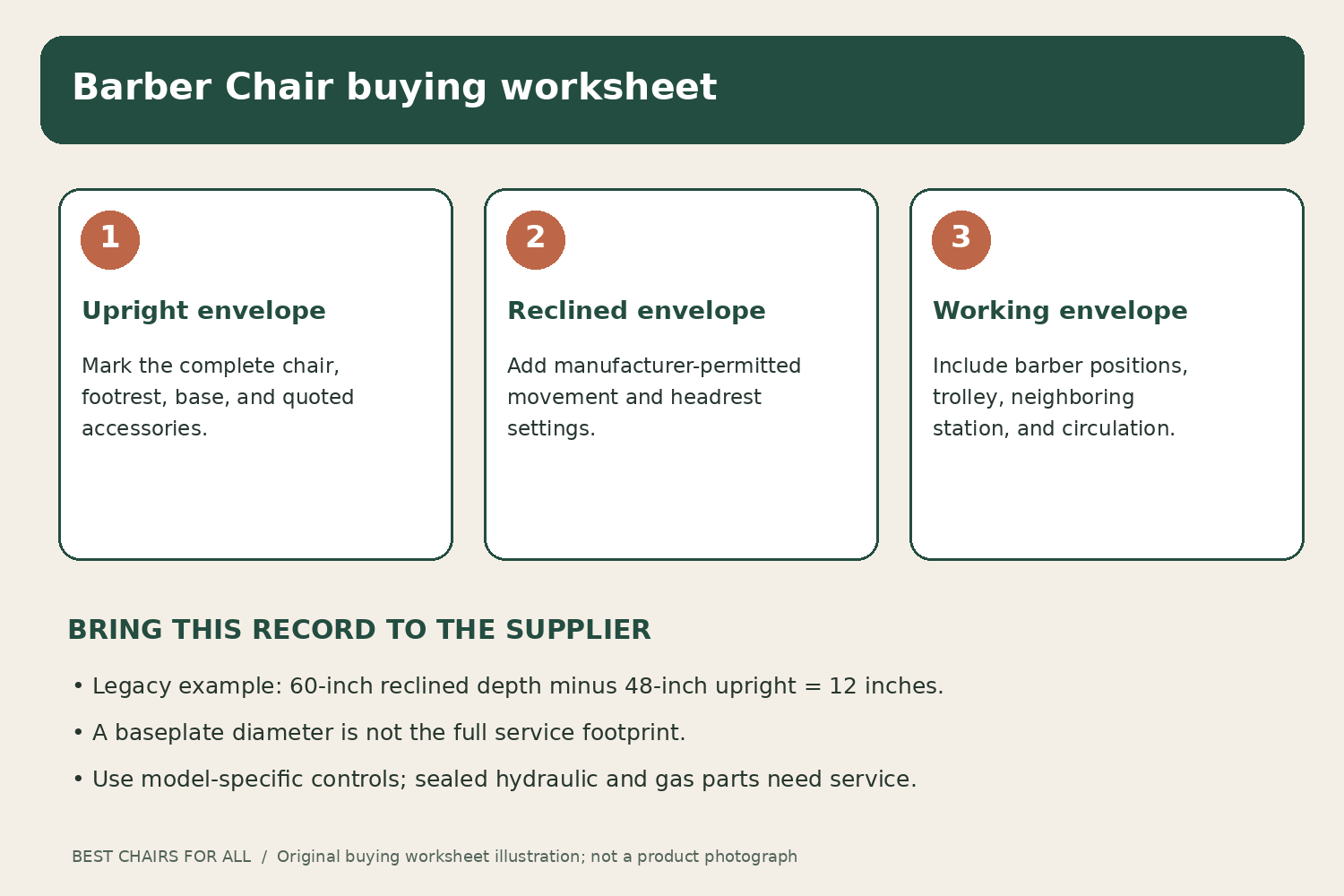
Draw three outlines around the proposed chair center. The first is the upright equipment outline, including the footrest. The second is the maximum manufacturer-permitted reclined outline in the intended service configuration. The third is the working area the barber needs for those services, with trolley, tools, and circulation shown. Ask the supplier to identify dimensions and clearances that belong in each outline.
The Legacy example illustrates the difference without pretending to be a layout approval. Its manufacturer gives approximate depth changing from 48 inches upright to 60 inches reclined, a 12-inch difference. A cabinet placed just beyond the upright outline could therefore conflict with a reclined service. The exact position, headrest setting, occupied body space, and working clearances still need evaluation. Do not treat the difference as a universal required gap for every chair.
Measure barber chair recline clearance through the service positions before deciding how many stations fit the room.
Mark the door route and neighboring station on the plan. A chair may recline without touching a cabinet yet block another barber’s path or place the trolley out of practical reach. Reproduce a representative service sequence during a supplier demonstration. The useful result is a list of observed fit questions, not a claim that a single square-foot allowance works for every shop.
Create one row for each critical service: upright cutting, side work, supported reclined grooming, and cleaning. Record which configuration was demonstrated, who demonstrated it, and which measurements remain unknown. If you will use an optional headrest or another approved accessory, include it in the envelope. A product’s base configuration does not settle the space needed by an extended accessory.
Compare the headrest and foot support as service equipment
A removable headrest is valuable only if its adjustment and approved position suit the intended service. Ask the supplier how it is secured, what routine inspection is required, and how it is cleaned. Obtain the model-specific instructions instead of assuming every familiar-looking release works identically. Do not use an improvised pad or adapter to create support outside the manufacturer’s intended arrangement.
A stationary footrest and a synchronized footrest also create different client and barber experiences. Neither is universally better. Demonstrate the approved movement and confirm that the client-support arrangement remains appropriate throughout the required positions. If a client’s individual support needs cannot be met, discuss another suitable service arrangement rather than expecting the barber chair’s generic adjustment range to solve them.
Check the permitted use of step surfaces separately from their appearance. A broad footrest can look like an entry step without being intended for standing. Follow the exact manual and supplier instruction; this guide does not provide a universal entering, exiting, or transfer sequence. Keep the ordinary operating instructions available to every barber who uses the station.
Delivery is a real installation constraint
Measure the delivery route from vehicle access through the building to the station. Include thresholds, door openings, corners, stairs if present, and any restrictions imposed by the premises. Ask the supplier which assembly and handling arrangements are required and which dimensions apply to the delivered package. Shipping-carton measurements are different from assembled-chair dimensions and should be labeled accordingly.
Do not plan to dismantle hydraulic, gas-recline, or powered components to get equipment through a doorway. Installation and any approved assembly should be handled according to manufacturer instructions by the appropriate personnel. If a route does not work, resolve it before payment or delivery. A beautiful chair stored in a reception area because it cannot reach the station is an expensive avoidable problem.
Cleanability, appearance, and replacement parts
Ask for the upholstery care instructions and chemical-compatibility guidance. Barber products, hair color if used, disinfectants, and cleaning solvents can have different effects. A wipeable finish is not permission to apply any chemical. Confirm the approved routine and any restrictions for the exact vinyl, painted finish, chrome, headrest, and footrest surfaces. Keep a material-specific cleaning record with the station instructions.
Ask whether replacement upholstery, headrests, footrest components, controls, and base service parts are available for the quoted model. Choose color and trim after confirming the functional configuration. A custom finish may change return terms and lead time without changing the chair’s practical suitability. Request physical swatches where appearance is important rather than relying on screen color alone.
Controls, faults, and service planning
Takara Belmont’s US hydraulic-chair instructions identify the equipment as professional salon products for trained users. Have the supplier provide the applicable manual and demonstrate normal lift, lower, recline, and rotation controls for the actual chair. A hydraulic lift and a gas-controlled recline are different mechanisms; their presence should not be collapsed into one generic maintenance routine.
If a chair moves unexpectedly, sinks, leaks, or has an unsecured support, take it out of service and contact the authorized provider. Record the symptom and exact model without opening a pump or pressurized component. Ask who handles warranty calls, labor, travel, and replacement parts. The shop should know how it will manage appointments if a key chair is unavailable for repair.
Make the final quote reviewable
Request the complete top, base, footrest, headrest, upholstery, accessories, freight, placement, assembly, and any installation charges. Ask the supplier to identify all departures from the demonstrated setup. Current price and lead time need direct confirmation; this guide does not classify these products into a hard budget tier. Read custom-order cancellation and return conditions before paying a deposit.
Choose Commander I when the stationary footrest and occupied fit match the service brief, Continental Sync when its broader synchronized arrangement is useful, and Legacy 90 when its documented traditional layout and availability fit the plan. Approve the equipment only after the three-envelope drawing, client fit discussion, delivery route, and service contact are all established for the exact quoted configuration.
Something unclear or out of date? Send a correction with this article’s title and the detail to check.
Sources, research & corrections policy ↗