Used means a chair has had a previous owner or prior use. Refurbished should tell you that someone performed a defined restoration process, but the word alone does not tell you which parts were inspected, replaced, cleaned, or tested. Compare the seller’s documented work and responsibility rather than assuming every refurbished chair is equivalent or that every used chair is a poor choice.
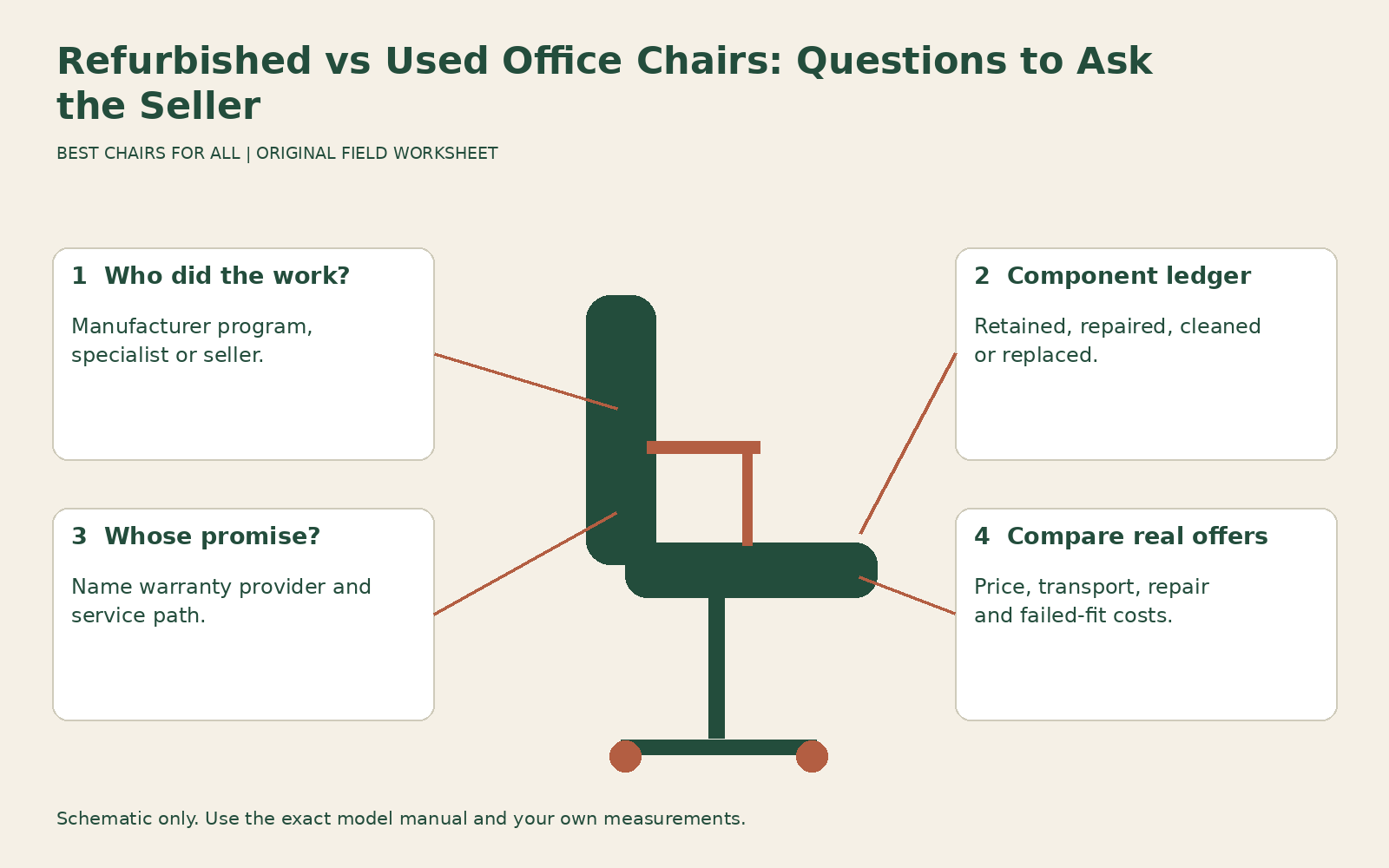
This guide uses a restoration ledger: one row per component, with the work performed, evidence, replacement source, and person responsible if it fails. It is different from a physical inspection checklist, which is covered in our used-chair inspection guide. Here the objective is to understand what extra work and support, if any, you receive for the refurbished price.
Identify who performed the refurbishment
Ask whether the work was done through a manufacturer program, an authorized channel, an independent specialist, or the seller personally. Those categories describe responsibility and access to documentation, not an automatic quality ranking. An independent restorer may provide a clear process and useful support, while a vague listing can leave you with little evidence regardless of its professional appearance.
Record the business name shown on the invoice and the business that will handle service. If the marketplace seller, restorer, and warranty provider differ, write down each role. A brand name in the listing title usually identifies the original chair manufacturer; it does not establish that the manufacturer approved the restoration or will cover the transaction.
For a concrete example, Steelcase U.S. Remade and circular design program describes the U.S. Circular by Steelcase: Remade program and a warranty associated with that program. This is evidence that a defined manufacturer-related restoration channel exists, not that every chair advertised as remanufactured Steelcase belongs to it. Ask for documentation connecting the actual offer to the program if that is part of the seller’s claim.
Ask what refurbished means on this specific chair
Request a component list rather than a general promise that the chair was restored to excellent condition. Ask which items were replaced on every unit, which were replaced only if inspection indicated a problem, and which were retained. These are different processes. A new fabric cover does not establish a new cushion, and new casters do not establish a serviced tilt mechanism.
The word tested also needs detail. Ask which ordinary functions were checked and whether the seller retains a record for the delivered unit. You do not need proprietary engineering documents to ask whether seat height, depth, recline, arms, and back support were verified. A brief final function check and a manufacturer mechanical test program are different kinds of evidence and should not be presented interchangeably.
Ask whether the chair is restored to the original configuration or deliberately modified. Thicker foam, aftermarket arms, alternative casters, and replacement cylinders can change fit or compatibility. An alteration may be clearly disclosed and acceptable, but it should be evaluated as part of the actual product. Do not assume a premium-sounding upgrade preserves every original specification.
Build the restoration ledger by component
Create rows for base, casters, cylinder, tilt assembly, seat pan, cushion, upholstery, backrest, lumbar component, arms, and labels. For each, enter retained, cleaned, adjusted, repaired, or replaced. Add the reason and part reference when provided. Mark unknown information plainly; an attractive photograph cannot establish the condition of a mechanism beneath the seat.
If a component was replaced, ask whether it is manufacturer original equipment, an approved compatible part, or another aftermarket part. Avoid treating OEM wording as a substitute for an exact reference. A part can be genuine yet belong to a different version. Conversely, a compatible replacement needs a clear basis for compatibility rather than a claim that it fits many popular chairs.
For original retained parts, ask what condition standards apply. Cosmetic scratches may be acceptable while cracks or failed adjustments are not. If the seller uses condition grades, request the definition and photographs representative of the actual unit. “Grade A” can mean different things across businesses and may describe appearance rather than the completeness of functional restoration.
Read authorized refurbished warranties on their own terms
The MillerKnoll authorized refurbished U.S. and Canada limited warranty is a useful current example. For covered authorized-channel Herman Miller refurbished purchases in the United States and Canada, it states a five-year term for functional components and mechanisms, with eligibility and exclusions. It is separate from the new-product warranty and effective for covered refurbished purchases on or after May 27, 2026. These details were checked on November 6, 2026 and should be rechecked before buying.
That policy should not be generalized to every refurbished Herman Miller chair. It depends on the authorized channel and the policy’s conditions, and it distinguishes function from cosmetic prior-use conditions. If an independent seller promises another warranty, identify that seller’s policy and responsibility separately. A manufacturer’s product name on the seat does not automatically connect your purchase to its refurbished program.
Herman Miller warranty and service guidance also explains its approach to products from unauthorized resellers and where to seek parts and service. Use that guidance to ask who will actually help with your specific offer. Do not conclude that an old manufacturer’s warranty transfers simply because a used chair still has a label or the original model once carried a long term.
Compare support as a process, not just a number
A warranty duration is only part of its usefulness. Ask how a claim begins, who diagnoses the fault, whether labor is included, who handles transport, and what happens when a part is unavailable. If the seller expects customer installation, determine which jobs are appropriate and which require service. A long promise with no practical repair path may leave significant inconvenience unresolved.
Keep returns separate. A chair can work mechanically and still be the wrong size or contour for you. Ask whether a fit-related return is permitted, what condition is required, who pays transport, and whether there are deductions. A refurbished warranty for defects does not necessarily provide a trial for discomfort. Save both sets of terms with the invoice. Photograph the delivered condition before ordinary use so any disagreement about prior cosmetic wear can be discussed against the actual arrival record.
For a private used sale, support may be limited or absent under the actual agreement. That does not automatically make the purchase unreasonable, but it changes the cost and uncertainty you accept. Compare that offer with the refurbished option using concrete terms rather than assigning every refurbished listing a manufacturer-level service package it may not have.
Use actual offers to compare total commitment
Write purchase price, delivery, applicable fees, known immediate repairs, and the cost of an unsuccessful fit for each offer. Use current quotes, not generic savings percentages. Leave unknown future repairs as unknown rather than inventing an annual maintenance budget. A cheap used chair needing several verified repairs can cost more initially than a documented refurbished unit, while a sound local used chair can be a coherent lower-cost choice.
For an illustrative comparison, imagine a used chair offered at 250 dollars and a refurbished option at 400 dollars. The used offer needs a quoted 80-dollar approved repair and 40 dollars of transport, creating a 370-dollar initial commitment. The refurbished offer includes delivery but has a specific return deduction. These numbers are hypothetical; the method is to compare actual obligations before calling one option better value.
Do not convert the difference into guaranteed cost per year without evidence of remaining life. You may use scenarios for planning, clearly labeled as assumptions, but refurbishment does not reset every retained component to new age. The ledger reveals which wear items are new and which remain part of the original chair. That is more informative than an unsupported lifespan promise.
Verify the configuration and identity
Record the original model, generation, size, and identifying label, then list the options now installed. A restored chair may have different upholstery or arms from the manufacturer’s stock photograph. Ask the seller to confirm the exact configuration on the order and provide photos when choosing a particular unit. A seat slide or lumbar option should be verified rather than inferred from the model family.
Check capacity through documentation for the approved assembly and ask how any replacement parts affect that claim. Do not assume a stronger-looking base increases the user rating. If the seller cannot establish the chair identity or compatibility of major components, mark those questions unresolved. A clean finish cannot supply missing structural or fit evidence.
For recalls, use the exact model and identifying information to check the applicable official database and manufacturer notices before use. A restoration label is not proof that a recall remedy was completed. If a notice matches, follow its instructions and obtain evidence of any required remedy. Do not rely on a seller’s statement that the chair has been checked without knowing what was checked.
Send a focused seller request
A useful request reads: “Please provide the restoration record for this model and unit, identifying retained and replaced components, replacement-part sources, and final function checks. Please confirm the exact seat, arm, lumbar, and cylinder configuration. Who provides the warranty and service, and what are the separate fit-related return terms?” This asks for reviewable facts rather than an assurance that the chair is like new.
Use the answer to complete the ledger and identify your remaining risks. If the refurbished offer documents meaningful work and practical support that matter to you, the extra price may be justified. If it provides only cleaning and vague wording, compare it accordingly with a transparent used offer. The strongest purchase is the one whose actual condition, fit, restoration work, and support you understand before paying.
Something unclear or out of date? Send a correction with this article’s title and the detail to check.
Sources, research & corrections policy ↗