The first difference is who moves the chair. A transport chair is generally intended for an attendant to push, while a manual wheelchair may be configured for self-propulsion, attendant assistance or another assessed method. Choose around the user’s actual routine and support needs, not the smallest folded package alone.
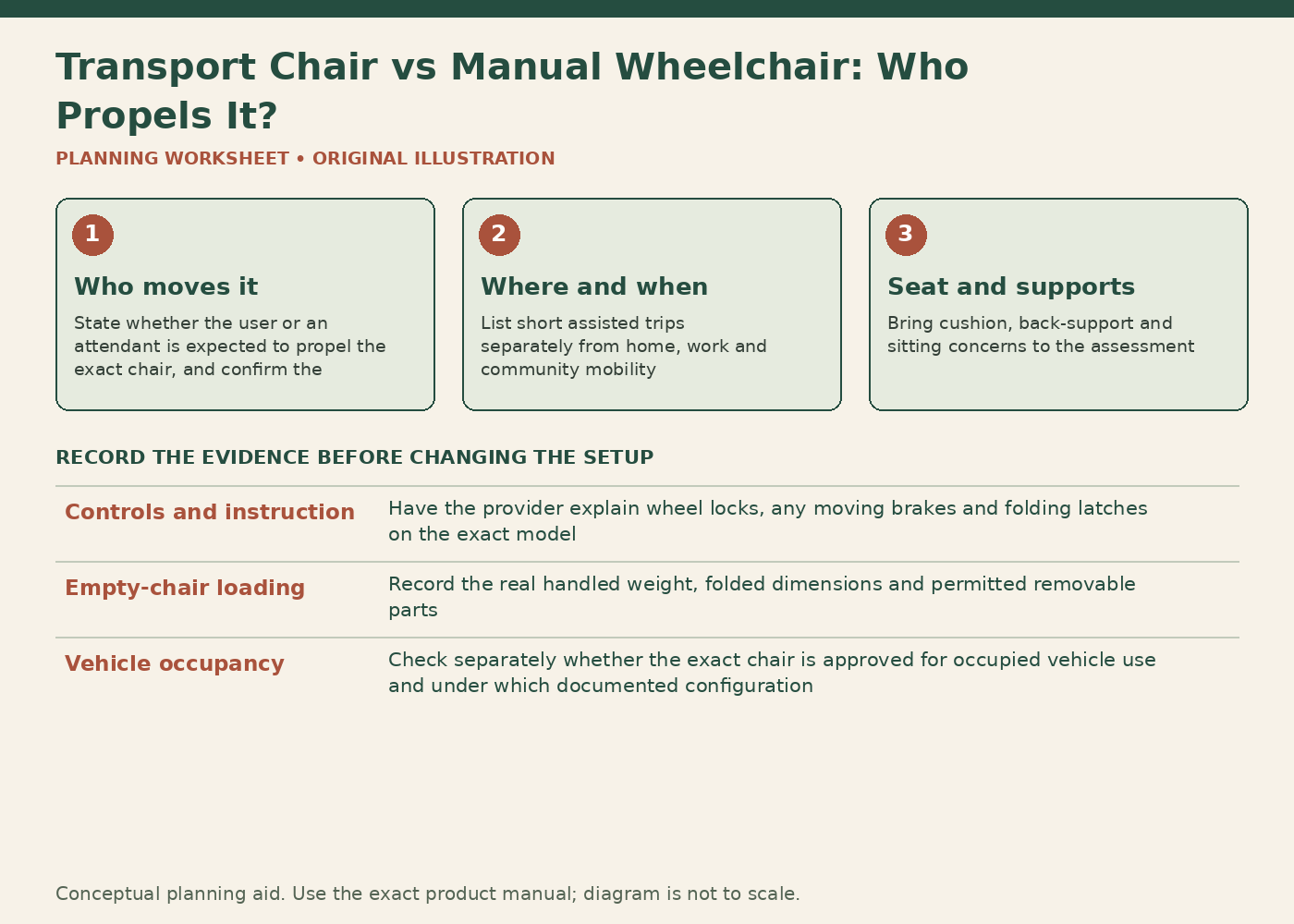
Identify the propulsion method before comparing features
The Medline Ultralight Transport Chair manual states that only a caregiver should operate the covered transport chairs and describes them for short transport between places rather than independent use. That instruction is more useful than a marketplace photograph of small wheels. The exact manual establishes how its product is intended to be used.
Self-propelling manual wheelchairs commonly provide large rear wheels with handrims, but the equipment and user must be assessed together. A user may require assistance for some routes even when they independently propel elsewhere. Do not assume that every person who can move one chair briefly can use it for all daily distances, or that a transport chair allows independent movement because the user can reach a wheel.
Describe the day in terms of tasks
Write down the destinations, distance types, surfaces, time seated and the points where assistance is actually available. Separate a brief trip from a car to an appointment from mobility throughout a workday or home routine. Identify the user’s priorities, including control over timing and direction, rather than framing the decision entirely around the person loading the vehicle.
A transport chair can be convenient for a planned assisted outing but leaves a practical gap if the attendant steps away and the user needs to move. A self-propelling chair may address that goal only when its configuration and the person’s abilities support it. Take those tasks to a qualified seating and mobility assessment. The outcome can involve different equipment or assistance arrangements; the article is not a prescription for one category.
Keep fit separate from propulsion
NSW Agency for Clinical Innovation’s wheelchair configuration guidance relates chair configuration to individual support, comfort, transfer technique and function. A transport chair still needs an appropriate seat and support arrangement; attendant propulsion does not make the occupant’s fit irrelevant. Conversely, a seat width that looks suitable on a catalog cannot establish the correct cushion, back support or overall configuration.
Ask the assessing team what seating supports are needed, how long the equipment will be used at a time and which adjustments are available on the proposed model. Do not add a random thick cushion to solve discomfort without checking the resulting height and support relationships. Bring an existing prescribed cushion or support to the appointment and explain any difficulty experienced with the current chair.
Distinguish wheel locks from moving control
Look at the actual controls and read their purpose in the manual. A lever beside a rear wheel may be a parking wheel lock; an attendant hand control on another chair may have a different braking role. Do not infer that either can be used to slow a moving chair. Ask the provider to demonstrate the covered functions on the exact model and explain the limitations.
The Medline example includes specific wheel-lock instructions and warnings. Those directions are for the listed products and do not authorize a general transfer method or route technique for every chair. A person’s transfers require assessment and instruction suited to them. Do not use an article to improvise curb negotiation, stairs or slope handling. If the intended route exceeds the product’s instructions or the available assistance, change the plan before the trip.
Compare handling with the chair empty
Record the assembled and folded dimensions, the weight in the configuration actually handled and which components may be removed under the manual. A small package can still be difficult to grip or lift into a deep trunk. A manual wheelchair with quick-release wheels may separate into different parts, while another model may fold with its wheels attached. Measure the actual required handling task.
Arrange an empty-chair demonstration with the supplier and the vehicle where practical. Do not fold a chair while it is occupied or lift it by detachable components unless the manufacturer designates them as carrying points. Keep hands clear of folding mechanisms. Avoid promising that a chair is “easy for one person to lift” without knowing the actual user, handler and loading position.
Transportability does not mean occupied vehicle approval
The word transport in a chair’s name describes its mobility role and does not automatically authorize sitting in it inside a moving vehicle. The researched Medline manual says the covered chair is not approved for that use. Other wheelchairs may have specific transit configurations, but those require exact manufacturer documentation and appropriate vehicle and occupant-restraint arrangements.
Ask the provider to distinguish transporting an empty chair from transporting its seated user. Do not attach a vehicle restraint to an arbitrary tube or assume an ordinary positioning belt is a crash restraint. Arrange the person’s vehicle travel with the relevant trained professionals and transport provider. This question should be settled before choosing a chair for recurring journeys, rather than discovered when the vehicle arrives.
Evaluate the attendant’s part of the plan
For an attendant-propelled chair, identify who will assist, when they are available and whether they can use the equipment on the intended route. They need the model’s operating instructions and appropriate training, not only the ability to unfold it. Include doors, crowded areas, uneven surfaces and waiting arrangements in the conversation without using those obstacles as a home skills course.
If assistance changes from one caregiver to another, provide a clear handoff: product identity, current support arrangement, permitted controls, maintenance concerns and the planned route. Do not leave a user in a transport chair with no way to request help or change position as assessed. Convenience for the attendant is a legitimate practical concern, but it should be considered alongside the user’s participation and autonomy.
Consider the equipment process, not a one-click category choice
Permobil’s Wheelchair Handbook presents equipment selection as a process involving the user’s routines and assessment team. Bring the task list, current equipment, route information and transport questions to that process. A supplier can explain model options, while the clinical team assesses individual seating and mobility needs.
Before accepting equipment, request instruction, a written configuration record and the relevant service contact. Ask how changes in function, assistance or the environment will be reviewed. A transport chair can remain useful for a particular assisted task without being the answer to every mobility goal. A manual wheelchair likewise needs appropriate configuration and follow-up rather than being assumed suitable because it has larger wheels.
Propulsion and assistance planning worksheet
| Check | Evidence and decision |
|---|---|
| Who moves it | State whether the user or an attendant is expected to propel the exact chair, and confirm the manual’s permitted method. Do not substitute wheel appearance for its intended-use instructions. |
| Where and when | List short assisted trips separately from home, work and community mobility. Identify periods when the attendant is absent. A convenient outing chair can leave a different daily task unresolved. |
| Seat and supports | Bring cushion, back-support and sitting concerns to the assessment. Ask what the proposed model can accommodate. Propulsion category does not establish an appropriate seating system or time-in-seat plan. |
| Controls and instruction | Have the provider explain wheel locks, any moving brakes and folding latches on the exact model. Obtain the prescribed training for the person’s tasks. Do not learn unfamiliar slopes or transfers from generic internet directions. |
| Empty-chair loading | Record the real handled weight, folded dimensions and permitted removable parts. Assess the vehicle opening and reach. A catalog’s lightest figure may not describe the piece the caregiver actually lifts. |
| Vehicle occupancy | Check separately whether the exact chair is approved for occupied vehicle use and under which documented configuration. A transport label, positioning belt or convenient tie-down-looking tube does not establish approval. |
Worked example
A user independently moves around home in a prescribed manual wheelchair but needs an attendant for a particular crowded appointment route. A family considers a compact transport chair solely because it folds neatly into the car. The useful comparison asks whether the transport chair provides the required support and whether an attendant will remain available throughout that outing. It does not assume the compact chair should replace the person’s independent mobility equipment at home.
In another hypothetical routine, a user will be left at a desk while the attendant parks the car. If they need to move during that interval, the plan has an assistance gap regardless of how smoothly the empty chair folds. The assessment team can consider equipment, timing and assistance together. The worksheet therefore begins with movement and support tasks, then evaluates storage and loading. It does not turn one favorable feature into a complete mobility recommendation.
For recurring outings, also write a service and backup plan. Identify who checks tires or wheels, folding locks, supports and the condition of the seat according to the exact manual. Keep the service contact with the chair information. If a required part breaks on the day of travel, do not substitute a different chair merely because it is available without checking its fit and intended use. A backup arrangement should preserve the assessed support and assistance requirements. That planning can matter more to a successful appointment than a small difference in the folded package.
Sources checked November 6, 2026
Use the current document for the exact model, market and production revision. These sources establish the cited instructions and distinctions; they do not certify an individual chair or replace a personal assessment where one is needed.
- Medline: Ultralight Transport Chair user instructions
- NSW Agency for Clinical Innovation: Wheelchair configuration and individual fit
- Permobil: The Wheelchair Handbook
- Sunrise Medical: Manual wheelchair options and accessories
Something unclear or out of date? Send a correction with this article’s title and the detail to check.
Sources, research & corrections policy ↗