As an Amazon Associate, we earn from qualifying purchases. Read our affiliate disclosure.
For a tall buyer, investigate Ogawa BioVision first for its current explicitly written five-foot-to-six-foot-five recommended range, while resolving the conflicting shorter range on the brand’s general comparison chart. Compare Real Relax PS6500 only after the maker clarifies its ambiguous decimal-foot notation. Human Touch Super Novo 2.0 is a premium fit-trial candidate because its manual provides manual shoulder-height adjustment, but that adjustment chart is not an upper-height guarantee.
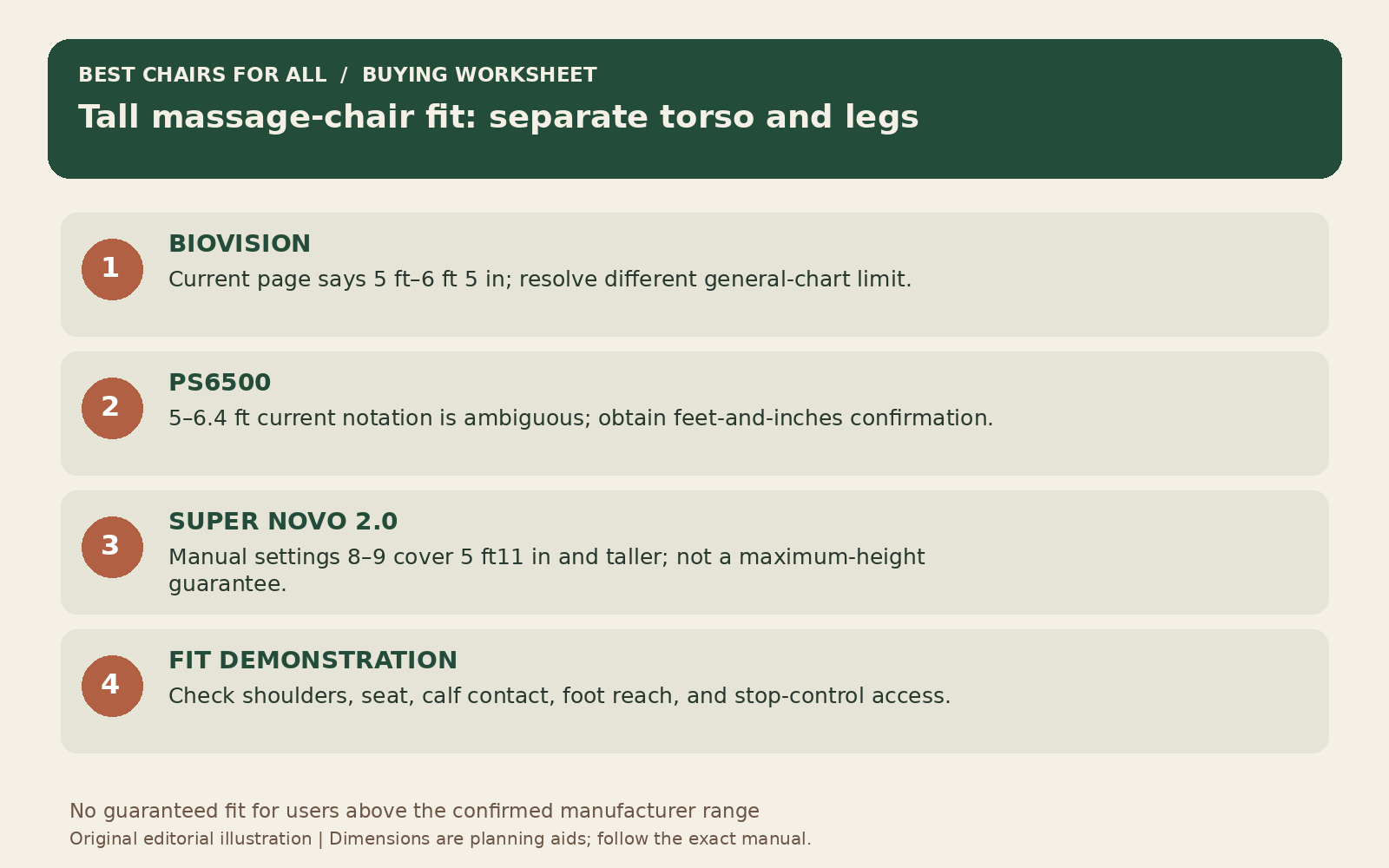
This is a conditional shortlist based on manufacturer research checked November 6, 2026, not a promise that every tall person fits any of these chairs. We did not perform body-fit trials. Tall users vary in torso length, leg length, shoulder width, and foot size, so standing height alone cannot decide the purchase. The most useful outcome is a documented fit demonstration and written confirmation for the exact model delivered.
The evidence, including the conflicts
| Model | Manufacturer fit evidence | Published upright / reclined size | Buying limitation |
|---|---|---|---|
| Ogawa BioVision | Current page: 5 ft–6 ft 5 in; general chart differs | 63 × 31.8 × 49.4 / 74.4 × 31.8 × 40.4 in | Resolve exact-version height range |
| Real Relax PS6500 Brown | Current page: 5–6.4 ft; older official page: 5–6.5 ft | 61.81 × 30.71 × 48.82 / 74.02 × 30.71 × 38.98 in | Decimal notation and revisions need clarification |
| Human Touch Super Novo 2.0 | Manual shoulder settings 8–9 for 5 ft 11 in and taller | 63 × 33 × 46 / 74 × 33 × 32 in | Adjustment guide does not establish maximum height |
BioVision: the clearest current tall-user range, subject to version confirmation
The current BioVision product page gives a recommended height range of five feet to six feet five inches, a 320-pound capacity, 21.3-inch seat width, and 23.2-inch shoulder width. It lists automatic calf adjustment, leg-length detection, and an adjustable foot-and-calf section. Those are relevant features to investigate for a tall user because lower-body fit and upper-body alignment need separate attention.
Its upright dimensions are 63 by 31.8 by 49.4 inches, increasing to 74.4 by 31.8 by 40.4 inches reclined, with a 293.6-pound net weight. The manufacturer listing showed $11,999.99 and in-stock language during research. This is a substantial premium purchase requiring a clear fit and delivery case, not a model to select merely because it appears longest in a feature list.
There is a real evidence conflict: Ogawa’s general comparison chart gives a shorter upper fit limit for BioVision than the current model page. Ask Ogawa to confirm the exact model revision, written range, maximum footrest extension, and applicable user manual before buying near the upper boundary. We would investigate it first for a six-foot-four or six-foot-five buyer, but only with that confirmation and an actual fit trial. The published range is not proof that a very long-legged user or a broad-shouldered user will fit comfortably.
PS6500: useful dimensions, unresolved height notation
The current PS6500 Brown listing gives a 21.26-inch seat width, 23.62-inch seat depth, 24.41-inch maximum shoulder width with airbags deflated, and a 300-pound maximum recommended weight. Its extending footrest and long SL-track description are relevant to tall-user shopping. However, the stated height range is five to 6.4 feet, which is not the same thing as an unambiguous six-feet-four-inches notation.
The older official specification page uses five to 6.5 feet and also lists different weights from the current product page. We would not resolve this by choosing whichever maximum looks more generous. Obtain the current written fit range in feet-and-inches, the exact model identifier, and the applicable manual. A decimal-foot conversion may be mathematically straightforward, but it cannot tell you what the seller intended when entering the specification.
The current chair is 61.81 by 30.71 by 48.82 inches upright and 74.02 by 30.71 by 38.98 reclined, with a 205-pound net weight and observed $2,599.99 base price. It is a useful lower-priced conditional comparison for a tall user once the range is clarified. It is a poor purchase to make sight unseen at the boundary on the assumption that a long seat or deep shell guarantees roller reach. Shoulder airbags deflated also describes a maximum measurement, not the usable space under compression.
Super Novo 2.0: manual shoulder adjustment is worth testing
The Super Novo 2.0 manufacturer manual gives shoulder settings eight to nine for users five feet eleven inches and taller. That is useful operational information because a body scan may need checking or manual correction. It is not an invitation to assume unlimited upper-height accommodation: the highest category on a controller chart does not state the product’s maximum height or maximum leg length.
The current product page lists a 20-inch-wide, 18-inch-deep, 21-inch-high seat and 285-pound maximum load. The chair measures 63 by 33 by 46 inches upright and 74 by 33 by 32 inches reclined, with a 313-pound net weight and two inches of rear clearance. The current base price was $10,999 with a purchase option. Its S-and-L-track design and extending leg section make it worth trying where the premium budget is realistic.
Choose it for further investigation when you can test the shoulder adjustment, leg section, and foot contact with your own proportions. Pass if a seller offers only an unsupported statement that all tall people fit or refuses to clarify the exact limits. Do not borrow a six-foot-nine range from an unrelated dealer chart without confirming it directly for the offered 2.0 generation. At this price, uncertainty about the most important fit dimension should be resolved before the order, not after a freight delivery.
A tall-user measurement card
Record standing height without shoes, body weight, approximate seated shoulder height on a firm chair, comfortable seat depth, shoulder breadth, and usual shoe size. These numbers are discussion aids for the manufacturer, not a home formula that proves fit. Ask the seller which measurements its stated range actually controls and whether the minimum and maximum refer to roller coverage, footrest reach, or overall seating.
Two adults can both stand six feet four inches tall and still need different chairs. One may have a long torso and shorter legs, requiring more upper roller travel without unusually long footrest extension. Another may have long legs and a shorter torso, needing greater lower-body reach while using a more ordinary shoulder position. A chart based only on standing height cannot distinguish them. This is why a tall-user recommendation should include a fit demonstration rather than simply favor the longest track advertised.
Record your personal must-pass items before the demonstration. Examples include shoulders aligning inside the intended support, calf contact occurring at the correct designed zone, feet reaching the foot section without bent or forced posture, and the remote remaining reachable. Do not compensate for a mismatch by sitting on improvised cushions or removing structural padding. Ask the maker whether an adjustment is approved rather than trying to trick the body scan.
The five-stage showroom fit protocol
Begin upright with the chair in its instructed starting state. Check whether the back and head rest naturally without sliding the hips forward to create more legroom. Confirm the seat width and arm channels allow the intended resting position, including when air compression operates at a mild approved setting. A published shoulder width with airbags deflated is not enough to establish comfortable inflated clearance.
Next run the model’s body-positioning process and verify where it identifies the shoulders. If the manual permits a correction, use it and check whether the rollers follow the intended upper-back area. Stop if rollers reach an inappropriate place or the chair feels uncomfortable. More intense pressure cannot correct a roller that is misaligned with the body.
Then test the lower section through the approved range while keeping hands and loose objects clear. Confirm the footrest reaches without forcing the knees or ankles into a position that feels wrong. Ask whether leg extension is automatic, spring-loaded, or manually set and how the user is supposed to hold it. Do not infer the operation from another chair with a similar appearance.
Finally, recline and return upright using the intended controls, then practise stopping the program. Height can change how easily an adult reaches a fixed armrest control or corded remote. Repeat the test after resetting the chair rather than relying on the configuration left by a previous customer. If the chair will be shared, test the shortest intended user too; solving the tallest person’s fit should not silently exclude everyone else.
Do not confuse tall fit with heavy-duty capacity
The published maximum loads here range from 285 to 320 pounds. A tall person can exceed or remain well below those limits; they are a separate requirement from roller reach and footrest travel. Likewise, a broader seat is not automatically a longer backrest. Verify each dimension independently and do not treat a higher load rating as proof of extra shoulder or leg space.
BioVision’s 21.3-inch seat width, PS6500’s 21.26-inch seat width, and Super Novo’s 20-inch width are useful starting data. They do not account for every contour, side bolster, or airbag movement. If your body is close to a measurement or capacity boundary, obtain a direct answer and try the actual chair rather than accepting a generic reassurance. A fit problem cannot be cured by a warranty extension.
Buying near a specification boundary
Ask the seller to write the exact model, current fit range, observed settings in the demonstration, delivery terms, and oversized-return conditions on the quotation. If the demonstration chair differs from the offered revision, repeat the verification for the actual order. Keep photographs of its model label and your written specification answers. This creates an identifiable purchase record instead of a vague promise that the chair is for tall people.
If you are above the maker’s confirmed maximum, do not assume an extra inch is harmless. Find a model with documented suitability or reconsider the purchase. We did not verify a universally suitable chair for users above six feet five inches in the current primary-source evidence used here. This is a research limitation, not a claim that no such product exists.
Follow the exact manual’s safety and health restrictions. These products are relaxation furniture, and tall stature does not establish that pressure or heat is medically appropriate. Keep the full moving area clear, learn the stop control, and stop use on discomfort or abnormal operation. Check the current recall database by exact model and register the product.
Which chair should a tall buyer investigate first?
Start with BioVision’s current clearly written range, resolving its conflict with the general chart. Treat PS6500 as conditional until the maker clarifies its notation and revision. Consider Super Novo 2.0 for a fit demonstration with manual shoulder adjustment, without mistaking its controller chart for an upper-height specification. Recheck the CPSC recall database, current stock, and complete quote before paying. A documented match to your torso and legs matters more than a tall-user badge.
Something unclear or out of date? Send a correction with this article’s title and the detail to check.
Sources, research & corrections policy ↗