A waterfall seat edge is a rounded or downward-curving front edge on a chair seat. Its purpose is to make the transition beneath the thighs less abrupt than a square front lip. The term describes shape; it does not tell you whether the edge is soft, flexible, correctly positioned, or comfortable for your legs. Inspect the occupied seat and its construction rather than accepting the label as proof of a pressure-free fit.
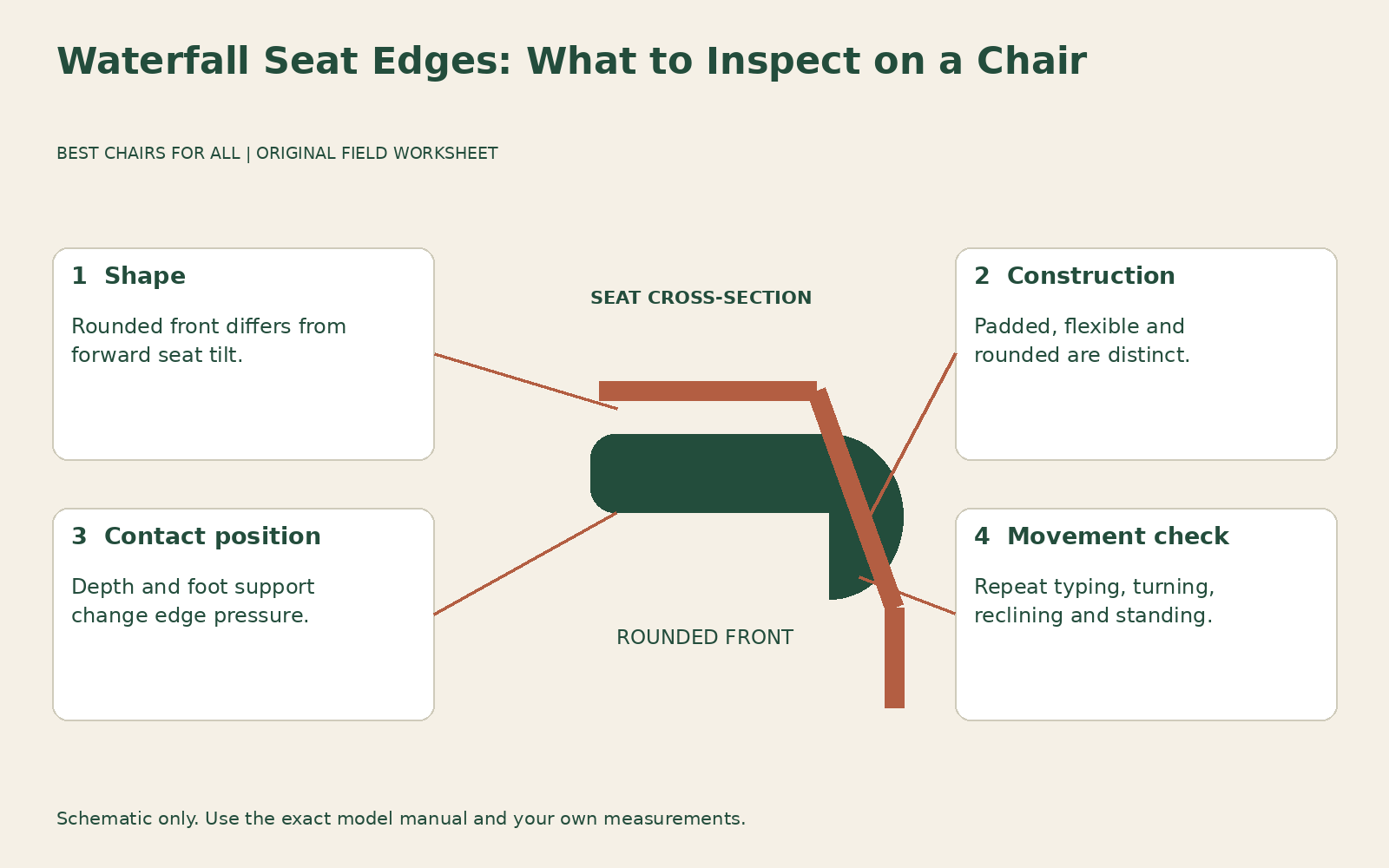
This guide uses an edge-contact diagnosis: identify where the seat meets the thighs, separate shape from height and depth, and compare the edge during normal movement. It is especially useful if a chair advertised with a waterfall edge still feels uncomfortable near the knees. The result should be a specific explanation of the contact problem, not a search for a larger or more dramatic curve.
Look at the side profile first
From the side, identify whether the front transitions downward in a gentle curve, forms a rounded roll, or remains nearly square beneath a covering. A padded rounded edge, a molded shell, and a mesh seat with a surrounding frame may all present different contact surfaces. The top fabric can make them look similar in a photograph, so inspect the underlying form without dismantling the chair.
OSHA computer workstation chairs includes a rounded waterfall edge among seat design considerations and separately discusses suitable height and depth. That separation is essential. The curve is one part of a seat design, while the position of your legs relative to it determines whether you experience unwanted contact. A rounded edge cannot make a seat of any length or height fit every person.
Do not confuse a downward front curve with forward seat tilt. A waterfall edge can be part of a level seat, while a forward-tilted seat changes the angle of a larger sitting surface. A product can have either feature, both, or neither. Ask the seller to identify the shape and any movement separately so your trial tests the feature you actually care about.
Distinguish rounded, padded and flexible
Rounded describes geometry. Padded describes a layer or cushion at the contact area. Flexible describes movement under load. A chair can combine them, but one does not establish the others. A thick rolled cushion may compress into a firm edge beneath it, while a thin-looking front may flex usefully as your legs move. Visual bulk alone cannot predict the occupied feel.
For a concrete manufacturer example, Steelcase Leap flexible seat-edge description describes flexible edges on Leap’s seat. That is a separate feature from merely calling a front edge waterfall-shaped. Do not assume the same flexing behavior exists on another chair or that every component on a related generation moves identically. Use the exact model instructions and product description to establish what is intended.
At a showroom, apply only ordinary contact and movement. Sit normally, change leg position, and notice whether the edge yields smoothly. Do not bend the seat by hand beyond normal use or test its strength by standing on the front. If the front appears cracked, detached, or asymmetrical in an unexpected way, ask for service assessment rather than deciding that it is supposed to flex.
Locate the contact while seated back
Set the chair to a useful working height and sit against the backrest. Check where the front edge ends relative to the backs of your knees. You need useful thigh support and comfortable clearance, without moving forward to escape the seat. A side observer can help identify the contact location without you changing posture to inspect it.
If the seat is too deep, the curved portion can still reach an unwanted area. Shorten the depth within its approved range if possible and repeat the check. If there is no suitable setting, record a depth limitation. Adding a larger waterfall curve at the same location would not necessarily address the fact that the entire sitting surface extends too far forward for you.
CCOHS office chair adjustment includes both front-edge shape and knee-area clearance in its chair adjustment guidance. For this diagnosis, treat clearance as an occupied relationship rather than an instruction to maintain a universal gap measured from a photograph. Cushion compression, backrest projection, clothing, and leg proportions can change where the usable front edge meets the body.
Check height and foot support independently
A seat set too high can make the front contact feel more forceful because the feet do not provide the intended support. Lowering the seat may help if the work surface permits it. At a fixed high desk, an appropriate stable footrest may complete the arrangement instead. Compare the entire workstation rather than lowering the chair until the knees feel clear while the arms reach upward.
Write down whether both soles are comfortably supported and whether you are pushing through the feet to remain in position. Bracing can obscure the edge problem by changing your contact with the seat. A footrest placed too far forward may also encourage you to straighten the legs or slide. Move only one variable at a time and repeat the same ordinary task.
Do not use a footrest to hide an excessively deep seat without checking back contact. Raising the feet can alter the thigh relationship, but it does not shorten the pan or guarantee access to lumbar support. If every improvement at the edge creates a new problem at the desk or backrest, the chair may have reached its fitting limits.
Compare three edge constructions fairly
A foam-upholstered seat can have a rounded front created by cushion shape over a firmer support. Inspect the occupied contact and ask whether the foam or complete seat assembly is replaceable. A smooth new cover cannot tell you whether a used cushion has lost support. Feel and visible condition should be recorded separately from the shape named in the listing.
A molded or flexible-shell seat may rely more on its structure and contour. Ask whether the front is intended to move and how the manufacturer describes that feature. Do not add thick padding automatically; an accessory can change occupied height, usable depth, and the way the front flexes. Test the intended design before layering another surface over it.
A suspended or mesh seat can have a rounded perimeter with a firmer frame beneath or around the textile. Check whether your thighs contact the intended sitting surface or a surrounding edge at the useful depth and height. Avoid a universal claim that mesh edges are hard or upholstered edges are soft. The construction and occupied fit of the specific chair determine the relevant result.
Use an edge-contact worksheet
Draw a side view of the seat and mark the contact region in words: broad thigh contact, narrow front pressure, knee-area contact, or no intrusive contact. Create columns for seat height, foot support, depth, angle, and observed result. Include any cushion and the task. A sketch can communicate the problem more clearly than saying the seat feels wrong.
Start with the ordinary working configuration. If knee-area contact occurs, check depth first. If the feet are unsupported, resolve height or foot support before judging the material. If the geometry works but a narrow hard area remains, investigate the edge construction or condition. Keep these branches distinct so you do not blame foam firmness for an unresolved workstation relationship.
An illustrative record could read: “Seat at keyboard height, feet unsupported, broad front pressure. Added suitable foot support without changing depth: pressure reduced but knee contact remains. Shortened seat one approved setting: back contact retained and knee area clear.” That result identifies two contributing relationships. It does not prove that a particular edge shape improves circulation or treats a symptom.
Check the edge during real movement
After resolving the still position, move between typing, using the mouse, reading, and standing. Notice whether one thigh presses into the front when you turn or whether a recline raises the edge beneath the legs. The entire mechanism affects the contact relationship. A comfortable static seat can behave differently when the seat and back move together or by different amounts.
If the chair offers forward tilt, compare that separately with the ordinary seat position. Keep feet supported and use the exact controls. Do not assume a decline reduces every front-edge sensation; it may change sliding or contact in another way. Record the result for the task instead of treating forward angle and waterfall shape as a combined guaranteed benefit.
For frequent leg position changes, test the range you actually use within the chair’s instructions. A seat that fits only with feet in one precise place may offer too little practical flexibility. You do not need to maintain one rigid pose to prove the edge works. Conversely, unusual positions outside the intended use cannot establish whether the normal design is suitable.
Separate a design mismatch from damage
Look for split seams, exposed support material, persistent flattening, detached trim, or a front section that moves unlike the manufacturer description. A used chair can retain its original waterfall silhouette while its cushion or attachment has changed. Ask for a service opinion where condition is uncertain. Do not cut the cover, remove structural elements, or glue the edge into a different shape.
If the chair is new and all reasonable normal settings still leave intrusive contact, document the exact position and consider a different seat shape or size during the return period. A waterfall claim does not obligate you to find it comfortable. If pain, numbness, or persistent symptoms occur, stop the trial and seek appropriate professional advice rather than continuing to adjust through them.
The useful purchase note is specific: rounded shape verified, occupied depth suitable, feet supported, and no intrusive edge contact during the important tasks. Or it identifies the precise failed relationship. That is a stronger basis for choosing a chair than selecting the most pronounced downward curve or assuming a familiar term guarantees the whole seat will fit.
Something unclear or out of date? Send a correction with this article’s title and the detail to check.
Sources, research & corrections policy ↗