A recliner integrates a moving back and usually a leg support into one piece of furniture. An accent chair with a separate ottoman lets you position the leg support independently, but it creates a second object to place and move. Compare the two by drawing the room in use, checking seated support, and trying the routine of sitting down, raising the legs, and leaving the seat.
Neither arrangement is automatically smaller, easier to use, or more supportive. A separate ottoman can be flexible in an open room and awkward in a narrow route. A recliner can keep the leg support attached while occupying substantial space when extended. The useful choice depends on the specific products and daily tasks, not on a style label.
Separate an accent chair from a separate-ottoman recliner
An accent chair may have a fixed back, a flexible frame, a swivel base, or a reclining back. Adding an ottoman does not change those functions. Conversely, some reclining chairs are designed around a separate matching footstool rather than an integrated legrest. These are distinct arrangements, even though room photographs can make them look similar.
La-Z-Boy’s recliner guide distinguishes several integrated recliner types. IKEA’s POÄNG buying guide shows a chair family with separate matching ottoman choices. Use each manufacturer’s descriptions to identify what moves, what remains fixed, and which components are intended to be used together.
Begin with the seated task
Write down the main activity: upright conversation, reading, television, or occasional leg support. A fixed-back accent chair may suit an upright activity without providing the reclining adjustment you expect for resting. A recliner may offer that adjustment but position the head differently relative to a screen or book. Try the activity rather than judging the chair while standing beside it.
Use the same ordinary sitting posture and footwear for both arrangements. Note back contact, arm support, floor contact, and how the legs rest. Do not infer clinical benefit from a more reclined appearance or a higher foot position. If a health condition or care plan affects positioning, obtain individual advice and bring those requirements to the product assessment.
Draw the occupied layout, not just stored furniture
For the recliner, mark upright size, full recline, required rear gap, and any rocking or swivel range. For the chair-and-ottoman arrangement, mark the chair, the ottoman in its actual use position, and the space between them. A product page showing the ottoman tucked close to the chair may not represent where your legs comfortably rest.
Add the table, lamp, doorway, and normal walking routes to both drawings. Compare the occupied arrangements at the time they matter, such as when another person needs to cross the room. Do not credit the ottoman with storage flexibility unless there is a realistic place to put it when unused. Likewise, do not assume the recliner will always remain closed.
Use a worked length comparison
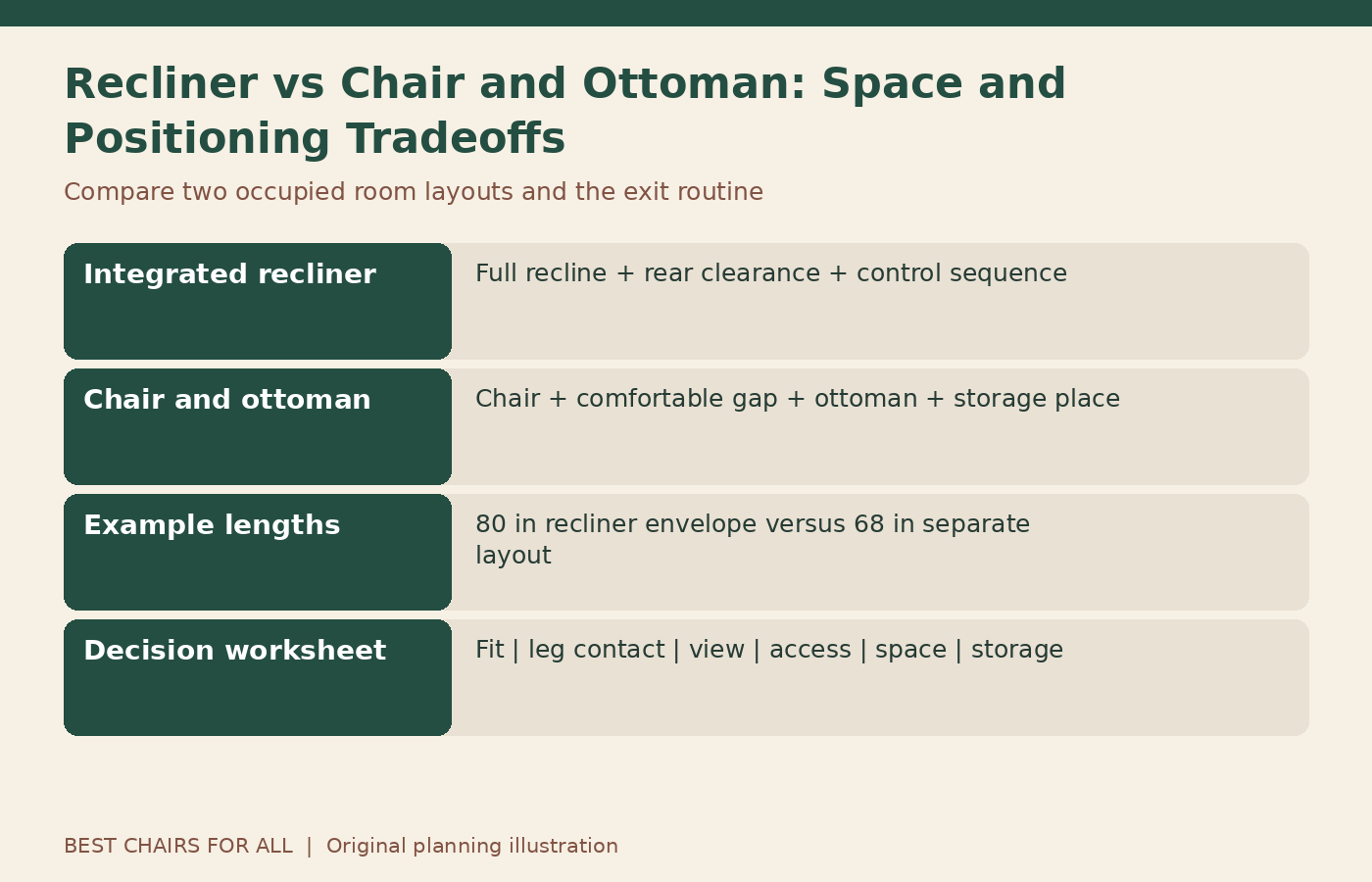
Imagine a recliner requires a confirmed 12-inch rear gap and measures 68 inches from back to footrest tip when fully reclined. If those reference points align, its occupied wall-to-front depth is 80 inches. A hypothetical chair-and-ottoman setup has a chair projecting 36 inches from its rear reference, a 10-inch use gap, and a 22-inch-deep ottoman, totaling 68 inches before any required rear clearance.
The second arrangement appears shorter in this invented example, but it may use more width or place the ottoman across a walking route. Actual user comfort may require a different gap. The calculation is therefore a comparison method, not proof that separate ottomans save twelve inches. Obtain real dimensions and test the occupied spacing before making that conclusion.
Check ottoman height, angle, and distance together
A separate ottoman’s usefulness depends on more than its top height. The cushion compresses, the surface may slope, and the chair’s seat angle changes the relationship to the legs. Move the ottoman only in ways the manufacturer allows and find a comfortable supported position without dragging it while seated. Record the distance and orientation that work.
The IKEA POÄNG ottoman page provides its own dimensions and intended relationship to the matching chair. That is useful product evidence, not a universal height formula for other combinations. A visually matching storage ottoman may have a very different surface and use specification from a purpose-designed footstool.
Compare the leg-support contact pattern
An integrated recliner may use a continuous chaise pad or a smaller footrest. A separate ottoman may support a different part of the lower legs depending on its position. Ask the manufacturer where the calves and heels are intended to rest, and compare that with what you experience. Visible heel overhang is not automatically a problem; the model’s intended support pattern matters.
Record broad contact, a gap, or an intrusive edge rather than deciding that the longest upholstered surface must be best. If one arrangement requires sliding forward or losing back support to reach the leg support, note that as a fit issue. Do not use a separate ottoman to disguise an unsuitable chair depth or height without checking the full seated arrangement.
Test the complete sit-and-leave routine
For a recliner, try the permitted control sequence and return to the normal upright, closed position. For a chair with ottoman, consider how you place your legs on it and then move them back to the floor. The ottoman’s location should not trap the route you need to stand or leave. Do not assume that a lighter piece is easy for every user to reposition.
If mobility or balance affects the routine, seek individual assessment rather than labeling one arrangement universally accessible. Include the actual helper or walking aid where relevant. A separate ottoman may require another person to move it; a power recliner may require dependable controls and a plan for outages. Those are concrete household tasks to test and document.
Compare moving parts and service needs
A fixed accent chair and simple ottoman may have fewer motion components, while a recliner includes a mechanism and possibly motors and controls. A separate-ottoman recliner can still have an adjustable back or moving footstool top. Read the manuals before treating any arrangement as mechanically simple or maintenance-free. Intended-use restrictions apply to each piece.
Ask who handles service and which components have distinct warranty terms. A chair-and-ottoman set may have different upholstery or structural coverage from a powered recliner. Do not assume a footstool is suitable as a seat or step; use it only as its manufacturer permits. The ability to move an object around the room does not establish another approved purpose.
Consider the ottoman’s stored position honestly
Choose a specific unused location and measure it. If the ottoman will live beside a sofa, check whether it blocks a cupboard, radiator, or route. If it is supposed to slide under a table, verify actual height and clearance rather than relying on a promotional photograph. An unused corner may be occupied by a pet bed, basket, or door swing in everyday life.
Also consider who moves it and how often. A plan that requires lifting a bulky upholstered piece twice a day may become inconvenient, while a small footstool with an approved handling arrangement may be easy. Record the actual routine and avoid assuming that every household member can perform it comfortably. Storage flexibility is valuable only when it can be used in practice.
Include electrical supply where relevant
A manual accent chair and ottoman may avoid furniture power cords, but some chairs include powered recline, charging, or integrated heat. A powered recliner needs its approved outlet, transformer, and cable route. Compare the systems actually under consideration rather than assuming all accent chairs are unpowered or every recliner needs electricity.
For a floating room layout, ask about approved battery options and charging arrangements for any powered candidate. Do not use an extension cord or generic battery merely to preserve the preferred placement. The electrical instructions may change the room plan. Keep cable routes separate from ottoman movement and normal footpaths so repositioning the leg support cannot pull or crush a lead.
A decision worksheet for two layouts
Make six rows: seated fit, leg contact, activity view, approach and exit, occupied floor space, and stored arrangement. For each candidate, write one observation and one unresolved question. Example observations might be ottoman requires a wider gap than expected or recliner’s headrest works for reading but changes television view. Avoid a single total score that hides a failed access requirement.
Then identify the decisive tradeoff in one sentence. A hypothetical household might choose the recliner because no ottoman storage position exists. Another might choose a fixed chair and matching footstool because the occupied route stays clear and the user prefers independent leg-support placement. Neither conclusion needs a claim that one category is inherently superior.
Check delivery and assembly for both pieces
A two-piece arrangement can be easier to route into a room, but that is a possibility to verify. Obtain the largest component and carton dimensions, not just the assembled footprints. Measure doors, turns, stairs, and elevator openings. Ask whether assembly is included and whether any chair back is designed to be removed by the delivery team.
Do not plan to dismantle a powered mechanism to solve access. For a chair-and-ottoman set, confirm that all cushions and frames in the quote are the intended matching versions. A similar-looking footstool from another collection may differ in height, angle, or care requirements. Keep the product codes on the comparison worksheet and final order.
Make the choice reviewable after delivery
Save the two room sketches, seated observations, use spacing, and exact product identifiers. At delivery, check the assembled arrangement against the documented plan before arranging accessories around it. If the ottoman needs a different comfortable position, reassess the walking route rather than forcing it into the earlier tape outline. If a recliner needs more operating space than expected, contact the retailer.
The final choice should support the intended activity and the whole sit-to-leave routine while fitting the room in use. A recliner offers integrated movement; a chair and ottoman offers independent placement. The better arrangement is the specific one whose fit, operating space, access, and maintenance routine you have actually confirmed.
Something unclear or out of date? Send a correction with this article’s title and the detail to check.
Sources, research & corrections policy ↗