The right director-chair height places the client's face within a usable working zone for the makeup artist while allowing the client to sit, remain supported, and leave the chair through its intended access method. Seat height is the key product dimension, but it is not enough on its own. Client torso proportions, artist footwear, reach, lighting, and foot support all affect the result.
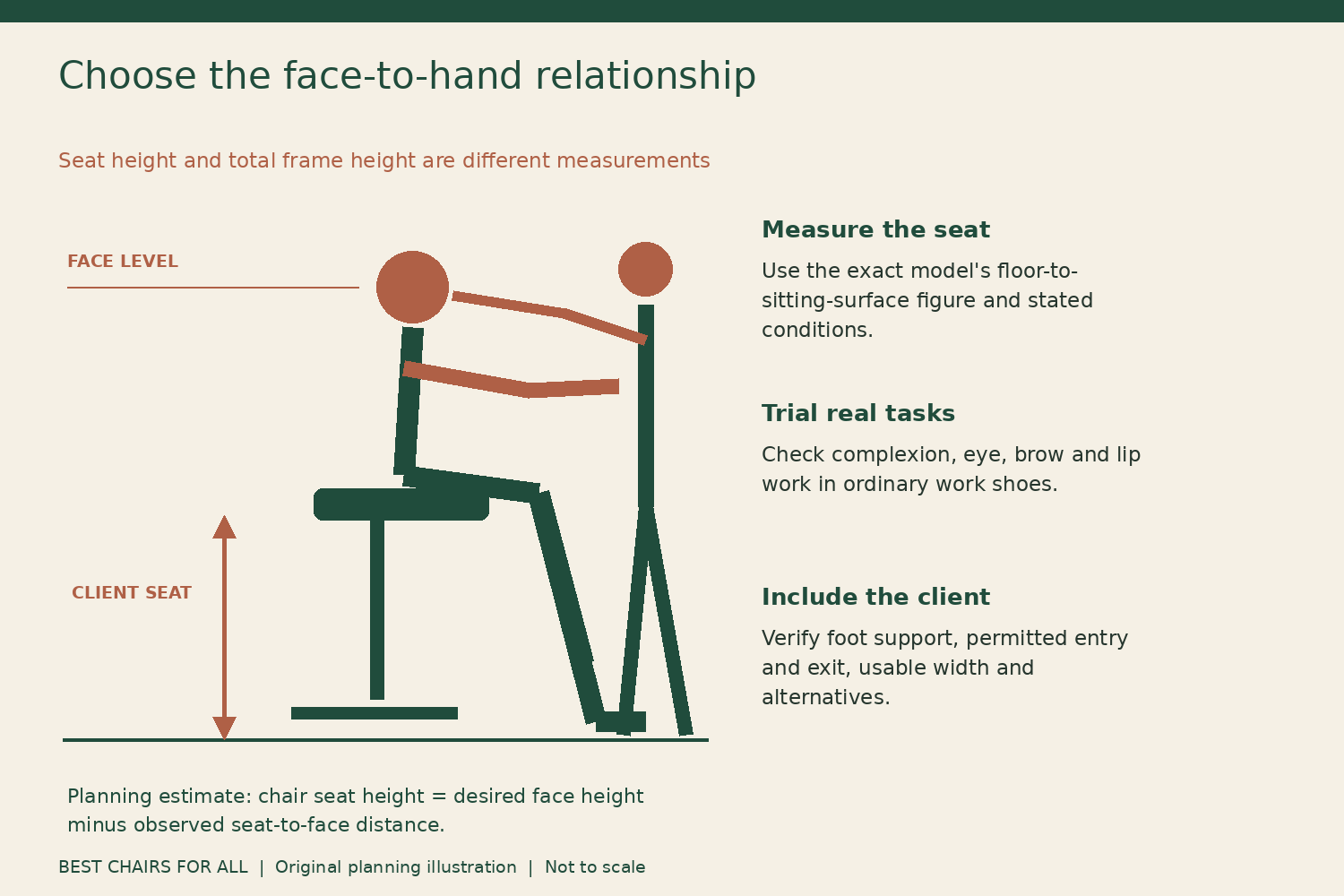
Many portable director-style chairs have a fixed seat height. That makes a practical demonstration especially valuable: you cannot assume an adjustment lever will solve a mismatch later. Compare the complete chair's sitting height, frame and support arrangement, permitted use, and carrying dimensions before choosing it for studio or mobile appointments.
Read seat height separately from total height
Seat height runs from the floor to the sitting surface under the manufacturer's stated measurement conditions. Overall height usually reaches the top of the backrest. A listing that simply says a chair is 110 cm tall may be describing the whole frame, not where the client sits. Ask for clarification rather than ordering from an unlabeled number.
For example, the Gold Medal Contemporary 30-inch seat specifications and care describes a 30-inch seat height in use and separately states its intended settings and care limitations. The Telami Makeup director-chair seat and overall dimensions lists a 76 cm seat height and 118 cm total height. Those are similar sitting heights expressed in different units, but their overall dimensions do not establish identical fit or access.
Crown Brush Australia's Crown Brush DC103 seat height and dimensions lists its DC103 at 740 mm seat height and 1080 mm total height. These manufacturer or brand specifications illustrate the distinction clearly. They are documented examples, not hands-on recommendations or proof that one height works for all makeup artists and clients.
Plan around face position
A client's face height depends on the seat plus the vertical distance from that seat to the part of the face being worked on. Two people of similar standing height can have different seated torso proportions. The same fixed chair can therefore place their eyes and lips at noticeably different heights.
Think in terms of a usable zone rather than one perfect line. Complexion work, brows, eye detail, and lips require slightly different hand positions. The artist also changes side and distance. A chair that places one client's eyes conveniently may still make lip work awkward if the surrounding setup blocks closer approach.
Use willing adults in an ordinary, non-procedural fitting demonstration where appropriate, or a suitable training arrangement. Do not ask anyone to sit on an improvised elevated surface to simulate a taller chair. Measurement can shortlist heights, but the final demonstration should use suitable seating assembled and operated as intended.
A simple planning calculation
Call the desired face-working height F and the observed seat-to-face distance T for the reference position. The approximate required seat height is F minus T. The result is a planning estimate, not a prescription, because the client, posture, seat sag, and task can change the relationship.
Suppose a hypothetical artist finds a comfortable standing hand-work zone around 54 inches above the floor, and a reference client's relevant face point is 24 inches above the occupied seat. The estimate is a 30-inch seat: 54 minus 24. Those example values were chosen to demonstrate the calculation, not to define a recommended height.
If another client's seat-to-face distance is 27 inches, the same 30-inch chair places that point at 57 inches. The artist needs to assess whether the changed relationship remains usable. A fixed-height chair may suit much of the workload while requiring another appropriate seating option for some clients or artists.
Record the artist's real working stance
Wear the shoes normally used for appointments and recreate the ordinary standing position. If the artist sometimes sits or perches for detail work, include that separate position. Do not choose a client chair entirely around standing if much of the actual service happens from another seat.
Notice whether the shoulders rise, the hands reach far forward, or the artist bends repeatedly to see the face. Record what happens during specific tasks rather than simply labeling the chair comfortable or uncomfortable. The problem might be height, horizontal distance, light placement, or an armrest blocking approach.
A tall seat can reduce one kind of bending while creating another reach problem for a shorter artist. A lower seat may make client access easier but place the face below a taller artist's preferred zone. These are practical tradeoffs to test, not evidence that the tallest portable model is automatically the most professional choice.
Client foot support deserves equal attention
Check where the client's feet rest when they are seated normally. A fixed foot bar may not suit every leg length, and a canvas seat can change the sitting position under load. Ask the manufacturer about the intended support and access method, and assess it as part of the complete chair.
Do not assume a footrest is designed as a climbing step. Follow the exact chair's instructions and ask the supplier to demonstrate normal entry and exit. If a client cannot use that method comfortably, discuss suitable alternative equipment or arrangements rather than improvising a ladder-like sequence or physically lifting them into place.
Discuss access preferences privately before mobile appointments when the available chair might be a limitation. Let the client describe the assistance or seating they need. A high director chair is a piece of service equipment, not a universal access solution. Keep another appropriate arrangement available where your business requires it.
A director-chair fitting worksheet
Record the chair model, published seat height, overall height, usable seat width, depth, footrest arrangement, rated capacity, and whether the seat-height measurement is stated in use. Add the source document and date. Keep product mass and folded dimensions in separate fields for transport planning.
For each fitting demonstration, record artist footwear and working position, client reference proportions without identifying personal details, face-working height, hand reach, foot support, and access observations. Add rows for complexion, eyes, brows, and lips. This makes the worksheet specific to the actual service sequence.
Mark the result suitable as demonstrated, unsuitable, or needing another trial. If a seller cannot explain whether a dimension is seat height or total height, leave it unresolved. Do not use another model's measurement because the frames look similar or the product names share the word “tall.”
Fixed height versus adjustable seating
A fixed director chair can be practical when portability, storage, and a known working relationship are priorities. An adjustable salon or service chair may offer a broader range for multiple artists or client proportions, but it brings different weight, footprint, maintenance, and installation considerations. Compare those systems separately rather than expecting them to have identical travel convenience.
If the studio is shared by artists with very different working heights, test each person with the proposed fixed chair. Changing shoes or asking everyone to tolerate the same stance is not a complete fitting strategy. A different approved chair height or an adjustable station may serve the team better.
Do not add homemade risers to a director-chair frame or shorten its legs. Folding geometry and floor contact are part of the complete design. If the manufacturer offers another size, obtain that documented product. If it does not, choose another appropriate system rather than modifying the frame to achieve a measurement.
Mobile work adds a second fit problem
A chair can fit the artist and client while failing the vehicle, stairway, or venue. Measure folded dimensions and carrying weight separately from open dimensions. Include the transport bag and any attached organizer. Check the narrowest part of the actual route, not just whether the chair fits through a standard doorway in theory.
At the venue, confirm a firm suitable setup area, enough room around the open frame, and a clear route for the client. Do not wedge the chair into a corner simply because it unfolds there. The artist still needs access to both sides, lighting, supplies, and normal client entry and exit.
Outdoor or temporary locations need the manufacturer's use and storage guidance. Gold Medal's cited description, for example, specifically limits prolonged outdoor exposure and storage for the named chair. That is a model-specific care condition. Do not assume that a director-style appearance establishes weather resistance or suitability for every event surface.
Light, mirror and organizer placement
After choosing a promising height, position the light and mirror in the demonstration. A low mirror can encourage the client to lean forward or down, changing the face relationship the chair was chosen to create. A light stand can also occupy the artist's approach path or introduce a cable near the frame.
Place frequently used products within a practical reach while respecting the studio's hygiene procedures. An organizer hanging from one side should be used only within the manufacturer's intended arrangement and load conditions. Do not attach heavy bags to a frame simply because a strap fits around it.
Assess the whole setup with the chair occupied normally, without conducting a tip or overload test. If the frame does not open, lock, or sit as the instructions require, remove it from use and contact the supplier. A folded-chair mechanism should not be forced or repaired through improvised parts during an appointment.
Verify what arrives
Check the delivered chair model and components against the order and manual. Confirm that the sitting-height specification refers to the version supplied. A custom back panel, cushion, or replacement canvas can alter the seating experience, so use approved parts and keep the configuration record current.
Learn the unfolding and locking sequence before taking the chair to a client. Rehearse transport and setup in a clear area, and retain the care instructions for the frame and fabric. If the business depends on a specific chair height, do not accept a substitute without reviewing the fitting worksheet again.
The useful director-chair height is the one that supports real makeup tasks for the artist and real sitting and access needs for the client. Measure the sitting surface, estimate the face relationship, and verify the complete working setup. That gives a fixed-height purchase a clear practical basis while keeping its limitations visible.
Sources and specifications checked November 6, 2026. Examples are planning exercises, not product testing.
Something unclear or out of date? Send a correction with this article’s title and the detail to check.
Sources, research & corrections policy ↗