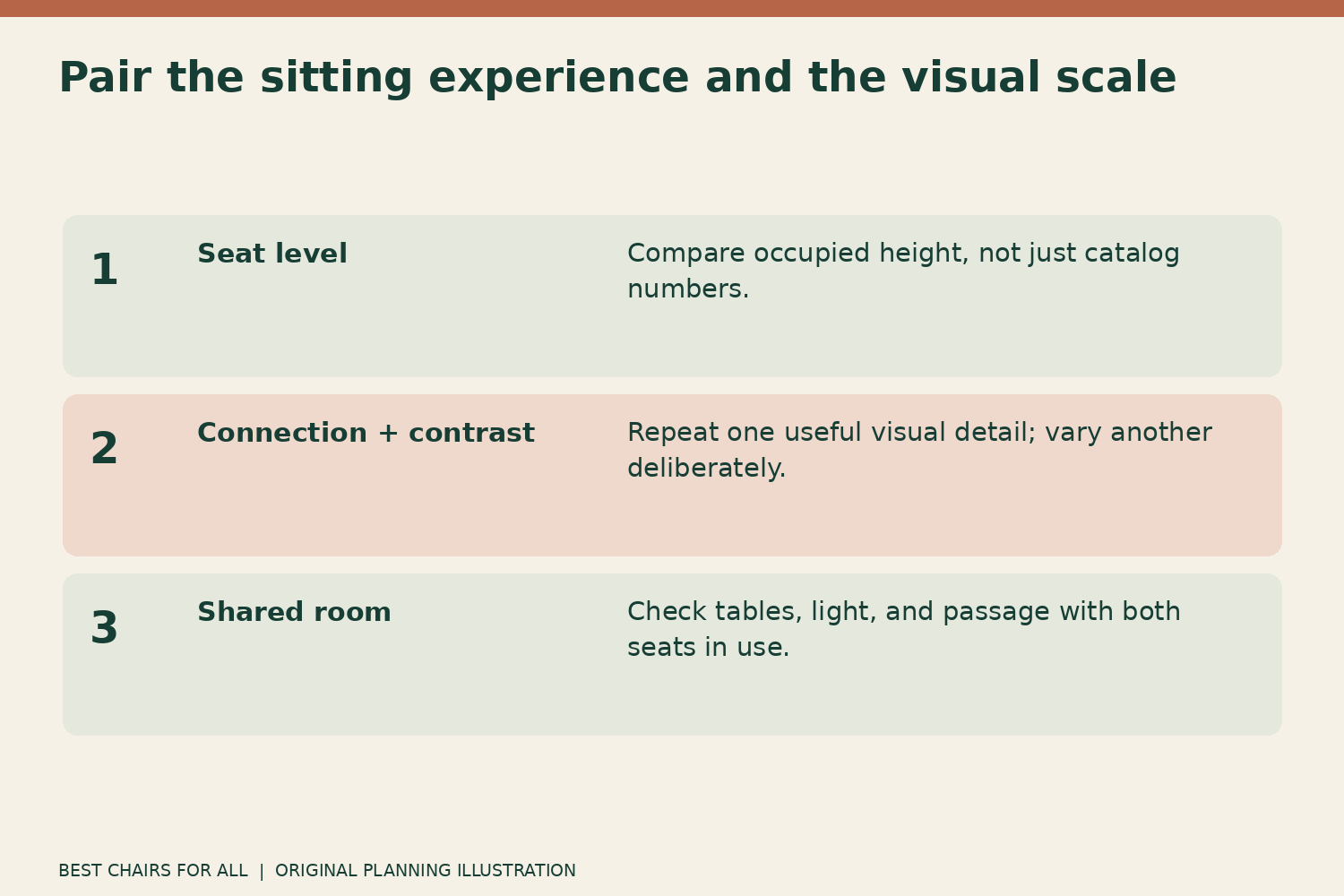
Pair an accent chair with a sofa by checking three relationships: how the people sit together, how the furniture occupies the room, and which visual details connect the pieces. Seat height and usable depth matter before fabric coordination. A chair can contrast beautifully with a sofa yet feel awkward if its user sits much lower, cannot join the conversation comfortably, or has no clear route into the seat.
Start with the sofa you actually own or the exact model you intend to buy. Measure it, sit in it, and record its important features. Then choose a chair that contributes something useful, such as upright reading support, a different texture, or an additional conversation direction. Matching every detail is optional; making the relationship intentional is the goal.
Describe the sofa before shopping for the chair
Record overall width, depth, back height, seat height, usable seat depth, arm height, and cushion construction. Note whether the sofa looks light on visible legs or substantial with a skirt or low solid base. These characteristics explain why a chair feels compatible more reliably than a broad style label such as modern or traditional.
Also describe how the sofa is used. A deep lounging sofa may need a more upright chair for readers who prefer feet down. A formal conversation sofa may work with a relaxed chair that introduces a second posture. The chair does not have to duplicate the sofa’s sitting experience to belong in the same room.
Photograph the sofa straight on and from the room entrance. Include a known measurement in your notes rather than relying on the photograph’s apparent scale. Wide-angle room photographs can make near furniture look larger and distant pieces smaller. Keep the sofa’s actual dimensions beside any chair images you collect.
Compare seat height in the occupied position
Seat height affects how people relate during conversation and how a shared table feels. Measure from the floor to the seat surface at a consistent reference point, then observe the cushion under ordinary use. Two published heights can be close while the occupied positions differ because one cushion compresses more or the seat slopes backward.
For a documented example, IKEA’s MORABO sofa in Gunnared dark gray with metal legs lists an 18½-inch seat height. IKEA’s EKENÄSET armchair in Kilanda light beige lists 17¾ inches. The nominal difference is ¾ inch, but that arithmetic does not prove they feel identical when occupied.
Use the example as a comparison method rather than a recommended pairing. Put the two actual users in the seats if possible and let them talk normally. A small difference may be unremarkable, while a larger one may be a deliberate lounge arrangement. There is no need to force all seats to an identical catalog height when the people prefer otherwise.
Keep depth and cushion softness separate
A chair with the same seat height as the sofa may still encourage a very different posture if its usable depth is shorter. That can be helpful. Someone reading a heavy book may prefer a back they can reach with feet down, while the sofa remains the place for stretching out. Compare the task, not just dimensional similarity.
Room & Board’s accent-chair comfort guide separates cushion comfort, seat depth, and seat height. It also defines depth from the back cushion’s inside face to the front edge. Use this separation when building your own shortlist rather than treating a plush fabric or large outside depth as proof of comfort.
If the chair’s cushion is much firmer than the sofa’s, its nominally lower seat may still hold a person higher after both seats settle. During a trial, record where the shoulders and eyes end up relative to the neighboring person. Those occupied observations are more meaningful than trying to solve the relationship from measurements alone.
Compare visual mass in three dimensions
A chair’s width is only part of its presence. Thick arms, a tall solid back, dark fabric, and a base that hides the floor can make it appear substantial. Visible legs, open sides, and a lower back can make a similarly sized chair look lighter. Compare height, depth, and the amount of visible structure as well as outside width.
Beside a broad low sofa, a tall wingback can create a useful vertical accent rather than a mismatch. It still needs to fit the sightline and the room’s architecture. A tiny low chair may preserve openness yet look incidental beside a large sectional. Mock up back height with cardboard before deciding that the floor footprint alone looks balanced.
West Elm’s accent-chair guidance discusses silhouette, scale, and color as ways a chair contributes to a room, including pairs beside larger seating. Treat these as design possibilities. A pair is not necessary if one well-placed chair meets the seating need and leaves a better circulation route.
Choose a visual connection and a useful contrast
Pick one or two features that make the relationship legible. A chair can repeat a sofa cushion’s muted green, echo the sofa’s rounded arms, or relate to nearby wood furniture. Then allow a different feature to provide contrast, such as a wood frame beside a fully upholstered sofa or a textured chair beside a smooth leather sofa.
This is a planning exercise rather than a rigid decorating formula. Too many matching details can make the chair disappear into a coordinated set, while too many competing features can make the arrangement feel unsettled. Start with one connection and one contrast, then view the pieces with the rug, curtains, tables, and lighting already present.
For a patterned sofa, compare the chair sample with the actual pattern rather than a screen image. A solid chair can repeat one quieter color from the sofa. If both are patterned, vary their scale and check them at room distance. Small swatches held close together can exaggerate a conflict that is barely visible across the room.
Use a sofa-to-chair worksheet
The following original worksheet separates functional fit from decorative coordination. Fill in the sofa column first, then compare each candidate chair against it. Describe the result in plain words. An unexplained score such as eight out of ten does not tell you which issue still needs a measurement or sitting trial.
| Relationship | Sofa record | Chair decision |
|---|---|---|
| Occupied seat level | Height and cushion compression | Comfortable conversation level |
| Preferred posture | Upright, reclining, or deep lounging | Complementary posture that users want |
| Visual mass | Back, arms, base, color | Balance without unnecessary bulk |
| Connection | Existing shape, color, or material | One deliberate repeated feature |
| Contrast | Dominant sofa characteristic | A different useful texture or silhouette |
| Shared surroundings | Table, rug, lamp, circulation | Reach and access from occupied chair |
For a hypothetical example, a deep gray sofa has broad upholstered arms and dark legs. An open oak-framed chair in a muted warm fabric can repeat the wood tone elsewhere in the room while reducing visual upholstery mass. Its functional test remains independent: the reader must still reach the back, rest the feet, and use the arms comfortably.
Position the chair before finalizing upholstery
A chair opposite the sofa creates a direct conversation relationship. A chair at one end can complete an L-shaped group. A diagonal position can connect two directions, but its outside corners may project farther into the room. Tape the chair at its actual angle rather than using an unrotated rectangle.
Keep the route between doorways and the sofa clear when the chair is occupied. The user’s legs and standing movement add to the furniture footprint. A chair that fits beside the sofa arm while empty may block passage once someone sits with feet extended. Test the whole arrangement with ordinary activity.
For a swivel candidate, include the swept path and the place it faces during each task. A chair can look coordinated while parked toward the sofa but turn its back to the group during television viewing. That may suit the room; the point is to evaluate the orientations you will actually use.
Check the table relationship from both seats
A coffee table chosen for the sofa may be too far from a shallow chair or awkwardly high beside a low lounge seat. Rehearse putting down a book from each position. If reaching requires leaning far forward, consider a small side table rather than pulling the chair into a position that crowds the group.
Arm height matters for a table placed between sofa and chair. A surface that tucks beneath one arm may be blocked by the other. Measure the tabletop and any projecting edge, then check real hand access. Keep drinks outside a swivel’s sweep and avoid balancing a tray on an arm that was not designed as a tabletop.
Make fabric coordination practical
Compare actual swatches under the room’s lighting and beside the sofa upholstery. Two grays may differ in undertone, and two warm neutrals may look unexpectedly pink or green together. An intentional contrast is often easier to judge than an almost-match whose difference becomes obvious only after delivery.
Read each material’s care requirements independently. A wipeable sofa does not make a neighboring delicate fabric chair easy to maintain. Think about which seat receives food, direct sunlight, pets, or frequent hand contact. Choose the upholstery because its exact instructions fit that use, not merely because its texture balances the sofa visually.
Confirm the pairing through an ordinary evening
Before committing, recreate a normal routine: someone reads in the chair while another person sits on the sofa, both use the tables, and someone walks through the room. Check light, conversation, reach, and standing access. A pair of attractive product images cannot reveal these interactions.
Keep the final chair measurements, swatch, seat-height observations, and placement sketch together. Order only after the remaining questions have specific answers. A successful accent chair adds a useful seat and a deliberate visual relationship to the sofa, while preserving the comfort and movement that make the room work every day.
Something unclear or out of date? Send a correction with this article’s title and the detail to check.
Sources, research & corrections policy ↗