As an Amazon Associate, we earn from qualifying purchases. Read our affiliate disclosure.
A $3,000 massage-chair budget can buy a substantial feature set, but the right choice depends on which functions you will use and how much the complete delivery costs. Compare the Real Relax PS6500 for a larger SL-track feature set, Human Touch WholeBody 7.1 for an open chair form with warm-air comfort, and the lower-priced Real Relax PS5200 when you would rather preserve budget room than spend to the limit.
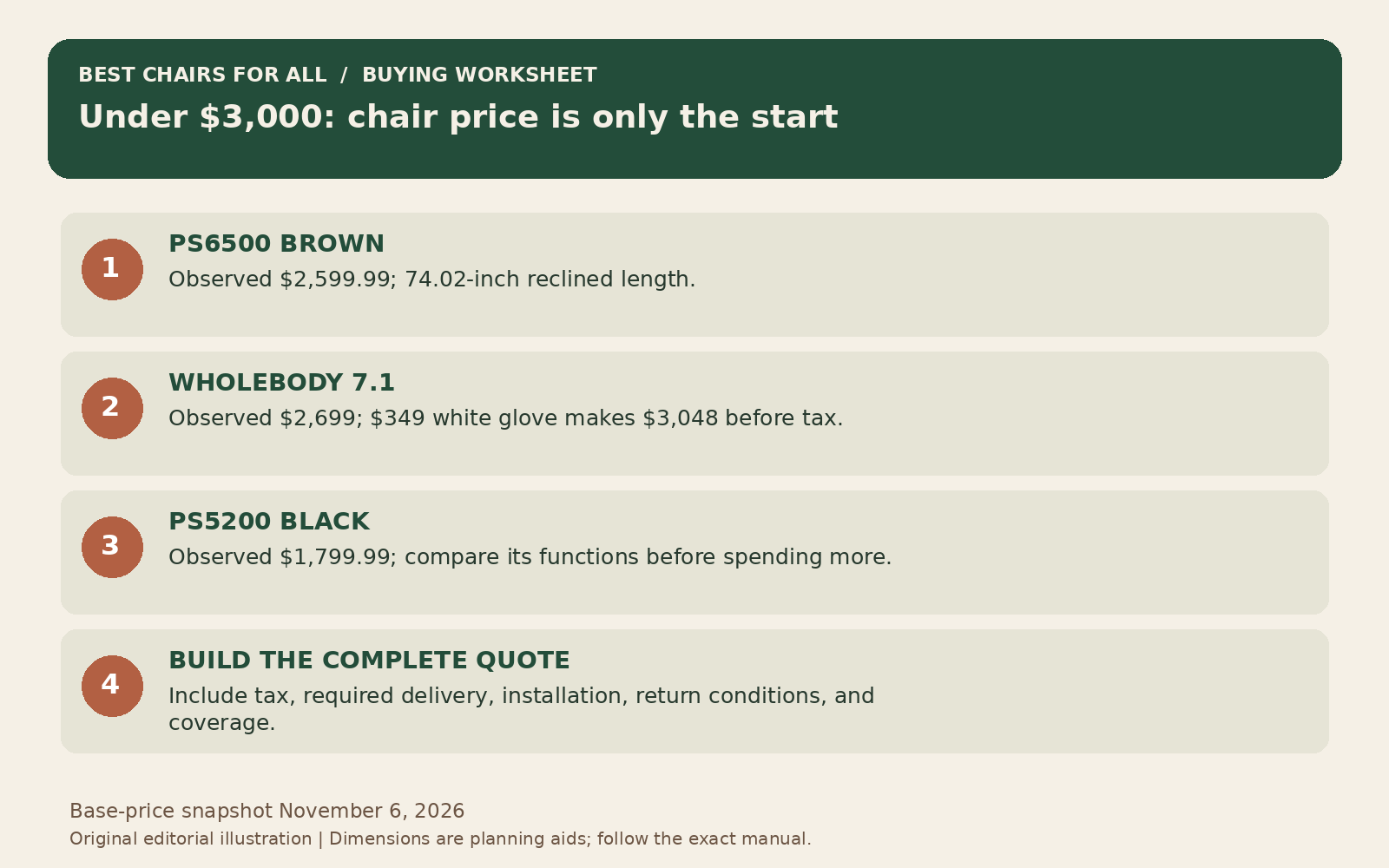
All three exact manufacturer listings had purchase options during our November 6, 2026 research. This is a specification and transaction comparison, not evidence from our own testing. Prices below are base chair prices before tax, delivery upgrades, and optional coverage. We give particular attention to a $3,000 all-in budget, because an under-cap chair can become an over-cap purchase when the chosen delivery service is added.
Three different ways to use the budget
| Exact model | Observed base price | Manufacturer upright size | Operating size |
|---|---|---|---|
| Real Relax PS6500 Brown | $2,599.99 | 61.81 D × 30.71 W × 48.82 H in | 74.02 D × 30.71 W × 38.98 H in reclined |
| Human Touch WholeBody 7.1 | $2,699 | 44 L × 28 W × 40 H in | 66 L × 28 W × 29 H in reclined |
| Real Relax PS5200 Black | $1,799.99 | 57.5 D × 29.1 W × 44.5 H in | 70.1 D × 29.1 W × 38.6 H in reclined |
PS6500 Brown: more features, more floor length
The PS6500 Brown page showed $2,599.99 and an active purchase option. It lists a 4D mechanism, extended SL-track, 27 automatic programs, three zero-gravity positions, 28 air cells, foot rollers, waist heat, and an extendable footrest. Its touchscreen, voice control, and favorite-setting features are useful functions to investigate if you want more ways to operate a shared chair. We do not treat the advertised AI soreness detector as a verified medical diagnostic tool.
The 61.81-by-30.71-by-48.82-inch upright body extends to 74.02 inches deep when reclined. Published net weight is 205 pounds, maximum recommended weight is 300 pounds, seat width is 21.26 inches, and seat depth is 23.62 inches. That deep seat is a reason to check the fit rather than assume a larger chair suits everyone. The current page’s height notation is five to 6.4 feet; ask the maker to express the range unambiguously in feet-and-inches for your intended users.
This is the first candidate to investigate when the longer reclined footprint works and you specifically want its track, controls, and feature mix. It is less convincing for a small room, a shorter user who cannot obtain the correct supported position, or a strict delivered budget that requires a costly setup service. Other official pages contain older PS6500 weights and ratings; use the current exact product and supplied manual rather than combining incompatible revisions.
WholeBody 7.1: an open chair with a different feature balance
The WholeBody 7.1 manufacturer page showed $2,699 and an active cart. Its published upright dimensions are 44 by 28 by 40 inches, and its reclined size is 66 by 28 by 29 inches. The chair weighs 114 pounds and has a 285-pound maximum load. It separately specifies nine inches of rear clearance. This is a different room-planning proposition from an enclosed chair with a 74-inch reclined length.
Human Touch lists FlexGlide massage, five automatic programs, warm-air technology, a swiveling base, and a retractable foot-and-calf massager. The seat is published as 21 inches wide, 18 deep, and 19 high. The open arm area can appeal to someone who dislikes a cocoon-style enclosure, but it also means you should compare the actual massage zones rather than assuming every full-body label describes the same arm and shoulder coverage.
Choose this model when its open form, manageable published dimensions, and warm-air feature align with your priorities. It is less suitable if a continuous SL-track into the seat, enclosed arm compression, or zero-gravity positioning is essential; do not infer those functions from a general massage-chair label. The manufacturer offered a $349 white-glove option on the checked page, which pushes the base price plus that service above $3,000 even before tax. That is a significant limitation for this budget guide, not an incidental checkout detail.
PS5200 Black: a serious comparison when the budget is a ceiling
The current PS5200 Black listing showed $1,799.99 with an active purchase option. It lists a 4D mechanism, SL-track, 20 automatic programs, two zero-gravity settings, 30 air cells, lumbar heating, foot rollers, and five levels each of massage intensity and air pressure. That makes it a relevant lower-priced comparator, rather than assuming every buyer should spend almost $3,000 once they can afford to.
Its upright size is 57.5 by 29.1 by 44.5 inches, increasing to 70.1 by 29.1 by 38.6 inches reclined, with a 174.2-pound net weight. It is shorter and lighter than the PS6500 by the current published specifications, but that does not establish better fit or easier handling. Ask for the actual shipping package and approved installation route. The current and older official fit-range statements differ, so confirm the exact version and personal fit before relying on a height limit.
This is worth investigating when the track and controls meet your needs without PS6500’s additional programs or wider, deeper seat. It fails if a needed function is absent, the fit does not work, or the seller cannot provide acceptable service and return terms. We do not consider anion or aromatherapy language a reason to spend more, and we do not credit a lower purchase price with unverified long-term reliability. Its advantage here is the known difference in base price and the possibility of preserving a practical transaction reserve.
A delivered-budget example that changes the shortlist
Use the amount you can actually spend, rather than the article title, as the final filter. At a hypothetical eight-percent sales-tax rate, PS6500’s $2,599.99 base becomes about $2,807.99 before paid delivery. WholeBody 7.1’s $2,699 becomes about $2,914.92. PS5200’s $1,799.99 becomes about $1,943.99. The resulting margins below $3,000 are approximately $192, $85, and $1,056 respectively. These are illustrative calculations, not quotes for your address.
Now add a required delivery service. WholeBody’s observed $349 white-glove option already makes its base-plus-service subtotal $3,048 before any tax calculation. A buyer who requires that service should therefore not treat it as an under-$3,000 all-in selection. The correct response is to find a confirmed lower complete offer, select another suitable chair, or revise the budget deliberately. Do not hide necessary delivery outside the decision simply because the product headline qualifies.
Make one line for every charge and one line for any condition that could create a return expense. Ask how oversized returns are collected, whether the original carton is mandatory, and who pays freight. Do not assume free outward delivery means free collection if the chair feels wrong. A large remaining reserve is not itself proof that the cheaper chair is better, but it makes the financial difference visible.
Map the massage zones before comparing program counts
Draw a simple seated-body outline and label upper back, lower back, seat, arms, calves, and soles. For each product, mark whether the manufacturer identifies moving rollers, fixed massage elements, air compression, heat, or no dedicated mechanism at that zone. This turns a vague full-body comparison into a concrete feature map. Ask the maker to fill any gap rather than guessing from a lifestyle photograph.
PS6500 and PS5200 advertise SL-track systems and separate air-cell systems, while WholeBody 7.1 describes a different open FlexGlide arrangement and foot-and-calf unit. A larger air-cell count does not prove better pressure, and 27 programs do not guarantee a useful program for every adult. The most valuable setting can be a mild, controllable routine rather than the strongest or most complicated preset.
If possible, compare the actual controls in a demonstration. Can you choose the area, reduce intensity, turn heat off, stop the program, and return upright without help? If a chair is shared, check what happens to the previous user’s settings. A touchscreen, voice interface, and app each introduce different practical preferences; none should be a reason to accept a body-fit problem.
Confirm the room and the service before adding premium features
Tape the complete reclined rectangle on the floor and keep the manufacturer’s required wall gap and access area. PS6500’s 74.02-inch operating depth is about eight inches longer than WholeBody 7.1’s published 66-inch length, but the wall-clearance methods differ. Ask the manufacturer how the placement reference works rather than subtracting the two numbers as though the chairs pivot identically.
Record the shipping-carton dimensions, doorway openings, corner turns, and stairs separately from the chair’s operating footprint. Determine which assembly steps the manufacturer permits and whether the delivery team will perform them. Never plan to solve an uncertain doorway fit by dismantling the powered mechanism. For a heavy chair, the most attractive specification sheet cannot fix an inaccessible room.
Compare written service coverage by component and time period rather than only the headline warranty length. Ask whether labor is in-home, who supplies replacement parts, whether transport is covered, and whether an authorized seller is required. We have not measured either company’s future response quality, so a warranty table should not become a fabricated reliability ranking. Keep written answers with the invoice.
Marketing features have practical limits
A chair’s body scan is a positioning function, and a soreness sensor or program name should not be treated as a diagnosis or a prescribed therapy. These products are discussed as consumer relaxation furniture. Anyone with concerns about pressure, heat, recent surgery, pregnancy, or a condition addressed in the manual should seek individualized professional advice before use. Do not use a program to work through pain or assume stronger pressure means a better result.
Read the exact supplied safety instructions, learn the stop controls, and keep children and pets outside the moving footprint. Follow the model-specific cleaning instructions; PS6500’s current page, for example, specifies unplugging and a dry cloth rather than a general wet-upholstery routine. Stop use if a cord, cover, or mechanism is damaged, and contact authorized service. Check recalls and register the exact model instead of interpreting the presence of a retail listing as proof of safety.
The price-cap decision
Investigate PS6500 when its seat and operating size fit and the complete total remains acceptable. Compare WholeBody 7.1 for an open chair and warm-air comfort, recognizing that the observed white-glove option exceeds an all-in $3,000 cap. Keep PS5200 in the comparison when spending less preserves useful room for delivery and support. Recheck current prices, selected-version availability, and the CPSC recall database before committing. The strongest under-$3,000 purchase is a fitting chair with an affordable complete transaction, not the largest discount badge.
Something unclear or out of date? Send a correction with this article’s title and the detail to check.
Sources, research & corrections policy ↗