Tattoo artist stool height should be chosen around the working position of the hands and the supported client area, while the artist's feet remain supported and the stool stays controllable. A tall maximum is useful only if the stool also reaches the lower positions your work requires. Check the complete seat range and test the actual station arrangement before buying.
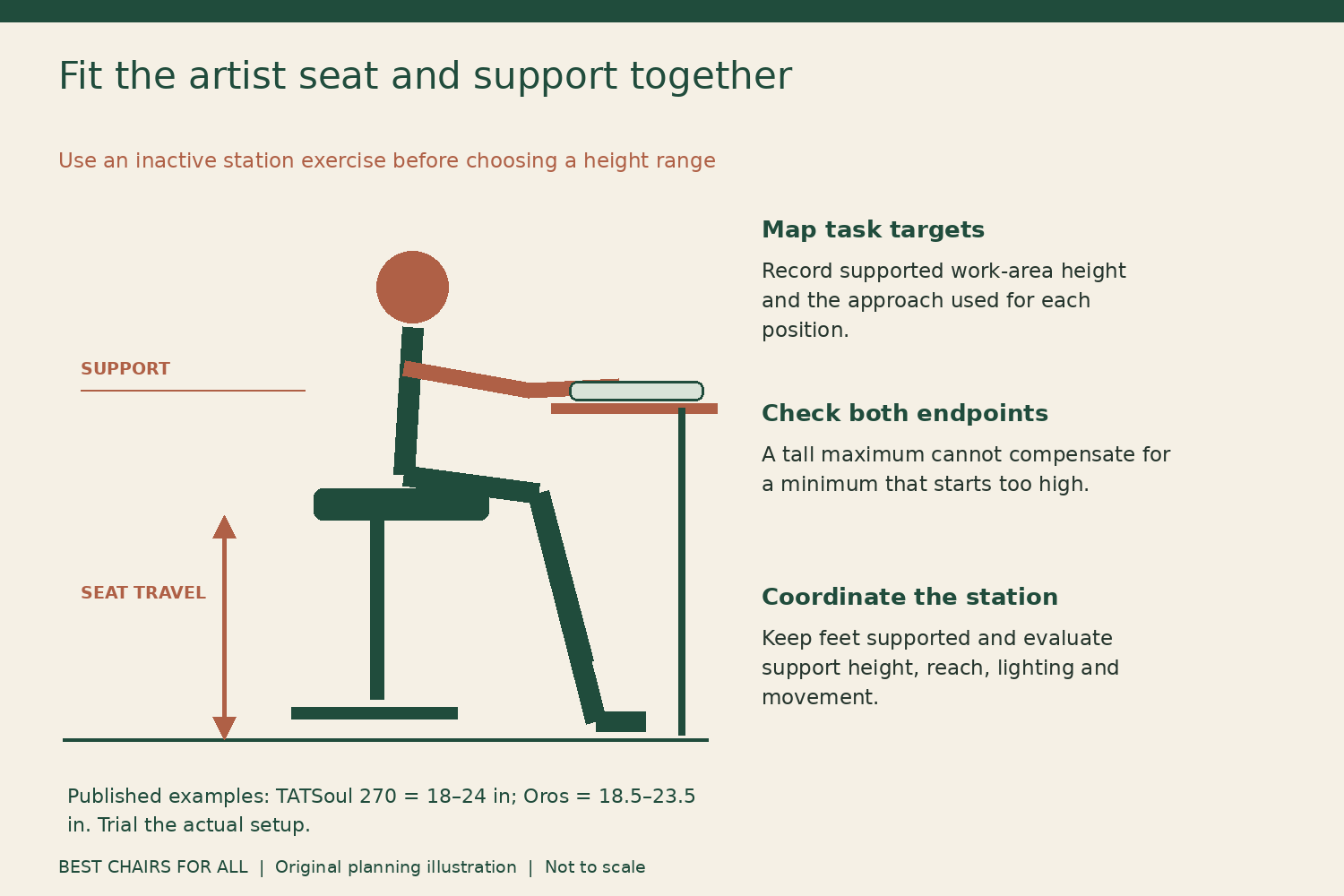
There is no single ideal height for every artist or placement. The client support, armrest, artist's proportions, seat shape, floor, and preferred working position all affect the relationship. Treat height adjustment as one part of a coordinated setup rather than expecting a stool to compensate for every limitation of a fixed client chair or bench.
Define the working targets
List the positions your ordinary work needs: a supported forearm, a higher shoulder area, a lower leg, or another placement within your professional scope. Record the approximate height of the supported work area, the side from which you approach it, and whether you normally sit facing forward or use a manufacturer-permitted straddle position.
Do this as a furniture-planning exercise without performing a procedure. Use an inactive, clear station and appropriate training or demonstration arrangements. Do not ask a client to maintain an uncomfortable position to prove that a stool can reach the area. Client support and access should be planned respectfully around their needs.
For each target, note what can move: stool height, client support height, armrest height, support angle, and your position around the station. A fixed low support may be the limiting element even when the stool has a large range. Identifying the adjustable pieces makes the fitting process much more precise.
Read the full seat-height specification
Look for floor-to-top-of-seat measurements, not backrest height or gas-cylinder travel. TATSoul's TATSoul 270 artist-chair floor-to-seat specifications lists the 270 Artist Chair at 18–24 inches and explicitly says its heights are measured from the ground to the top of the seat cushion. It also lists separate adjustments for the seat and back. Those facts describe that model, not a universal artist-stool range.
The TATSoul Oros artist-chair height and controls lists a different 18.5–23.5-inch range and a front-bar lift control. The two models overlap substantially, but they do not have identical endpoints or controls. Their published ranges are useful shortlist information rather than evidence that one will fit a particular artist better.
Record the exact base and wheels with the range. A replacement caster or different mechanism can change the finished relationship. Ask the supplier whether any optional component changes the seat-height specification. Do not combine an old product drawing with a current accessory photograph and assume the resulting assembly has been documented.
Minimum height can be the deciding factor
When the work area is low, a stool that starts too high may push the artist toward bending or reaching. Lowering only the head or rounding forward does not solve the equipment mismatch. Check whether the supported work can be raised through its approved adjustments or whether another seat range is needed.
Conversely, lowering a seat until the feet feel secure can leave the hands too low relative to a high client support. That suggests the support and seat need to be assessed together. Do not use an unsupported extra cushion, a cut-down cylinder, or an improvised platform as a substitute for a suitable complete configuration.
Keep the low endpoint separate from the amount of travel. A stool with six inches of travel starting at 18 inches covers a different range from one starting at 22 inches. The latter is not “more adjustable” merely because it reaches higher. The useful range is the part that overlaps your task positions with appropriate foot support.
A height-range worksheet
Create a row for each planned working target. Record supported work-area height, artist seat setting, foot support, ability to approach the work, hand reach, and line of sight. Add the chair or stool model and any seat tilt or back-support setting. Use plain observations rather than a single ergonomic score.
In a separate column, name the adjustment that resolved a problem. Examples might be moving an approved arm support, changing the stool setting, or repositioning the station. If the task remains awkward at every permitted setting, mark the combination unsuitable or unresolved. Do not force a pass because one number falls within a manufacturer's range.
For shared equipment, make a separate record for each artist. Standing height alone does not capture leg length, seated proportions, or working technique. A useful shared stool has accessible controls and a range that actually serves the users, plus a clear alternative if it does not.
Worked example: comparing overlapping ranges
Imagine an artist whose inactive fitting trial identifies useful seat positions around 18.5 inches for a low supported area and 23 inches for a higher one. Both the published 270 range of 18–24 inches and the Oros range of 18.5–23.5 inches overlap those planning positions. This arithmetic shortlists them; it does not establish equal fit.
The artist then compares seat contact, access around the client support, control reach, and floor behavior. The 270's additional seat and back adjustments may matter for one technique, while the Oros front-bar control may be easier to reach in another position. These are questions for a trial, not conclusions that can be drawn solely from dimensions.
If the low task instead required a seat below both ranges, neither model's upper travel would solve that requirement. The next conversation would concern a different approved stool range or a suitable change to the support arrangement. The example demonstrates range matching without claiming a correct seat height for everyone.
Learn the controls before the session
Have the supplier demonstrate normal height, tilt, and support adjustments for the actual model. Similar-looking handles can have different functions, and the motion needed to raise a pneumatic stool differs from that used to lower it. Read the manual rather than experimenting during a procedure.
For a saddle alternative, Salli's Salli model-specific saddle adjustment instructions distinguishes height, tilt, width, and swing controls and identifies which models offer each adjustment. That is a reminder that seat shape and control set must be documented together. It is not permission to use a Salli sequence on an unrelated artist chair or to adjust an unsupported mechanism.
Place adjustment and repositioning within the studio's established work practices. If changing the stool requires an interruption, plan that interruption rather than reaching under the seat while concentrating on another task. This article addresses furniture fit and does not replace professional technique, hygiene, or exposure-control procedures.
Back or chest support has a working position
A support only helps when it meets the body where the intended task allows. On a chair designed for an approved straddle position, the backrest may be used differently from a conventional forward-facing chair. Verify the manufacturer's permitted positions, adjustment limits, and locking method before including that feature in your plan.
Do not assume a stool without a support is automatically more mobile or that a larger support automatically improves fit. A support can block close approach to a client chair, while a backless seat may not suit an artist who needs more sustained support. Record the real contact and access relationship during the trial.
Avoid forcing a position because a product description makes a health promise. Persistent pain, numbness, or an individual support need deserves appropriate professional advice. A short equipment comparison cannot establish a medical benefit or guarantee comfort throughout long sessions.
Height interacts with reach and visibility
If the stool fits vertically but you still stretch forward, inspect the horizontal gap. A wide client-chair base, a low rail, or the artist stool's own legs may stop close approach. Raising the seat may make that obstruction less obvious without removing the reach problem. Measure and record the interference directly.
Check lighting and the view of the work area separately. Moving your eyes closer by bending forward is not always a sign that the stool should be lower. The task, light position, support angle, and individual visual requirements can affect what you see. Resolve each issue through an appropriate station assessment rather than chasing a single ideal height.
Arrange frequently used supplies so the intended working posture does not depend on repeated twisting. Keep the station within the studio's established workflow and hygiene requirements. A trolley's location may be limited by more than convenience, so coordinate the furniture plan with the person responsible for those procedures.
Wheels and floor behavior belong in the trial
At a higher seat setting, foot contact and movement can feel different. Check ordinary mounting, dismounting, and deliberate repositioning using the approved configuration on the actual floor type. A product described as smooth rolling does not necessarily have a holding brake. Ask what the supplied casters do, occupied and unoccupied.
Do not jam wheels or mix different replacement sizes to keep the stool still. If another manufacturer-approved caster set is proposed, confirm compatibility and any height change before installation. A stem that appears to fit is not enough evidence for the complete assembly. Damaged or unpredictable equipment should be removed from use and assessed.
Keep cables and surrounding objects out of the stool's path according to the equipment instructions and studio procedure. Avoid using the stool to travel around the room while seated. The aim is controlled positioning close to the work, with supported feet and a clear way to leave the seat.
Save a useful setup record
After fitting, record the stool and support settings that worked for each general task position. A photograph of the empty equipment arrangement can supplement measurements without recording a client's body or personal information. Recheck the relationship after changing wheels, supports, client furniture, or work shoes.
When ordering, specify the complete configuration, supported height range, control type, and permitted positions. Keep the current manual available. Do not perform gas-cylinder disassembly or internal lift repairs to recover a preferred setting; contact the authorized supplier if adjustment fails.
A well-chosen tattoo artist stool offers a usable low and high position within a station that also provides appropriate client support, reach, visibility, and controlled movement. Matching those relationships through an inactive fitting exercise is more useful than buying the tallest model or treating a single advertised height range as a complete answer.
Sources and specifications checked November 6, 2026. Examples are planning exercises, not product testing.
Something unclear or out of date? Send a correction with this article’s title and the detail to check.
Sources, research & corrections policy ↗