A balance ball is not an evidence-based shortcut to a stronger core or a better fitted office workstation. Studies of ball sitting measure specific short-term outcomes under particular conditions; those findings do not establish that replacing an office chair will prevent pain, improve long-term health, or provide meaningful exercise. For routine desk work, start with an appropriately fitted chair and a work arrangement that allows changes of activity and position.
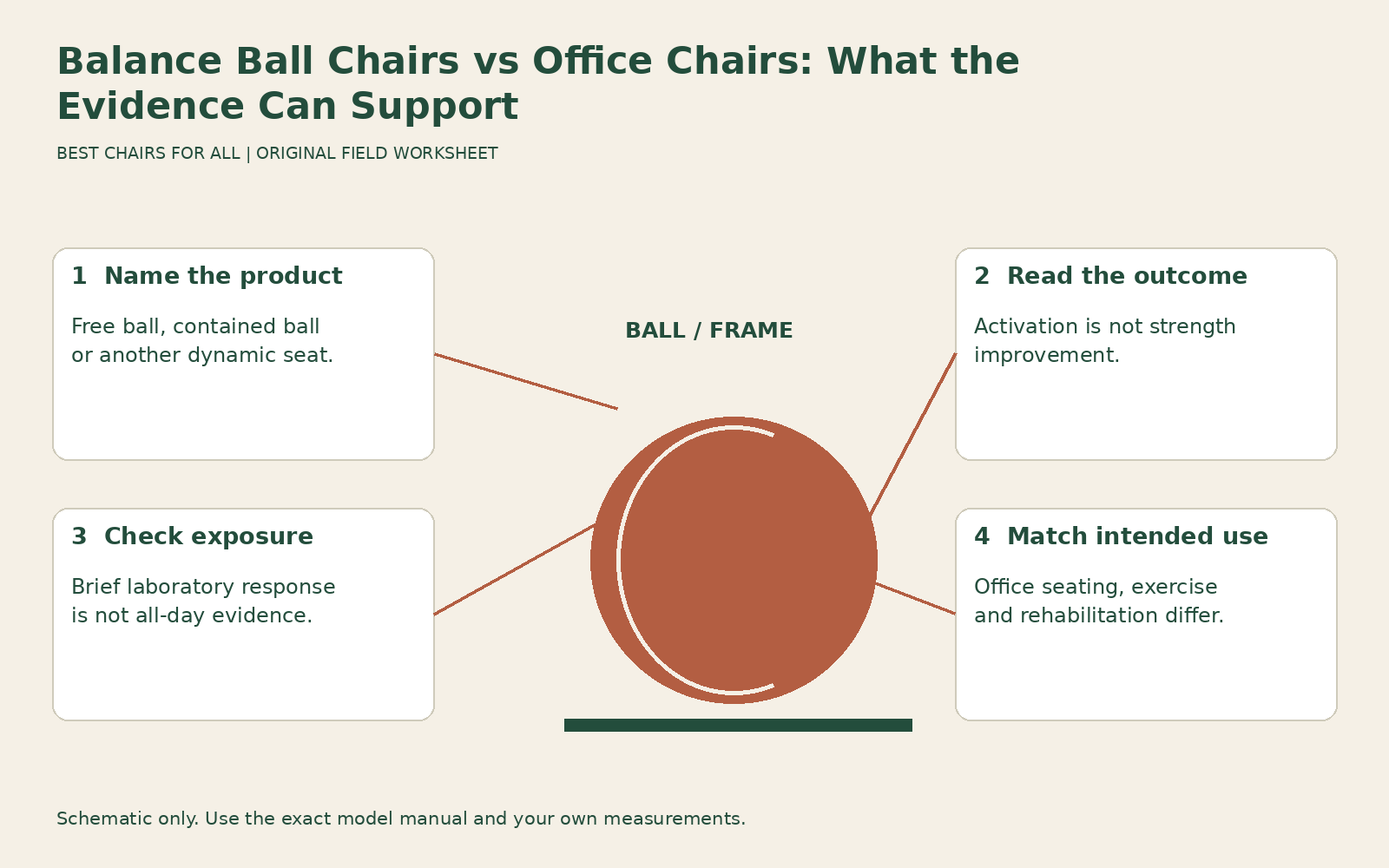
This guide distinguishes a free-standing exercise ball from a ball held in a chair-like frame, then provides a claim-checking worksheet for evaluating marketing. It does not prescribe ball exercises or a rehabilitation schedule. If a clinician recommends a ball for an individual purpose, use that person’s specific fitting, task, and duration guidance rather than adapting a general shopping article.
Define the product before applying research
A free-standing exercise ball has no conventional fixed seat pan, backrest, or stable chair base. A frame may add containment, wheels, a partial back support, or a handle, but the design details matter. A ball-shaped sitting surface in a frame is not necessarily equivalent to the free ball studied in an experiment. Nor does a frame automatically provide the adjustment range of an office chair.
Record the actual product construction: free ball or framed; fixed or adjustable frame; available support; stated user limits; intended use; and maintenance instructions. Identify whether the manufacturer describes it as exercise equipment, a sitting product, or both. A photograph showing someone typing cannot establish suitability for your desk, your body, or a full workday.
Also distinguish a ball from other dynamic seats. A flexible task chair, saddle stool, and wobble stool introduce different movements and contact arrangements. Evidence about one should not be used to certify another. A claim that “active sitting works” is too broad unless it specifies the product, activity, participants, comparison, measured outcome, and period involved.
Read the older office-chair comparison carefully
The Gregory, Dunk and Callaghan: stability ball versus office chair study compared stability-ball sitting and office-chair sitting in terms of muscle activity and lumbar posture. Its reported differences were small, while perceived discomfort was greater on the ball; the authors did not find a compelling advantage for prolonged sitting. This is relevant evidence against assuming that an unstable seat necessarily creates a better desk-work experience.
It is also limited evidence. A study of particular participants and conditions does not prove that no person can prefer a ball briefly, and it does not evaluate every modern framed product. The useful conclusion is narrower: the popular promise of automatic improvement needs more support than the fact that the surface moves. Do not turn a modest laboratory finding into a universal claim in either direction.
When an advertisement cites this or another paper, check the original outcome. “Muscle activity was measured” is not the same as “strength increased.” “Posture differed” is not the same as “pain was prevented.” A before-and-after photograph of one seated angle cannot fill the gap between those statements. Write the actual measured outcome into your worksheet before accepting the advertised interpretation.
Include newer evidence without overstating it
A 2025 pilot study of stability-ball sitting, energy metabolism and muscle activity examined energy metabolism and muscular activity in sixteen adults who used four seating conditions for ten minutes each. The abstract reports increased activity in some comparisons involving the ball. That makes the study relevant to short-term physiological response, but the small pilot and brief exposures do not establish long-term strength gains, weight loss, symptom improvement, or all-day workstation suitability.
This newer result should not be ignored simply because older findings were less favorable. Instead, ask whether the outcomes and conditions differ. Different muscles, tasks, seat designs, measurement periods, and comparison chairs can produce different observations. A careful evidence summary can acknowledge a measurable response while declining to translate it into a benefit the experiment did not test.
For purchasing, the critical gap is between a short measurement and your intended use. If you want a comfortable reliable chair for several kinds of desk work, a ten-minute physiological comparison does not answer entry and exit, useful adjustment, surface maintenance, sustained comfort, or desk access. Those questions require their own evidence and fitting checks, even if a laboratory response sounds appealing.
Separate activation from exercise and health claims
Muscle activation describes activity detected during a particular task. Strength and endurance improvements require different outcome measures and an appropriate intervention design. A sitting surface that demands more effort can be described as more demanding under those conditions; that alone does not make the demand beneficial or desirable while concentrating on work. More activity is not a complete ergonomic verdict.
Energy expenditure is also a measured quantity with a specific context. Do not multiply a short experimental difference across an imagined eight-hour day to promise weight loss. The experiment may not show that a person can, will, or should use the product continuously, and long-term behavior is a different question. Treat calorie claims cautiously unless they directly reflect a relevant studied protocol and appropriately limited interpretation.
Likewise, a more upright-looking position does not establish prevention or treatment of back pain. A person can change posture without achieving a clinical outcome, and discomfort may have several contributors beyond the seat. If a seller claims prevention, rehabilitation, or pain relief, ask for evidence addressing that outcome and the intended population rather than accepting a study of muscle signals as a substitute.
Take current workplace guidance seriously
WorkSafe Western Australia office safety and fitball guidance does not recommend fitballs as routine office seating because of their instability and distinguishes them from a properly adjustable chair. It separately recognizes that a medical provider may recommend an individually fitted temporary rehabilitation use with clear instructions and workplace assessment. This is current occupational guidance, not a claim that every ball product has been tested identically or that all supervised exercise use is inappropriate.
The practical implication for an office purchase is to involve the responsible workplace person before substituting exercise equipment for normal seating. A personal preference does not answer room access, task safety, equipment placement, or whether a suitable chair remains available. Do not use a desk edge, loose tether, or improvised frame to compensate for an unstable arrangement.
For home use, ask the same functional questions. Can you enter and leave the position predictably? Does the surface remain suitable while your attention is on the screen? Can you reach input equipment without leaning or bracing? A brief entertaining sit while deliberately balancing does not replicate ordinary distracted work. You do not need to conduct an unsafe trial to recognize that those questions are unresolved.
Use a claim-to-evidence worksheet
Create five columns: exact claim; product studied; participants and exposure; measured outcome; and supported interpretation. Copy a short claim in your own words, such as “strengthens core during work.” Then identify whether the evidence measured actual strength change, an electrical muscle signal, posture, energy use, discomfort, or something else. Keep a field for any difference between the advertised product and the studied seat. Record the paper’s publication year and whether you read the full article or only its abstract, because that limits how confidently you can evaluate the study methods.
An illustrative entry could read: “Core-strength claim; free ball compared with office seating; short laboratory exposure; muscle activity measured; strength benefit unresolved.” Another could read: “Suitable for all-day work; no matching long-duration product trial supplied; adjustment and sustained comfort not established.” These entries do not accuse a seller of misconduct; they identify exactly what the supplied evidence can and cannot support.
Add an intended-use column for your decision. If you want supervised exercise, a desk-work chair comparison is not the relevant instruction set. If you want a primary office seat, a demonstration of an exercise movement does not establish task-chair fit. Matching evidence to the actual use prevents one legitimate application from being stretched into a different unsupported recommendation.
Compare the ordinary workstation functions
A suitable office chair can offer useful height, depth, back support, movement resistance, and arm options, but those features still need to fit. Do not compare a well-fitted ball setup with an office chair left at someone else’s settings and call the result a category verdict. Adjust the ordinary chair appropriately and check the work surface before attributing its shortcomings to conventional seating itself.
If you are evaluating a framed ball product, inspect the documented adjustments individually. A frame’s overall height may not reveal occupied seat height after the ball deforms. A small back element may not provide useful contact at your working position. Inflation instructions, replacement-ball compatibility, and surface condition belong to the specific product; do not overinflate or modify it to imitate a missing seat-height adjustment.
Use ordinary task observations to describe fit, without turning the comparison into a balance challenge. If a product requires constant attention to remain stable or produces discomfort, stop rather than extending the trial to prove adaptation. A product that is inappropriate for your workstation does not become suitable because a brief research result showed a different muscle response.
Choose the role the evidence actually supports
For a primary desk chair, prioritize a documented intended use, stable workable setup, suitable support, and practical adjustments. For a clinician-directed temporary use, follow the individual instructions and workplace arrangements. For exercise, use appropriate exercise guidance. These are different purposes and should remain distinct when evaluating a ball-related product.
You can seek more movement through changes of task, position, and activity without requiring the sitting surface to function as exercise equipment. Keep the purchase decision tied to what you need the seat to do. The claim-checking worksheet makes room for new research while preventing short-term measurements from becoming promises about long-term health, strength, or a better workday.
Something unclear or out of date? Send a correction with this article’s title and the detail to check.
Sources, research & corrections policy ↗