Check a high chair footrest as part of the whole seating arrangement: seat depth, supported sitting position, the manufacturer’s adjustment system and the child’s growth all matter. A footplate is not a climbing step, a replacement restraint or a device that guarantees feeding or swallowing safety.
Start with the chair’s intended configuration
Identify the model, seat accessory and current mode before moving a footrest. An adjustable wooden chair can have different rules with a baby insert than as an older child’s seat. The Stokke Tripp Trapp US/Canada guide includes both seat and footplate adjustment instructions. It must be read together with the instructions for the accessory used on that specific chair. A general growth chart or a picture from another family cannot establish the correct assembly.
Write down what is installed: chair, Baby Set or other required insert, restraint, tray if used and feet or gliders. Do not treat the footplate as an isolated board whose position can be changed without considering the rest. If a part has been substituted or the chair is secondhand, resolve compatibility with the manufacturer before making a fit adjustment.
Observe foot support without prescribing an angle
Look at the child in the supported sitting position intended by the product, with the required restraint correctly used and an adult supervising. Notice whether the feet reach the available support, whether contact is comfortable and whether the child must slide forward to find it. Write an observation rather than assigning a universal knee angle. The child’s support and feeding needs can require a clinician’s assessment.
Avoid a familiar internet shortcut: drawing a right angle on a photograph and declaring the chair safe. A photograph may not show seat depth, the restraint path, movement or the support surface beneath the chair. It also cannot establish swallowing readiness or rule out a medical issue. A footrest check is an equipment-fit task, not a clinical evaluation or a choking-prevention treatment.
Seat depth can masquerade as a footrest problem
If the seat is too deep for the child’s supported position, the legs may not relate to the footplate as expected. Moving the footplate upward can appear to solve foot contact while leaving the seating relationship wrong. Review the seat’s permitted depth and height first, including any fixed placement required by a baby accessory. Do not move a required insert to an unapproved groove just to bring the feet closer.
Think in pairs: the seat supports the sitting position and thighs; the footrest provides the intended place for the feet. Neither should be adjusted by looking only at floor-to-seat height. A deeply contoured insert can also change the practical reference point. Keep a note of the complete configuration so the next fit review starts from the same arrangement instead of comparing an unsupported bare chair with a fully equipped one.
A model-specific example has boundaries
The researched Tripp Trapp US/Canada instructions describe the footrest height in relation to feet resting flat while the thighs remain in contact with the seat, and they restrict how far its front edge may project relative to the chair’s front legs. These are instructions for that product, not a universal permission to add a board between another chair’s legs. The manual also makes the proper fastening of seat and footplate part of the setup.
Use the matching installation sequence with the chair empty, keeping the child away from tools and small parts. Do not loosen structural screws while a child is seated. After an approved adjustment, complete the fastening and checks specified by the manual before use. A plate that slides unexpectedly, a cracked board or a fastener that will not tighten is a condition question for the manufacturer rather than another fit setting to try.
Keep restraints and supervision in place
CPSC’s high chair guidance requires using the safety straps snugly, staying near and watching, and preventing climbing or standing. Foot support does not remove those responsibilities. A child who can press on a footplate may still attempt to rise, so a better-looking lower-leg position is not a reason to loosen the restraint.
The Baby Set² US/Canada guide shows its own restraint and accessory arrangement. Follow it for that system and avoid mixing components across generations. If the child repeatedly attempts to climb or cannot be positioned within the product’s intended use, stop the session and review the setup, eligibility and support needs with the appropriate professional or manufacturer. Do not solve the problem by removing a required component.
Be cautious about aftermarket footrests
An accessory seller may say a footrest “fits” a popular chair. That statement does not necessarily establish that the chair manufacturer approves the combined arrangement. Ask the chair manufacturer about compatibility, the permitted attachment method, any effect on stability and the required supervision. Do not infer approval from color matching or from photographs in a marketplace listing.
Avoid improvised support made from tied fabric, foam blocks, an ordinary chair underneath or a board held by unverified hardware. A new crosspiece can create a climbing opportunity, an accessible small part or a changed load path. This article does not recommend a universal retrofit. If an adjustable, manufacturer-designed foot support is important to the purchasing decision, compare chairs that document that feature rather than planning to modify another model after it arrives.
Use growth as a trigger to observe again
Check the fit whenever an obvious change appears: the feet no longer use the support comfortably, the child starts sliding to reach it, footwear changes the relationship or the approved seat arrangement changes. Follow any review and maintenance intervals in the manual as well. Growth is individual, so an age-based slot table cannot replace observing the actual child within the documented setup.
Record the date, seat setting, footplate setting and accessory configuration. A photograph can help the manufacturer understand a question if it shows the whole arrangement and the relevant measuring points, but protect the child’s privacy when sharing it. Do not delay a review because a previously chosen setting was comfortable a few months ago. Likewise, do not change a well-fitting setting merely because another child of the same age uses a lower slot.
Ask a useful question when foot contact remains difficult
Prepare a focused message: exact chair and accessory, the current allowed settings, what you observe and what you have already checked. For example, explain that feet do not reach the support while the child remains against the intended back support, rather than asking which slot a one-year-old should use. Send the manufacturer’s requested photographs and measurements.
If the question concerns the child’s sitting ability, asymmetry, discomfort, feeding difficulty or another health issue, contact their clinician. Do not keep changing boards in an attempt to diagnose it. A product representative can clarify assembly and compatibility, but cannot turn an unsuitable arrangement into a personalized clinical recommendation. Keep the two questions distinct so the response addresses the actual problem.
Footrest fit and growth review
| Check | Evidence and decision |
|---|---|
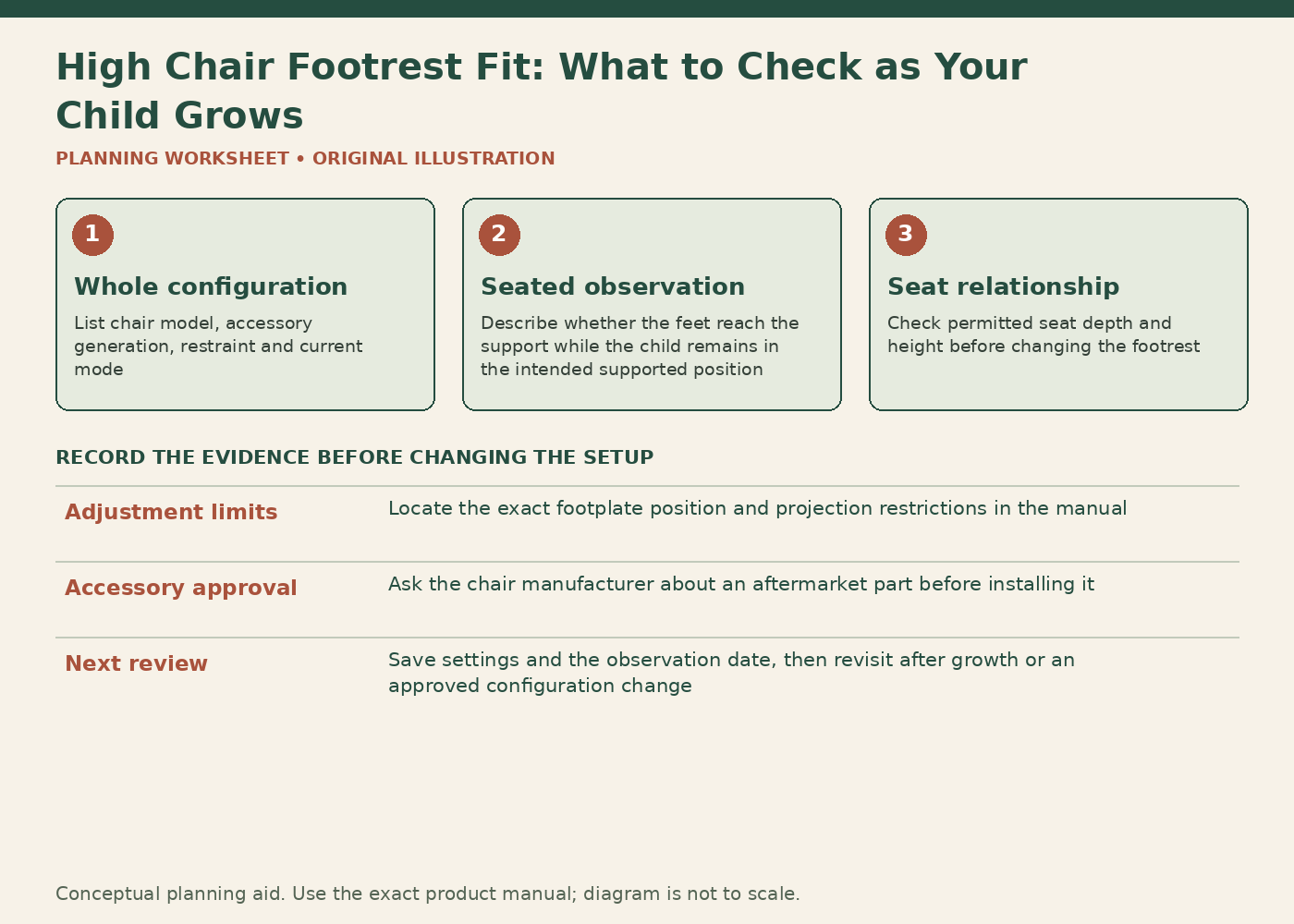
| Whole configuration | List chair model, accessory generation, restraint and current mode. Verify that these parts are permitted together. A fit observation is meaningful only when the chair is assembled in the documented arrangement rather than a temporary incomplete one. |
| Seated observation | Describe whether the feet reach the support while the child remains in the intended supported position. Note forward sliding or discomfort without assigning a diagnosis. Do not use an angle drawn on one photograph as a safety verdict. |
| Seat relationship | Check permitted seat depth and height before changing the footrest. Identify any accessory rule that fixes the seat position. An unapproved seat setting cannot be justified by improved foot contact. |
| Adjustment limits | Locate the exact footplate position and projection restrictions in the manual. Make changes only with the chair empty and complete the specified fastening procedure. Stop for slipping, damage or hardware that cannot be secured. |
| Accessory approval | Ask the chair manufacturer about an aftermarket part before installing it. Record the exact accessory and response. Physical attachment to the legs does not by itself show that the combined product is approved or appropriate. |
| Next review | Save settings and the observation date, then revisit after growth or an approved configuration change. Keep restraint and supervision checks separate. A footrest adjustment is complete only when the whole seating system is correctly restored. |
Worked example
A child in a hypothetical adjustable chair can touch the footplate only after sliding forward from the intended back position. Raising the plate might seem the obvious fix, but the caregiver first checks the documented seat depth and accessory setting. If the seat is in an unapproved arrangement, the correction begins there. If it is assembled correctly and the fit still cannot be achieved, the caregiver asks the manufacturer and, where support needs are involved, the child’s clinician.
The record contains the chair and insert revision, current permitted settings and the specific observation. It does not contain a conclusion that one more slot will prevent choking or improve development. Those claims are not established by this measurement. A successful foot-support review results in a documented appropriate equipment arrangement, with the required restraint and supervision preserved, rather than a modified chair made to resemble an idealized photograph.
Sources checked November 6, 2026
Use the current document for the exact model, market and production revision. These sources establish the cited instructions and distinctions; they do not certify an individual chair or replace a personal assessment where one is needed.
- Stokke: Tripp Trapp US/Canada user guide, revision G
- Stokke: Tripp Trapp Baby Set² US/Canada user guide
- CPSC: High chair standard and caregiver safety guidance
- CPSC recalls and product safety warnings
Something unclear or out of date? Send a correction with this article’s title and the detail to check.
Sources, research & corrections policy ↗