Leather chair labels mix several different kinds of information. Full grain describes the retained grain surface; top grain identifies the grain-side portion of a hide, with retail usage that needs clarification; split describes a lower layer; bonded describes a manufactured composite containing leather material and binder. Aniline and pigmented describe finishes. These words do not form a single reliable ladder of chair quality.
To compare chairs, ask what each upholstery panel is made from, how its surface was finished, and what care the manufacturer permits. A premium-sounding label cannot tell you whether the leather suits pets, frequent spills, direct light, or the appearance you want after years of use. This guide provides a way to decode the terms without inventing a universal grading system.
Start with the hide’s layers
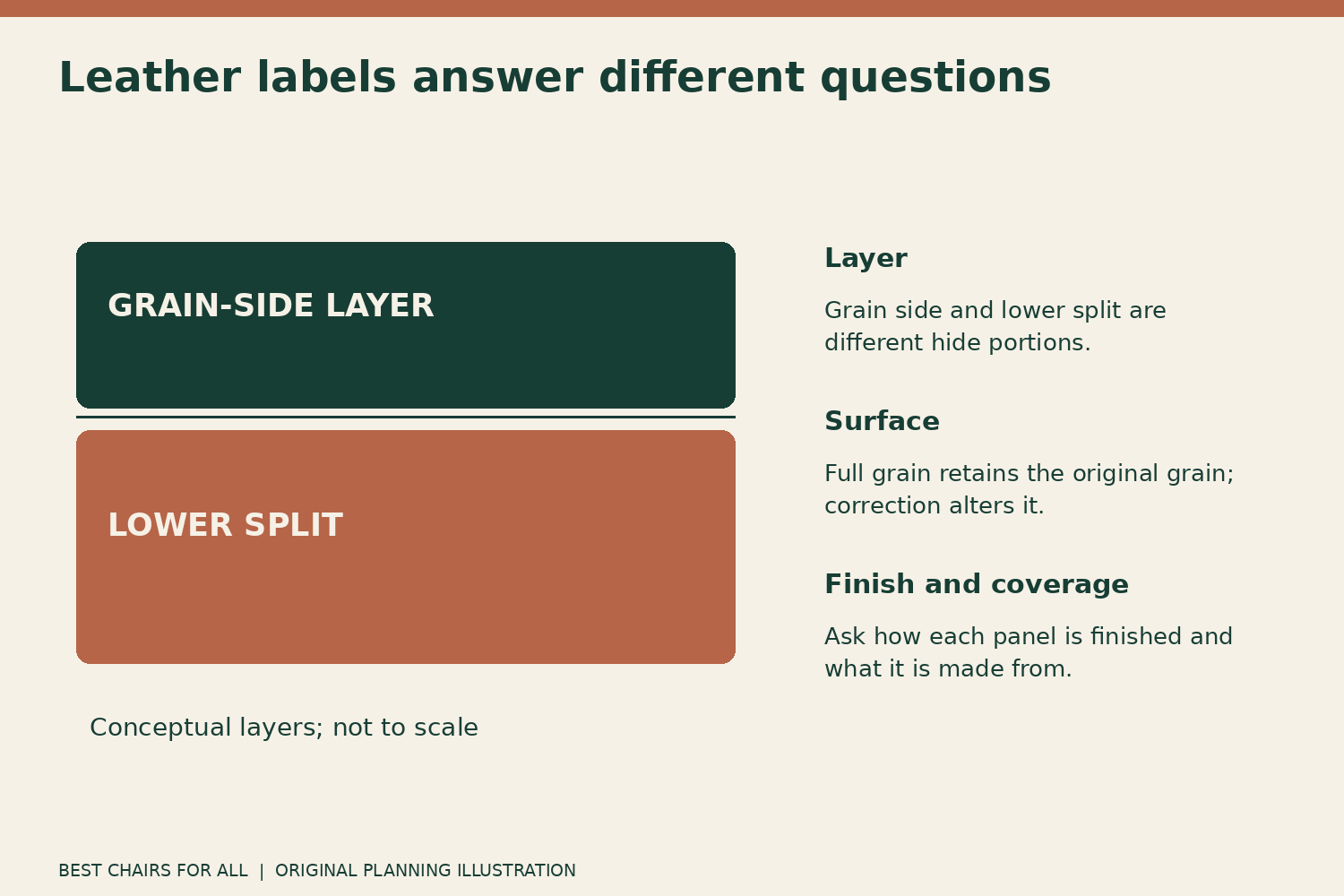
A hide can be divided horizontally into a grain-side layer and a lower split. The upper portion retains the side that originally carried the hair and grain pattern. The lower portion has a different structure and can be processed into products such as suede or finished split leather. Splitting is different from chopping leather into fibers for a composite.
The Leather Working Group’s modern leather processing guide illustrates this separation and distinguishes grain leather from split products. The practical implication for a chair buyer is that layer identity and surface treatment are separate questions. A visible smooth surface may have been created through finishing rather than being an untouched natural grain.
Ask the seller whether the chair uses one material throughout or different materials on different panels. Seats, inside arms, outside arms, and backs may not share the same specification. A description that applies only to contact areas should not be interpreted as a description of every upholstered surface.
Full grain means the original grain surface remains
Full-grain leather retains its original grain surface rather than having that surface removed by sanding or buffing. It can still be dyed and finished; full grain does not mean completely untreated. It also does not necessarily mean the entire original thickness of the hide remains, because a grain-side layer can be split to a usable thickness.
Moore & Giles’ leather source book distinguishes full grain from corrected grain and explains that both can come from the top-grain portion. This is a more useful model than a simplistic chart that treats full grain and top grain as wholly unrelated raw materials.
For a chair, full grain may allow natural variation in pores, wrinkles, and markings to remain visible, depending on the finish. Decide whether you like that variation across a large upholstered object. A small swatch may show little character while the finished chair contains more noticeable differences between panels.
Top grain needs a follow-up question
Top grain is often used in retail descriptions as though it were a precise finish or quality score. It is better treated as an incomplete material description until the seller explains it. Ask whether the surface is full grain, lightly corrected, more substantially corrected, embossed, and what finish has been applied.
The Moore & Giles explanation places full-grain and corrected-grain leathers within the grain-side category. The Leather Working Group processing guide likewise describes corrected or snuffed treatments for top-grain leathers. That distinction prevents a buyer from assuming that every top-grain chair has been processed in exactly the same way.
A corrected surface is not automatically unsuitable upholstery. It may be selected to produce more consistent appearance or meet a particular design brief. Evaluate the finished material’s feel, documented performance, care, and warranty. The useful question is whether the exact leather serves the chair’s intended use, not whether its name wins an oversimplified ranking.
Split leather is a layer, not bonded material
Split leather comes from below the grain-side portion and remains a leather layer. It can have a napped surface or receive a coating and pattern. It should not be confused with bonded leather, where leather dust, fibers, or fragments are combined with other substances to make a composite material.
Leather Naturally’s terminology guide distinguishes split, suede, coated split, and bonded material. Those distinctions explain why two surfaces that look similar in a product photograph can have different constructions beneath the finish.
If a listing says split leather, ask where it appears on the chair and what surface treatment it carries. If it says leather match, request a panel-by-panel material map instead of assuming match means another leather layer. Similar color and texture do not establish identical composition or identical maintenance requirements.
Bonded leather is a composite description
Bonded material is made by combining leather-derived dust, clippings, shavings, or fibers with a base or binder, often synthetic. It is not a continuous piece of hide. The exact leather content, backing, binder, and surface coating can vary, so the word bonded is the beginning of the specification rather than a complete recipe.
Ask for the material composition in writing and whether the visible contact surface is a polymer coating. Also ask which parts of the chair use the composite. Do not infer leather content from smell, a close-up photograph, or a seller’s description of the material as soft. Those observations cannot establish the construction.
Keep care advice tied to that construction. A conditioner intended for a particular hide leather should not automatically be applied to a bonded or coated composite. If the surface peels, a cosmetic patch does not restore the original material structure. Consult the maker or an upholstery professional before spending money on a repair product.
Finish explains much of the daily-use experience
Aniline, semi-aniline, and pigmented describe different surface approaches. The Leather Working Group’s definitions distinguishes a visible natural grain with little or non-pigmented coating, a lightly pigmented semi-aniline finish, and finishes that conceal the natural surface with pigment.
These finish descriptions matter because a buyer touches the finished surface and must maintain it. They do not replace the layer description. A meaningful product specification can therefore include both full grain and semi-aniline, answering two different questions about one leather.
Leather Naturally notes that minimally finished aniline leather has less protection from soiling than semi-aniline or pigmented options. Treat that as a reason to ask about your particular use, not as a promise that a protected finish cannot stain. Obtain the manufacturer’s actual spill-response and cleaning instructions before deciding.
Genuine leather and retailer grades do not settle the issue
Genuine leather generally emphasizes real leather rather than a synthetic imitation. It does not by itself identify the hide layer, finish, thickness, panel coverage, or quality of the finished chair. Reject the common shortcut that genuine must always be a named inferior rung between top grain and bonded.
Retailer letters, numbers, and price grades may describe a supplier’s internal grouping. Hancock & Moore states that its leather classes are based on characteristics rather than quality. Its published explanation is a useful warning against comparing one company’s class number directly with another company’s price grade.
Ask what the grade means within the seller’s own system. It may relate to cost, appearance, sourcing, or another factor. Then return to the actual material and finish. A higher upholstery surcharge does not, by itself, prove easier care or a better match for your household.
A panel-and-finish buying worksheet
Use this original worksheet for each candidate chair. Request answers against the model number and exact upholstery code. Blank fields identify the uncertainty that remains; they should not be filled by assumptions based on the chair’s price or a broad product-family description.
| Question | Record |
|---|---|
| Seat and inside back | Hide layer or composite; exact leather code |
| Inside arms | Same material as seat, or separately specified |
| Outside arms and rear | Leather, split, synthetic match, or other material |
| Surface processing | Full grain, correction, embossing, or unknown |
| Finish | Aniline, semi-aniline, pigmented, coated, or unknown |
| Maintenance | Approved cleaner, prohibited products, professional advice |
| Coverage terms | Relevant upholstery exclusions and claim procedure |
For a hypothetical comparison, Chair A says top grain on seating areas with matching material elsewhere, while Chair B specifies full-grain semi-aniline leather throughout. Chair B provides more complete material information, but you still need its care requirements and the user’s preference for natural variation. Chair A needs its matching panels identified before a fair comparison is possible.
Inspect samples without damaging them
View the swatch in the intended room and flex it gently only as the supplier permits. Observe color, sheen, texture, and any expected change when bent. Do not scratch it with a key, apply water, or test a conditioner without permission. A destructive demonstration can damage a sample without producing meaningful evidence of years of furniture use.
Ask for photographs of the same leather on a larger chair if natural markings matter to you. Also compare the sample with the manufacturer’s description of expected variation. Distinguish a natural marking from a cut, weak seam, peeling coating, or structural defect; when uncertain, request an assessment rather than making a diagnosis from appearance alone.
Evaluate the whole chair as well as the covering
Leather terminology does not describe frame joints, seat suspension, foam support, stitching, or delivery access. A well-described hide cannot compensate for a seat that does not fit you. Sit in the exact model, check normal entry and exit, and examine upholstery transitions at arms and cushion edges.
Make the purchase when the panel map, finish, care plan, and sitting experience all make sense together. Keep the written material specification with the receipt and swatch. That record is much more useful for future cleaning or repair than a remembered claim that the chair was made from a high leather grade.
Country-of-origin language answers another separate question. An Italian leather description does not establish whether the surface is full grain, corrected, split, or bonded, nor whether the entire chair was made there. Ask which stage or component the origin claim describes, and retain the layer and finish questions even when the geographic description sounds prestigious.
Something unclear or out of date? Send a correction with this article’s title and the detail to check.
Sources, research & corrections policy ↗