As an Amazon Associate, we earn from qualifying purchases. Read our affiliate disclosure.
For mobile seated massage, start with the Earthlite Vortex when carrying weight is the main constraint, the Earthlite Avila II when a more adjustable padded system and wheeled case justify extra weight, or the Oakworks Portal Pro when a 19-pound frame with built-in transport wheels matches the route. These are folding therapist chairs that support a seated client during a practitioner’s work. They are not powered home recliners or portable vibrating cushions.
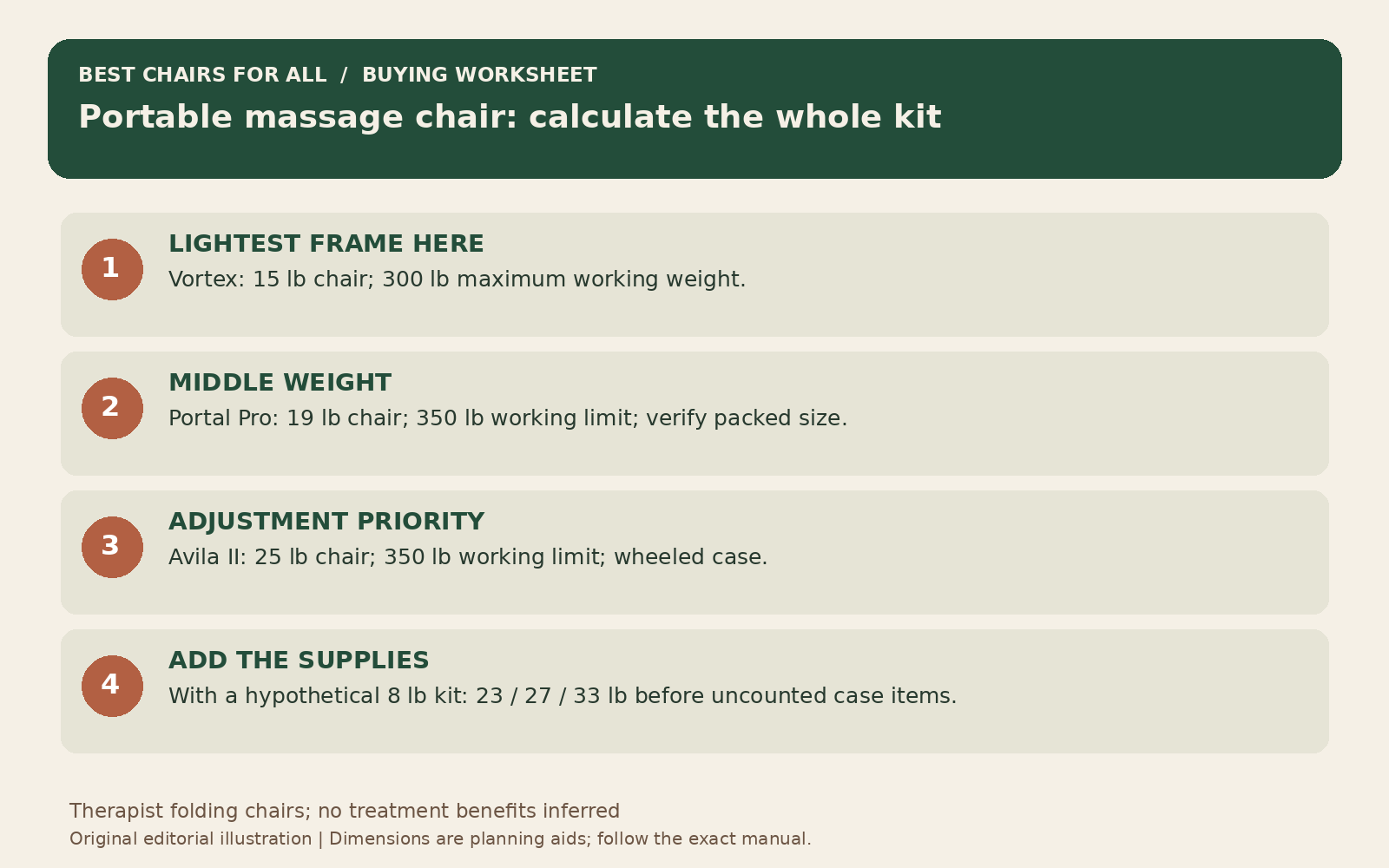
This is a research-based equipment comparison using manufacturer sheets, manuals, and current US listings checked on November 6, 2026. We did not load-test the frames, time setup, or evaluate client comfort in person. We also do not infer treatment outcomes from the equipment descriptions. The goal is a practical buying decision about carrying, support, adjustment, and maintaining a complete professional kit.
Compare working capacity and the complete carried kit
| Chair | Manufacturer chair weight | Published working limit | Dimension or transport evidence |
|---|---|---|---|
| Earthlite Vortex | 15 lb | 300 lb | 20.5–24-in seat adjustment range in official sheet |
| Earthlite Avila II | 25 lb | 350 lb | Dealer lists folded 22 L × 15 W × 28 H in; confirm current case |
| Oakworks Portal Pro | 19 lb | 350 lb | Dealer shipping carton 44 × 22 × 14 in; not an open footprint |
Earthlite Vortex: first investigate it for stairs and long carries
The Vortex manufacturer page publishes a 15-pound chair weight and a 300-pound maximum working weight. Its package includes the chair, carry case, sternum pad, and strap. The oval-tube aluminum frame and adjustable face, arm, and seat supports are practical specification differences from a cheap anonymous steel chair. The manufacturer dimension sheet shows a 20.5-to-24-inch seat adjustment range with three settings; verify that the delivered version uses the same geometry.
Fifteen pounds is a useful advantage when the route includes several flights of stairs or a distant parking area. It is a chair-only figure, so add linens, face-rest covers, cleaning supplies, and any optional equipment before judging the complete load. The 300-pound working rating should remain distinct from higher static-load figures used in some generic equipment marketing. We would not extrapolate the Vortex’s limit from another Earthlite chair or an online seller’s unsupported capacity claim.
A current US retailer listing showed a $499 Vortex package with stock, while the manufacturer product page provided specifications and ordering options. Price is context rather than a guaranteed total; confirm the exact upholstery, included accessories, warranty, and shipping. Vortex belongs first on the list for frequent carrying where its adjustment range meets your work. It is less suitable if you require the higher documented working limit of the other two chairs or a more elaborate adjustment system. Only a real setup check can establish how the pads and controls fit your practice.
Earthlite Avila II: accept more weight only for useful adjustment
The Avila II manufacturer listing describes a composite frame, removable padded supports, and a package with a wheeled carry case, sternum pad, and valuables pouch. Earthlite’s official sheet gives a 25-pound weight and 350-pound maximum working weight. Its lever-operated adjustment system is the main reason to compare it with the lighter Vortex, rather than treating the higher price as proof of better support for every client.
The manufacturer page showed a starting price of $699 and ready-to-order language during research; option-specific stock should be confirmed. A US dealer listing gives folded dimensions of 22 by 15 by 28 inches and a 14-to-21-business-day shipping estimate. Because folded case size is critical to a travel purchase, confirm those dimensions against the current manufacturer configuration before committing to a tightly packed vehicle. The pad diagrams and a shipping carton are not interchangeable with the complete bagged-chair measurements.
Compared with Vortex, the published chair weight adds ten pounds before accessories. A wheeled case can help across a smooth lobby, but it cannot remove that extra weight when lifting over steps or into a car. Avila II is worth investigating when you have a route suited to the case and expect to use its adjustment features frequently. It is less attractive when the main task is carrying equipment up stairs for short visits. Ask about current replacement pads and upholstery care, because removable supports are valuable only if replacement and cleaning remain practical.
Oakworks Portal Pro: a middle-weight frame with a rolling option
The Oakworks manufacturer catalog specifies a 19-pound Portal Pro frame with a 350-pound working limit and a supplied carry case. It describes built-in wheels that engage for travel and TerraTouch upholstery. That places its published chair weight four pounds above Vortex and six below Avila II. These are straightforward carrying differences, not rankings of stability or client comfort.
The current Spa & Bodywork Market package page showed an in-stock ordering option and lists a 44-by-22-by-14-inch shipping carton. Treat that expressly as shipping information; it does not establish the assembled floor footprint or the exact folded case shape. Obtain those measurements from Oakworks for the current model if your boot opening or storage shelf is tight. Some sellers call the product Portal Pro III or Portal Pro 3, so confirm the actual model and package before assuming accessories or measurements are interchangeable.
The manufacturer owner manual explains adjustment, folding, and transport. Use that procedure rather than forcing the frame into a bag or borrowing another chair’s sequence. This model is a logical candidate for a practitioner whose route mixes smooth indoor rolling with occasional lifting. It is less compelling when only the lowest possible carried weight matters or when current dimensions cannot be confirmed for a particular storage constraint. We did not verify a universal live selling price across all upholstery options, so compare the selected seller’s complete offer rather than an old manufacturer price-list PDF.
The route-and-load worksheet
List every segment of a typical appointment route: equipment cupboard to vehicle, vehicle boot lift, parking area to entrance, stairs, lift, corridor, and treatment space. Mark whether each segment permits rolling or requires lifting. Then record the complete kit weight rather than only the chair weight. This gives a much more useful reason to choose a chair than the word portable.
For a worked load example, suppose linens, covers, wipes, and other permitted supplies weigh eight pounds. A Vortex-based kit would begin at 23 pounds, a Portal Pro kit at 27 pounds, and an Avila II kit at 33 pounds using the published frame weights. Add the actual case and any other accessories if they are not included in those frame figures. These are planning calculations, not measured packed weights. Weigh your finished kit on a suitable scale before deciding how much you can comfortably carry.
Now imagine the route has two stair flights and a 200-yard flat corridor. Wheels help on the corridor but leave the stair lifts unchanged. A ten-pound chair-weight difference can matter repeatedly across that route. Conversely, a ground-floor corporate event with a nearby loading point may make adjustment convenience more important than the lowest frame weight. Choose according to the dominant handling task, and do not count wheels as a substitute for a safe lifting plan.
Keep the chair and clean supplies arranged so heavy items cannot crush a face-rest mechanism or load adjustment levers during transport. Verify how the frame locks in its folded position, where the carry strap attaches, and whether wheels remain usable with the case fitted. If a seller cannot explain the current transport configuration, request the correct manual and photographs before ordering.
Measure both the package and the working area
Measure the vehicle’s narrowest loading opening, the available interior length after other equipment is packed, and any corner the chair must turn through. A boot can have sufficient overall volume but an opening too small for a rigid folded frame. Ask for the complete bagged-chair dimensions, with the face rest and permitted accessories stowed as instructed. Make a cardboard gauge when the measurements are close.
Do not substitute a product’s carton dimensions for its folded size. The Portal Pro dealer’s 44-by-22-by-14-inch shipping specification includes packaging and may orient the product differently. The Avila II dealer’s explicitly labeled folded size is more directly relevant but still needs checking for the version and case you order. Vortex’s official pad and adjustment dimensions help evaluate support, yet they do not fully describe the loaded carry bag. Leaving these distinctions visible is better than publishing one falsely precise universal footprint.
At the destination, allow room for the practitioner to move safely around the deployed chair and for the client to enter and exit. The frame footprint is only part of the workspace. Cords, loose rugs, crowded furniture, or uneven ground can interfere with a setup that looks suitable on a floor plan. Follow the manufacturer’s permitted surfaces and configuration, and do not use a chair that cannot sit securely in its intended open position.
Working ratings and maintenance need exact definitions
A working-weight limit describes the manufacturer’s allowed use, not a target for an informal home stress test. Include the load conditions addressed in the manual, and never substitute a larger static capacity from a generic retailer listing. Keep the exact model’s label and instructions available. A 350-pound rating on Avila II or Portal Pro does not authorize a Vortex above its published 300-pound working limit.
Before each setup, inspect the frame, feet, restraints or locks where applicable, pads, face-rest connections, and adjustment hardware as the manual directs. Stop using equipment with a cracked frame, damaged locking component, or deteriorated support surface and contact the manufacturer. Do not drill the structure, add homemade braces, or keep working around an unreliable lock.
Clean the actual upholstery according to its manufacturer instructions and your professional obligations. Material compatibility matters: a cleaner intended for a hard countertop can damage flexible upholstery, and excessive liquid can enter seams or hardware. Use the correct dilution, contact time, and drying instructions for an approved product instead of guessing that a stronger mixture is better. Keep cleaning records and replacement-part information with the equipment file.
The buying decision
Check the current CPSC recall database and manufacturer support notices using the exact equipment identifier before purchase, especially for a used frame. No published specification establishes a treatment benefit or suitability for every client. Practitioners must work within their training and appropriate assessment, independently of the chair’s marketing.
Investigate Vortex first for the lowest documented frame weight in this comparison, Avila II for its adjustment system and wheeled case, and Portal Pro for the middle-weight frame and built-in wheels. Confirm current packed dimensions, accessories, option-specific stock, upholstery care, and the return policy. The best portable massage chair is the one that supports your actual work and survives the complete travel routine without missing parts or improvised setup.
Something unclear or out of date? Send a correction with this article’s title and the detail to check.
Sources, research & corrections policy ↗