The main difference between many single-motor and dual-motor lift chairs is how the backrest and footrest move. A typical single-motor configuration uses a coordinated movement path. A dual-motor configuration may let you adjust the back and footrest separately. The buying benefit is access to useful combinations of positions, not the motor count by itself.
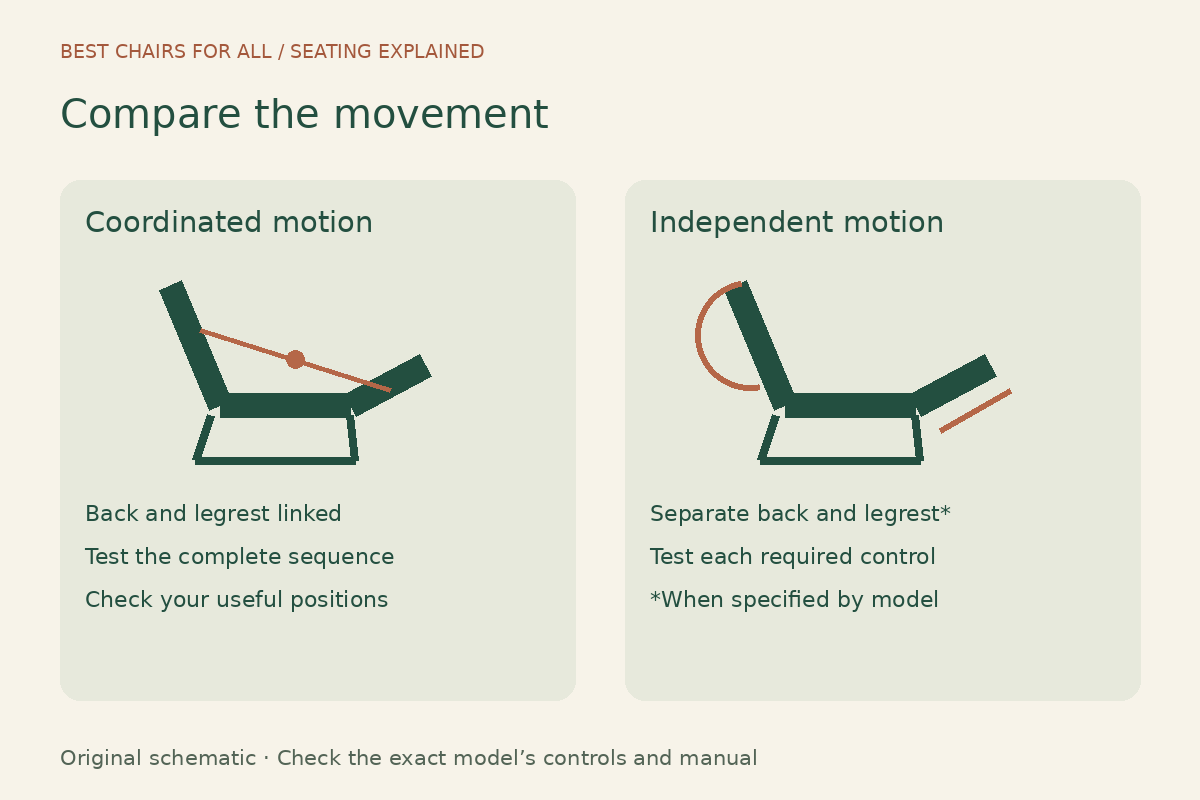
Read the exact chair’s control diagram before deciding. Manufacturers use terms such as three-position, infinite-position, comfort zones, and independent movement. Those terms do not create a universal specification across every brand. Also, two motors can serve a model-specific purpose, so confirm the functions rather than assuming the configuration from a headline.
This is a furniture comparison, not a recommendation for treating a medical condition. If the user needs help with transfers or has specific positioning requirements, include a qualified professional and an appropriate equipment retailer in the selection.
Start with movement, not the number on the listing
Write down two questions: can the footrest rise while the back stays in your preferred upright position, and can the back recline without automatically taking the footrest to an unwanted position? Ask the retailer to demonstrate both. The answers explain more than a description promising many reclining angles.
Pride’s position guide distinguishes coordinated three-position movement from true-infinite models with independently moving backrest and footrest. It also notes that the final positions and available adjustments differ among models. Use that distinction as a starting question when comparing chairs, not a reason to assume all products in either group behave identically.
| What to verify | Coordinated movement | Independent movement |
|---|---|---|
| Back and footrest | Follow the chair’s linked sequence | Have separate adjustment paths where specified |
| Everyday advantage | May offer a simpler operating sequence | May offer more useful back-and-leg combinations |
| Main showroom question | Does the sequence reach your preferred position? | Can you identify and use each required control? |
| Fit and lifting | Still need separate evaluation | Still need separate evaluation |
| Room footprint | Measure the actual model | Measure the actual model |
What a coordinated chair can do well
If your preferred sitting and reclining positions fall along the chair’s movement path, independent adjustment may add little value. A clear up-and-down control can also be easier for a particular user to learn. The important test is whether simplicity helps that person complete the whole sequence confidently.
Do not interpret three-position as a promise of exactly three usable stopping points. Ask how the control operates and where the mechanism can stop. Product terminology describes a mechanism family; the manual and demonstration establish the actual behavior.
Try ordinary activities rather than simply reaching maximum recline. Hold a book, face the television, and talk to someone beside you. If raising your legs tips your upper body farther back than you want, record that as a limitation. If you like the linked movement and do not need other combinations, paying for independent adjustment may not solve a problem you have.
What independent back and footrest adjustment adds
Separate movement is useful when you want the back in one position and the legs in another. For example, you might prefer a relatively upright back while reading with your feet supported. Another user might want a modest back angle without the maximum footrest extension.
Pride’s Infinity LC-525i product page describes independent backrest and footrest control on that collection. This is a specific example of the capability to look for. It does not establish the seat dimensions, clearance, or control layout of another chair advertising infinite positioning.
More adjustments bring an additional task: managing them. If the handset has several similar buttons, the user must be able to identify the right one and understand what will happen. A feature offers little practical value if someone avoids using it because the control sequence is confusing.
Motor count does not tell you the lifting motion
A lift chair’s reclining controls and its transition toward standing are related parts of the product but separate buying checks. Do not assume that a second motor makes the lift faster, raises the seat higher, changes the direction of travel, or increases capacity. Confirm each of those details from the relevant specification and demonstration.
Likewise, do not assume that every lift chair follows the same path. Golden’s support FAQs discuss different positioning technologies and define comfort zones as independently controlled seating regions. This is a useful reminder that manufacturers may organize additional motors around functions such as headrest, lumbar, or tilt, rather than a simple one-motor-versus-two hierarchy.
Ask the retailer to show the lift operation from the actual sitting position, with the intended user’s permission and any appropriate support. The user’s footwear, floor surface, arm reach, and ability to use the handset matter. A mechanism label cannot substitute for assessing the whole task.
Use a five-position showroom test
Make a short list before visiting the store: upright conversation, reading with supported legs, television viewing, a preferred rest position, and return to upright before getting out. These are examples of activities to assess, not prescribed postures or clinical targets.
For each activity, ask the salesperson to demonstrate the chair, then let the intended user operate the controls. Mark the result as comfortable, possible with an unwanted compromise, or unavailable. Add a note describing the compromise, such as “back reclines too far when footrest is raised.”
Repeat this on the second chair using the same activity list. Your notes become a direct comparison instead of a vague memory that one model felt more advanced. If both chairs meet every important activity, fit, service, and control accessibility can decide the purchase.
Do not extend a showroom test to positions that are uncomfortable or unsuitable for the user. Stop if there is pain, dizziness, or uncertainty about safe transfers. Equipment selection for those circumstances needs individual advice.
Measure seat fit separately from position range
A dual-motor chair can still have the wrong seat height or excessive seat depth. Record the usable seat width between the arms, seat depth, seat height, back height, and rated user capacity for the actual size. A product family may offer several sizes with different specifications.
Evaluate whether the user can sit back against the backrest without feeling forced to perch forward. Check the arm height during ordinary sitting and control operation. In the preferred reclined position, notice where support ends and whether the headrest suits the activity.
Do not select a much wider chair just to obtain a higher published capacity without also checking reach and seat depth. Similarly, an included footrest extension is a dimension to test, not proof of better fit. Write down what the user experiences and compare it with the manufacturer’s fitting guidance.
Check the remote as carefully as the seat
Photograph the handset with the retailer’s permission. Count the functions the user actually needs and identify the controls for them. Can the user read the symbols, hold the handset steadily, and stop movement when intended? Can they find the return control from the usual reclined position?
Ask whether presets move several sections at once and whether the chair must complete a sequence before another function starts. Confirm whether controls require continuous pressure. Do not rely on assumptions from another chair owned years ago; manufacturers update handset layouts and functions.
Plan where the remote will live. A side pocket on the wrong side, a short cable, or a handset that slides behind the cushion can interfere with everyday use. Put storage and cord routing on the written delivery checklist so that setup includes them.
Make room for every movement
Use the exact chair’s upright width, full reclined depth, wall clearance, and lift envelope. Mark the proposed location on the floor, then include side furniture and the route used to approach and leave the chair. A compact upright footprint does not show how much space the moving chair occupies.
Identify the power outlet and ensure the planned cable route follows the manufacturer’s instructions. Ask where the transformer and any approved backup unit should sit. Keep the delivery route separate from the operating footprint: getting a chair through the doorway does not prove it has space to work.
Ask the retailer to state the outage procedure in writing. Some backup arrangements are designed for limited emergency movement; others have different capabilities. Verify the exact included system, maintenance requirements, and what happens when the chair is reclined without mains power.
Do not buy a clinical promise hidden in a position name
Names such as zero gravity, lay-flat, or Trendelenburg describe marketing categories or positioning capabilities that still need model-specific verification. They do not show that a position is suitable for every user, and they are not a reason to ignore individual medical advice.
Pride’s VivaLift catalog identifies independent movement and other features on its listed models. Treat a catalog as documentation of features, then confirm the current model and size with the supplier. Do not turn a manufacturer’s comfort language into a claim that a chair will treat swelling, circulation problems, or back pain.
If a certain angle or support arrangement is required for health reasons, bring that requirement to a professional who can assess it. Buy against a clear functional specification rather than a position name printed in large type.
Compare service and total cost before choosing
Get itemized quotes including delivery, assembly, suitable accessories, removal, and any optional coverage. Request separate warranty details for the lifting and reclining mechanisms, motors, controls, electronics, upholstery, and labor. Ask who handles a stopped chair and whether home service is available in your area.
Keep the model number, serial number location, order, manual, and service contact together. Golden’s owner’s manual library is one example of manufacturer documentation to obtain before delivery; use the equivalent exact manual for another brand.
Choose the coordinated chair if its useful positions, controls, fit, and lifting operation meet the user’s needs. Choose independent adjustment when it resolves a specific limitation demonstrated during your comparison. In either case, an unresolved fit problem or difficult transfer is more important than the number of motors on the specification sheet.
Record the reason for the upgrade
Before paying for additional motors, complete this sentence: “The independent function is useful because it lets this user do _____ without _____.” A strong answer names an activity and a demonstrated limitation, such as reading with supported feet without an unwanted change in back angle. “It has more motors” is not a functional reason.
Keep a second list for features that sound appealing but have not been demonstrated. Ask the retailer to resolve those points before ordering rather than assuming they are included. Record the precise product suffix and size beside each confirmed feature, because a catalog family name can cover multiple configurations. If you change size, upholstery package, or control option, check which previous conclusions still apply. This creates a purchase record that a delivery team or service provider can understand later.
Something unclear or out of date? Send a correction with this article’s title and the detail to check.
Sources, research & corrections policy ↗