A saddle stool and a flat professional stool create different working positions. A saddle supports an astride position with the legs to either side of the seat. A flat or gently contoured stool supports a more conventional seated position. The better choice depends on seat fit, foot support, working height, movement, and the equipment around the user.
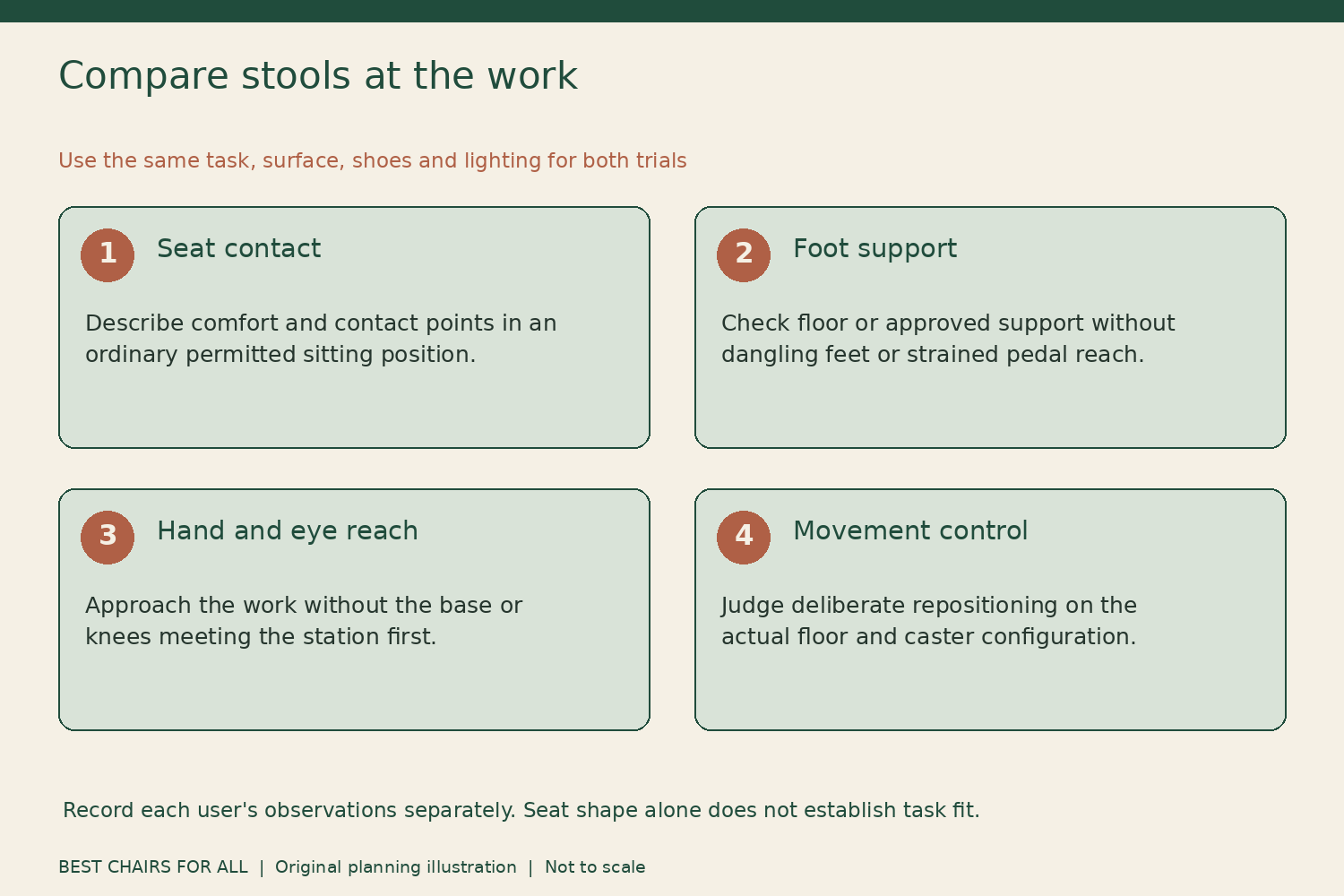
Neither shape guarantees comfort or a medical benefit. Compare actual models at the actual work surface, ideally through a supplier-supported trial. A stool that feels promising for a few minutes in an open showroom can become impractical beside a low bench, a wide client chair, or a pedal that needs one foot free.
Define the work before choosing the seat
Write down where the hands work, where the eyes look, how close the user must get, and whether the task involves a pedal or frequent changes of position. A bench task, a service beside a client, and a shared reception workstation can demand different stool arrangements. Do not choose a saddle simply because the product photograph shows someone sitting upright.
Also distinguish seated work from perching near standing height. A taller stool can be appropriate for one relationship and too high for another. If the feet cannot remain supported in the intended position, the stool's maximum height is not a useful working endpoint for that person.
Record clothing and footwear that affect the trial. A saddle's astride position may interact with an apron, uniform, or narrow space under a table. A flat stool may allow a different leg arrangement but need more clearance for the knees. These practical details can matter more than the marketing name attached to the seat.
Saddle is a family of designs
Saddles can have one piece or a divided seat, fixed or adjustable tilt, and fixed or adjustable width. Some permit movement through a swing mechanism. Others remain in a set position. Check which controls are actually included in the quoted model rather than assuming all saddle stools offer the same adjustments.
Salli's Salli model-specific adjustment instructions identifies height, tilt, width, and swing adjustments by model. It states, for example, that width adjustment is available on SwingFit and MultiAdjuster models and is not performed while sitting on the chair. That is a specific operating distinction to learn from the supplier, not a reason to adjust an unidentified saddle by force.
A divided seat may fit one user well and feel wrong to another. A narrower seat may improve access in one task while offering an unsuitable pressure distribution for another person. Treat the choice as a fitting question. Do not use a product's anatomical claims as a substitute for a comfortable, controllable trial in ordinary use.
Flat stools also vary
A “flat” stool may be round, rectangular, or gently shaped. It can have a backrest, a footring, locking casters, glides, or a height range intended for a different task. Compare the usable sitting surface and support arrangement, not only whether the seat has a saddle outline.
Earthlite's Earthlite pneumatic stool configurations describes a pneumatic rolling stool with a lever-operated height adjustment and an optional backrest. Its listed standard and low configurations have different ranges. This illustrates that a conventional seat can still require a deliberate height choice; buying the lowest advertised version without considering the work surface can be just as limiting as buying one that is too tall.
A backrest is useful only if the task allows the user to sit against it. If the work continually pulls the person forward, the apparent support may go unused. Conversely, a backless stool may be unsuitable for a person who needs more sustained support. Consider both the ordinary working posture and the opportunities to change position.
Height numbers are not interchangeable
A saddle's intended sitting position can be higher than a conventional stool's. Comparing identical seat heights therefore does not establish equivalent fit. Ask how the manufacturer measures the contoured seat and which gas-spring or cylinder option produces the quoted range. Keep the complete stool configuration attached to the measurement.
Salli's Salli gas-spring configuration guidance distinguishes gas-spring choices according to mechanism and user or working-height considerations. Its guidance is more specific than a single “short people use short cylinders” rule. Ask the supplier to select the approved complete configuration for your model and task; do not attempt to shorten or dismantle a pressurized cylinder.
For a flat stool, measure floor to the top of the seat under the manufacturer's stated conditions. For a saddle, use the manufacturer's reference and a practical trial. Do not compare one product's bare-cylinder length with another's finished seat height. Casters, base, mechanism, and seat construction can all affect the final position.
Foot support and close access
Check whether the feet rest where the intended sitting position requires them. A footring changes the support relationship and may occupy space the legs need beside a bench or client chair. It is not automatically a mounting step, and it should be used only according to the model's instructions.
Move close to the work without operating hazardous tools during the fitting trial. Notice whether the base meets the cabinet before the hands reach the task, whether knees strike a support rail, or whether the saddle's leg position is constrained by the surrounding equipment. A well-fitting seat cannot compensate for a bench structure that prevents access.
If one foot operates a pedal, test the relationship with the task equipment safely inactive. Can the other foot remain supported, and can the pedal be reached without the stool rolling away or the body twisting? Do not assume that a stool suited to free movement around a client will also work well at a fixed sewing or equipment pedal.
A controlled comparison worksheet
Choose one representative task and keep the work surface, footwear, lighting, and task materials the same. Record each stool's model, seat shape, cylinder option, base, casters or glides, and adjustment settings. Have the supplier explain controls before the user begins. Trial only ordinary positions permitted by the manufacturer.
Use separate observations for seat contact, foot support, hand reach, visibility, movement control, and ease of getting on and off. Write concrete notes such as “base meets cabinet before elbows approach body” or “height range ends before hands reach task.” Avoid a single comfort score that hides the reason a stool does or does not fit.
Repeat with the second seat, then return to the first if the trial arrangement permits. The purpose is to reduce the influence of novelty, not to conduct a scientific study. A brief informal comparison can identify obvious fit problems, but it cannot prove long-term health effects or predict every user's experience.
Worked task-fit example
Imagine a professional who works at both a higher service surface and a low fixed table. A saddle trial works well at the higher surface: feet are supported, the user can approach the work, and the seat's adjustment range is useful. At the low table, the same person must bend forward to reach the task because the work surface cannot rise.
A conventional stool may fit that lower table more easily, provided its seat and foot support suit the user. The reasonable decision could be two different seats or a change to the adjustable work surface. It is not necessary to declare the saddle a failure or insist that the person tolerate an awkward position because the stool is advertised as ergonomic.
Now consider a colleague using the same station. Their fit may differ because of leg length, body proportions, and preferred working technique. Record their trial separately. A shared seat needs usable controls and sufficient adjustment for the actual users, or a clear alternative arrangement rather than a setting everyone is expected to accept.
Movement, casters, and floor behavior
Seat shape does not determine rolling behavior. Casters, floor finish, slope, debris, and the user's task all contribute. Confirm whether the model offers locking, resistance, or other caster options and what those terms mean. A wheel that resists movement when unoccupied may behave differently when the user sits down.
Test normal positioning on the actual type of floor through a supplier-approved demonstration. Do not deliberately push the stool toward a tipping point or improvise a brake. If fixed glides are considered, verify they are an approved configuration and ask whether they change finished height or permitted use. Avoid mixing generic replacement wheels with an otherwise documented stool.
A stool that moves too easily can be distracting during precise work; one that is difficult to reposition can encourage reaching instead of moving closer. The useful choice supports deliberate movement for the specific task. This requirement applies to both saddle and conventional seats and should be judged separately from seat comfort.
Trial terms and long-term fit
Before buying, ask whether the supplier permits a workplace trial, how returns work, and whether customized upholstery or cylinder choices affect those terms. Clarify whether the delivered configuration will match the demonstration. A different wheel or mechanism can change the experience even when the seat looks identical.
Learn the adjustment sequence and keep a simple note of the settings that worked. Revisit them when the work surface, shoes, or task changes. Do not keep working through pain or persistent numbness in the hope that a new seat must eventually become suitable. Seek individual professional advice when symptoms or specific support needs affect seating choices.
Choose between a saddle and flat professional stool by the whole working relationship: seat contact, leg position, supported feet, reach, movement, and the range of tasks. The most useful evidence is a documented model configuration and a practical comparison at the work, with honest limits on what that trial can establish.
Sources and specifications checked November 6, 2026. Examples are planning exercises, not product testing.
Something unclear or out of date? Send a correction with this article’s title and the detail to check.
Sources, research & corrections policy ↗