Carry a stadium chair using the transport points and folded configuration its manufacturer provides. Before choosing a model, compare its packed shape, actual carried weight, strap arrangement, and the route from parking to your seat. A chair can be light yet broad enough to bump people in a queue, or compact enough for a trunk yet awkward on a long staircase. The useful question is how the complete package behaves on your particular journey.
This guide uses a route map and load inventory rather than a maximum walking distance or a universal strap setting. It also distinguishes carrying equipment from bench attachments. Follow the chair’s instructions for folding, closure, and transport; do not pick it up by a moving backrest strap simply because that strap is within reach. Plan the return walk with wet equipment and post-event crowds as carefully as the arrival.
Map the journey in segments
Draw the route as five stages: vehicle or transit stop, approach walk, screening queue, concourse, and seating row. Add stairs, narrow gates, turns, and any place where you need a free hand. Estimate distances from the venue’s official information or your actual route rather than a straight line on a map. A nearby parking lot can still require a long walk around a restricted entrance.
Mark where you may set the chair down without blocking movement. Also record the transport mode after the event: walking to a car, boarding a shuttle, or entering public transit. A broad flat seat can be simple to carry in an open lot but awkward in a packed shuttle. These observations help you choose a carrying shape suited to the whole route instead of optimizing only the first few minutes.
Compare real packed shapes
The GCI BleacherBack manufacturer page lists a folded shape of 16 by 16.7 by 3.5 inches and a chair weight of 2.9 pounds. It also identifies a shoulder carry strap. That is a relatively flat package whose width remains relevant in a crowd. Keep its current model identity with the dimensions because an older retailer listing may describe another version.
By comparison, the Picnic Time Ventura page lists a 20-by-32-by-2-inch flat item and adjustable backpack straps. The thin profile does not remove its larger broad outline. These examples show different transport arrangements; they are not a hands-on ranking. Neither set of specifications tells you how the chair will fit your body or how much extra equipment you plan to carry.
Weigh the actual game-day package
Put the folded chair, case if permitted, attached accessories, and items you intend to store in its pockets on a scale. Record the total separately from the manufacturer’s chair-only weight. Do not assume an occupant weight capacity also specifies how much cargo the carrying straps may hold. Ask the manufacturer about pocket and transport limits when they are not stated.
A worked example illustrates the difference. A hypothetical five-pound chair plus a one-pound bag and three pounds of drinks and clothing becomes a nine-pound carried package. That is an eighty-percent increase over the chair alone. The arithmetic is useful even without a universal acceptable weight. Replace the example with your own scale reading and reduce unnecessary items before trying to solve every carrying problem through tighter straps.
Identify the intended carry points
Read the folding and transport instructions, then locate the designated handles, shoulder strap, or backpack anchors. Distinguish them from the bench security strap and the straps that set backrest angle. If a strap is not identified, ask the manufacturer what it is for. Carrying from the wrong point can change how the chair hangs or allow it to unfold unexpectedly.
Inspect the identified carry system before leaving. Look at webbing, stitching, buckles, clips, and the points where they connect to the frame or fabric. Do not use an obviously damaged strap or substitute a loose cord through an arbitrary frame opening. Obtain the correct replacement and instructions. A replacement that seems sturdy in your hand may still create an unsuitable load path or interfere with the folding mechanism.
Set up a shoulder carry
Fold and secure the chair according to its instructions before putting on a supplied shoulder strap. Adjust only the intended hardware, keeping the chair clear of the ground and your walking stride. Check that the folded frame does not strike your leg or swing into people when you turn. There is no single strap length that fits every body, coat, or chair shape.
If the manufacturer permits more than one carry orientation, try each in a clear area at home. Record which keeps the chair controlled while allowing you to see where you are going. Do not wrap excess webbing around your hand or alter the strap to create a new configuration. If the chair cannot be carried comfortably using its intended system, consider a lighter or differently shaped model instead of relying on an improvised harness.
Set up backpack transport
For a chair with two intended backpack straps, place the folded package in the orientation shown by its maker. Adjust the two sides in small increments so it hangs evenly. Check whether a hinge, armrest, hook, or protruding fitting presses against your back. Clothing may change that contact, so try the coat or layers you expect to wear rather than judging only in a thin shirt.
Walk a short clear route and make an ordinary turn without forcing a long endurance trial. Watch the package’s side clearance as well as its pressure against your back. Backpack carrying can free hands, but it does not make a wide frame disappear behind you. Do not add a sternum or waist strap to structural points that were not intended for one unless the manufacturer approves the accessory and attachment method.
Keep access to tickets and handrails
Decide where your phone or ticket will be during screening and entry. Reaching a rear chair pocket in a queue can require taking off the entire package, while a separately permitted small bag may provide easier access. Check the actual event rules before changing the bag arrangement. Carrying convenience should be planned around permitted items rather than a last-minute collection of extra pouches.
On stairs, choose the venue’s appropriate route and keep the handrail accessible. If your chair package prevents normal safe movement, ask guest services about available route or seating arrangements instead of balancing extra gear in both hands. Do not carry several chairs on one strap unless the manufacturer explicitly supports that use. Multiple packages can shift independently and create a much broader load than a single chair’s specification suggests.
Plan screening as its own task
The Packers carry-in policy illustrates why transport features and admission features need separate review: it restricts pockets and other seat features as well as bags. Check your own event’s official policy. A comfortable carrying setup is irrelevant if the chair or its opaque sleeve cannot pass screening. Ask about the case specifically instead of assuming it enters with the chair.
Before joining the queue, secure loose straps using the manufacturer’s provided arrangement and make the chair easy to inspect. Do not hide prohibited accessories inside a folded panel. If guest services has answered a model-specific question, keep that reply accessible along with the event date. A written exchange helps explain your preparation, while actual entry remains subject to the event’s rules and staff.
Consider carrying two different objects
List the other things you must carry: permitted personal bag, rain layer, binoculars, or a companion’s necessary equipment. Compare combinations on paper. A backpack chair may conflict with an ordinary backpack, while a shoulder-carried chair may compete with a tote on the same side. The lightest chair can still be the worse package if it forces all the other items into an awkward arrangement.
Reduce duplication before buying more carrying hardware. If two family members can each use their intended chair straps, that may be more manageable than one person carrying both. Any sharing plan should reflect each person’s ability and the actual route. Do not assume that ‘hands free’ advertising means an item is suitable for every walking or access need; the complete equipment arrangement and user still determine the practical fit.
Prepare for rain and the return walk
After a wet event, follow the chair’s care instructions and any permitted temporary transport method. A wet underside may contact your clothes during backpack carrying. Decide how you will handle that before packing an extra opaque cover that the venue may reject. Do not seal damp upholstery for long storage; complete the model’s drying procedure once home.
Allow time to fold and secure the chair while remaining out of the aisle. Keep hooks, handles, and straps away from people passing in a crowded row. A package that was neat at home can be awkward when a blanket or loose jacket is draped over it. Restore the intended transport configuration rather than tying a bundle around the moving parts and hoping it remains closed.
Complete a route-and-load card
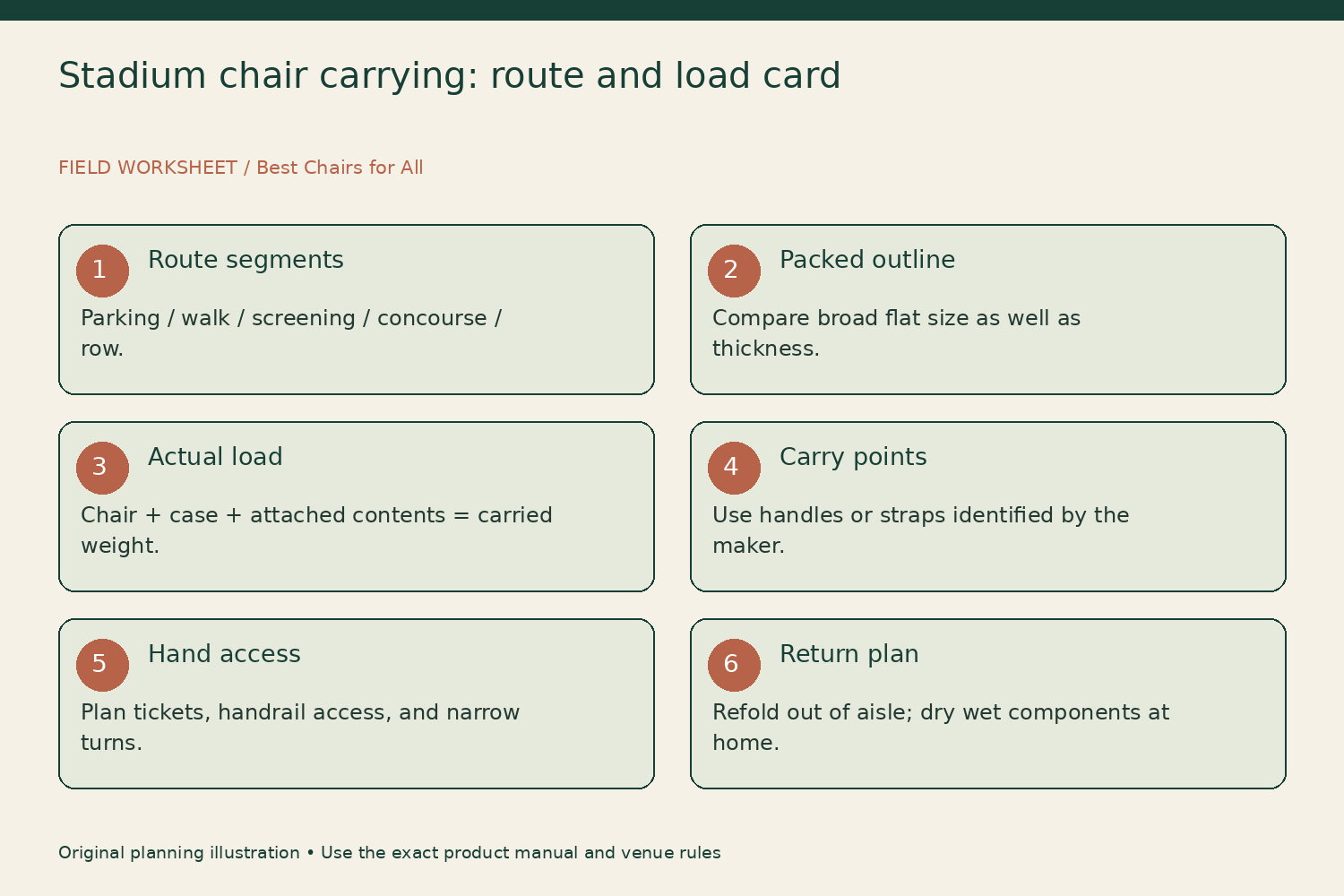
Write the route segments, longest difficult section, carried weight, packed dimensions, carry method, ticket location, and permitted case arrangement on one page. Add any model-specific folding instruction you tend to forget, using the manufacturer’s own diagram as the reference. Keep this card with your event planning notes so a different parking location or transit plan prompts a fresh look at the transport setup.
After ordinary use, record specific observations: the frame cleared the queue, the strap needed adjustment over a coat, or the chair was difficult to manage on the shuttle. These notes are more useful than declaring the item universally easy to carry. The best stadium-chair transport plan combines a permitted product, its intended carry system, a realistic load, and a route you can manage from departure through the walk home.
Something unclear or out of date? Send a correction with this article’s title and the detail to check.
Sources, research & corrections policy ↗