A high chair stands on its own base. A dining booster sits on a compatible adult chair and depends on that chair as part of the setup. Choose between them by checking the child’s eligibility, the restraint system and the complete support arrangement, rather than making a change on a birthday alone.
The support chain is the main difference
In a freestanding high chair, the seat, legs or pedestal and floor form the support arrangement. In a booster, the child sits in the booster, the booster attaches to an adult chair, and the adult chair supports the combination. The CPSC booster guidance treats booster attachment and the child restraint as distinct performance requirements. A booster’s straps around the adult chair do not replace the straps securing the child, and the child’s harness does not attach the booster to the chair.
This distinction changes the purchasing question. With a high chair, measure its footprint and its relationship to the table and route through the room. With a booster, begin by identifying a suitable adult chair. Its seat shape, dimensions, backrest and permitted attachment locations matter. The most convenient empty chair in the dining room may not be an approved support.
Read readiness and limits in the correct mode
Manufacturers can specify minimum age, developmental requirements, maximum weight and restrictions for different configurations. Record all of them. A child who meets a weight limit may still fail another requirement. Conversely, a child’s enthusiasm for the family table does not establish that a booster provides the required support. Ask the child’s clinician when there is uncertainty about their ability to sit safely or a special support need.
Convertible products need particular care. A product name containing “six in one” describes possible modes, not permission to use every mode at every age. The parts, restraint routing and attachment requirements can change during conversion. Read the section for the intended arrangement and keep unused required parts together. Do not remove a restraint simply because the seat looks more like an older child’s chair after conversion.
An actual booster manual makes compatibility concrete
The OXO Tot Nest manual illustrates an adult-chair seat at least 15.5 inches wide and 13.4 inches deep, with a backrest at least 7.5 inches high. It requires both chair-back and chair-bottom attachment straps for elevated adult-chair use and prohibits use on a stool or swivel chair. These are model-specific instructions, not dimensions for every booster.
Measure the usable support surface, rather than the outside decorative width of a chair. A deeply curved or upholstered seat can complicate the relationship even if its outer dimensions look large. Compare the intended chair’s shape and strap path with the manual, and ask the manufacturer about uncertainty. Do not route straps around an unstable decorative feature because it happens to keep the booster from sliding during an empty test.
Keep the tray and restraint decisions separate
CPSC’s high chair caregiver guidance says to use safety straps snugly and not use a tray to hold the child in the chair. A tray can make the front opening look small without providing the restraint the manufacturer designed. The same practical separation applies when a booster includes a removable tray: review the instructions for restraint and table use independently.
Plan how an adult will place the child, fasten the required straps and remain nearby throughout the meal. Do not leave the child seated while you fetch missing food, wash a tray in another room or answer the door. Set up the meal first. Neither type of dining seat is a place for infant sleep, a bath seat or a vehicle restraint.
Compare daily logistics with the complete setup
A high chair may require more dedicated floor space but avoids moving attachment straps between adult chairs. A booster may use an existing dining position but can take that chair out of adult service and need reattachment after removal. Compare the actual household routine: who sets it up, whether it travels and whether the support chair will change between rooms.
For travel, obtain the destination chair information before assuming the booster will fit. A hotel stool, restaurant pedestal seat or folding chair may be unsuitable. A portable product’s small packed size does not establish compatibility with whatever furniture is available. Bring an appropriate alternative or arrange seating with the destination when the intended support cannot be confirmed. Do not improvise by placing a dining booster on a countertop.
Calculate what changes at the table
Compare the child’s seated position relative to the actual tabletop, but keep the measurement separate from a clinical judgment about readiness. A booster raises the sitting surface by an amount dependent on its design and the adult chair beneath it. A high chair has its own seat-to-floor relationship. Catalog overall height may describe the backrest, so it cannot be substituted for seat height when checking the table.
For a hypothetical room survey, write the tabletop height, underside or apron height and the location of the chair during the meal. Then compare the manufacturer’s allowed setup. Record the presence of any table apron before comparing dimensions; it is easy to miss in a photograph. A thick table apron can reduce usable leg space even when the top surface looks appropriate. Do not select an unsuitable adult chair just to gain another inch, place a booster on stacked cushions or modify its attachment to force a better table relationship.
Keep an alternate mealtime plan available during the transition. If the booster is being cleaned, the adult support chair is needed elsewhere or a destination chair proves incompatible, use another suitable documented seat. The transition should not create a reason to use a partially fastened setup. Agree which caregiver checks the final arrangement and how the manual will be available when the product travels. That practical plan can reveal that a theoretically smaller booster is less convenient than retaining a freestanding high chair for a particular household.
Use behavior as a prompt to review, not to remove safeguards
Pushing against the table, standing attempts or climbing indicate that the setup and supervision need immediate attention. They are not reasons to loosen a harness or remove it for easier access. Review the manual’s limits and intended mode, look at nearby structures and consult the manufacturer or clinician when needed. Keep siblings from climbing on either chair arrangement.
A booster adds an important repeated check: it must remain correctly attached to its supporting chair. If that chair is moved, straps are loosened for cleaning or another adult uses the chair, the next meal requires a fresh setup check. Teach every caregiver both attachment systems. “The straps are on” is incomplete unless everyone knows which straps secure the seat and which secure the child.
High chair or booster: decision worksheet
| Check | Evidence and decision |
|---|---|
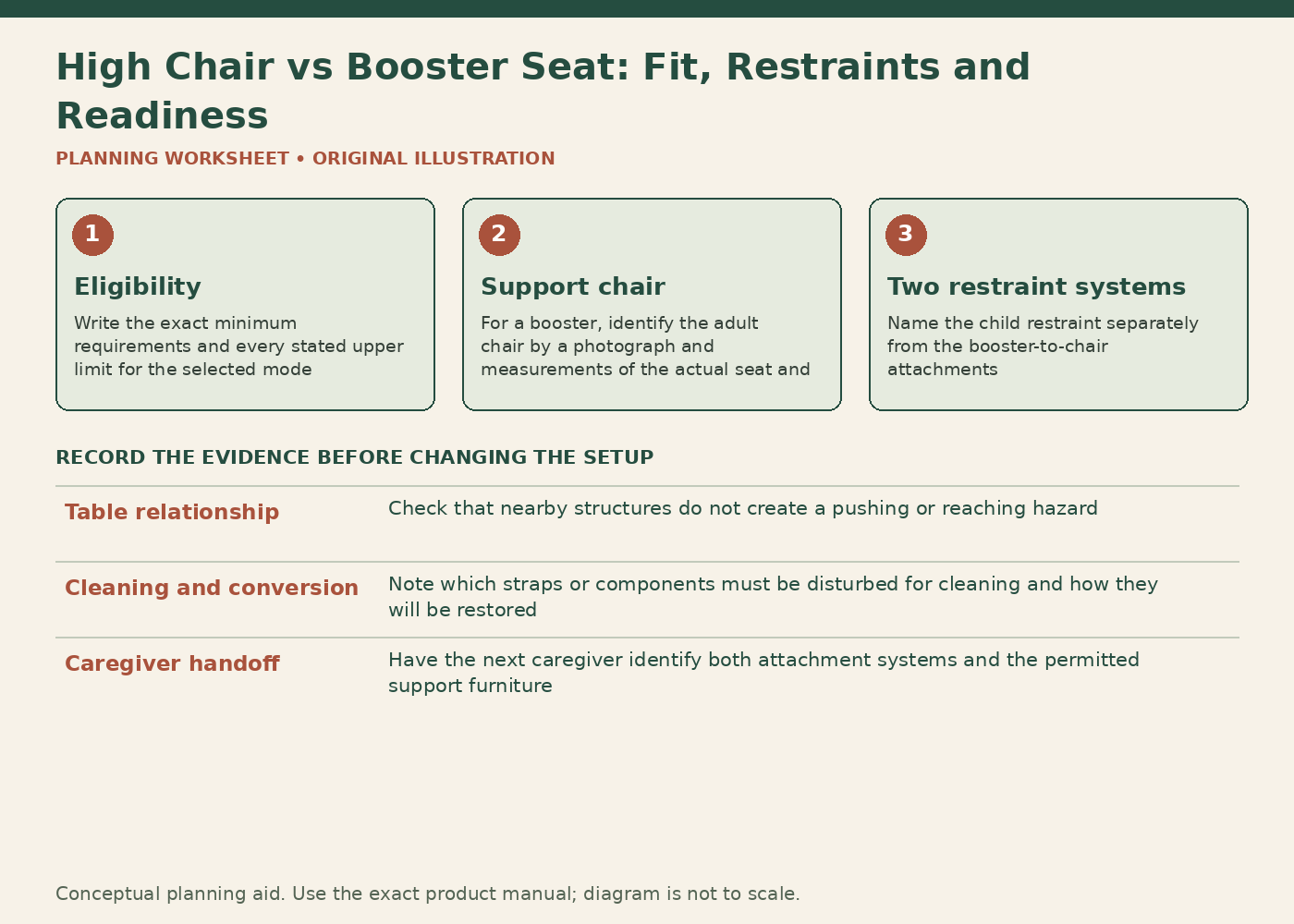
| Eligibility | Write the exact minimum requirements and every stated upper limit for the selected mode. Mark any unresolved ability or support question for the child’s clinician. Do not use an age range from a different product as permission to change seats. |
| Support chair | For a booster, identify the adult chair by a photograph and measurements of the actual seat and backrest. Confirm the allowed type and attachment route. For a high chair, record the base footprint and manufacturer-specified placement instead of inventing a support-chair requirement. |
| Two restraint systems | Name the child restraint separately from the booster-to-chair attachments. Check the required parts and routing in the exact manual. A secure-feeling tray or a high seatback cannot stand in for either system. |
| Table relationship | Check that nearby structures do not create a pushing or reaching hazard. Keep hot drinks, cords and sharp items beyond reach. Consider the adult chair’s position during ordinary dining, not only when it is pulled far away for installation. |
| Cleaning and conversion | Note which straps or components must be disturbed for cleaning and how they will be restored. Save photographs of the approved configuration. Schedule the task when another appropriate place is available for the child, rather than rushing reassembly before a meal. |
| Caregiver handoff | Have the next caregiver identify both attachment systems and the permitted support furniture. Keep the manual accessible. A quick verbal reminder should focus on the actual product’s fastening and stop conditions, not on a general claim that boosters are for older children. |
Worked example
A family wants to replace a high chair with a booster to gain floor space. Their dining chair measures 16 inches across its outer wooden frame, but the usable seat surface narrows toward the back. They also use a rotating bar stool at a breakfast counter. The OXO example dimensions and restrictions cannot be checked by the frame width alone, and the stool is not an approved alternative under that manual.
The useful outcome is a completed support-chair check before buying. The family measures the actual surface, compares its shape and backrest with the chosen booster instructions and asks OXO about any unclear fit. If the support chair cannot be confirmed, they retain a suitable high-chair arrangement or choose another documented solution. The child’s age has not answered the furniture question. Nor does a clean, undamaged booster compensate for an unsuitable base. That separation between child eligibility and furniture compatibility is what makes the choice reviewable.
Sources checked November 6, 2026
Use the current document for the exact model, market and production revision. These sources establish the cited instructions and distinctions; they do not certify an individual chair or replace a personal assessment where one is needed.
- CPSC: Booster seat definition and requirements
- CPSC: High chair standard and caregiver safety guidance
- OXO Tot: Nest Booster Seat instructions and adult-chair dimensions
- CPSC recalls and product safety warnings
Something unclear or out of date? Send a correction with this article’s title and the detail to check.
Sources, research & corrections policy ↗