A tall user’s recliner needs more than a high back. Seat depth, seat height, headrest position, lower-leg support, and the chair’s extended length must work together. Start by recording your seated proportions, then compare the exact chair in its upright and reclined positions. A big-and-tall label can describe width or weight capacity without proving that the head and legs receive the support you want.
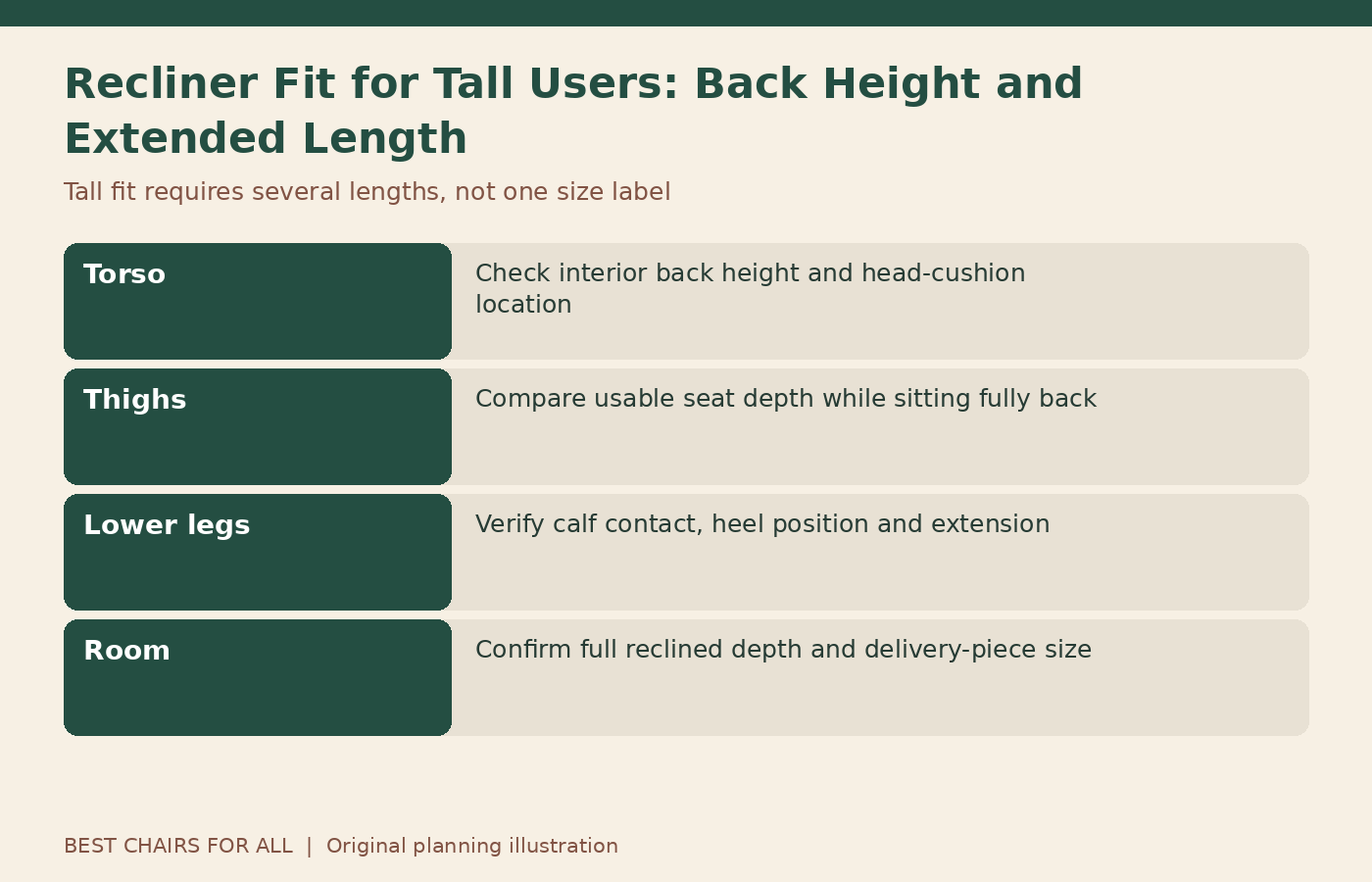
This guide uses a five-measurement fit packet and a showroom contact map. The aim is to identify which dimension is limiting the fit, rather than buying the largest-looking chair. The examples are hypothetical and do not establish universal measurements for a tall person or medical positioning advice.
Measure seated proportions before standing height
Standing height is a useful screening detail, but people of the same height can have different leg and torso lengths. On a firm chair with feet supported, record lower-leg height, the horizontal distance from the seated body to the back of the knee, seated hip width, and the distance from seat level to the top of the head. Note your usual indoor footwear and measurement method.
Pride’s sizing FAQ identifies these as separate fit dimensions. Use them to ask better questions about a candidate chair. A longer torso may make back and headrest position the main issue, while longer thighs may make usable seat depth more relevant. Standing height alone does not distinguish those cases.
Understand what back height measures
Overall chair height runs from the floor to the top of the furniture. Interior back height should describe the distance above the seat, but verify the manufacturer’s endpoints. A chair can be tall overall because the base is high while providing a modest amount of back above the cushion. That distinction matters when comparing a high-legged design with a low, deeply padded recliner.
Ask where the head cushion sits when occupied. An unusually high back is not automatically comfortable if a fixed head bolster presses behind the shoulders or pushes the head forward. Sit in the actual chair and observe support in your normal reading and resting positions. A headrest adjustment may help, but its range and operation need a demonstration.
Compare height and depth as a pair
A higher seat may suit a longer lower leg, while a deeper seat may suit a longer thigh. Neither change is universally beneficial. Check whether you can sit comfortably back, keep the feet supported upright, and avoid concentrated contact at the seat front. A deep seat selected for its tall label can still encourage an awkward sitting position if your leg proportions do not match it.
La-Z-Boy Australia’s tall-recliner guide highlights extended backs, deeper seats, and longer leg supports. Treat that as a shortlist framework. For a US purchase, verify the current US model and options separately; a regional guide does not prove that an identically named chair has the same specifications or availability in another market.
Separate reclined length from usable support
A published fully reclined length measures the furniture, not the length of a flat human support surface. Some of that length belongs to the back’s exterior, gaps, curves, or an extension below the main leg pad. Ask the retailer to identify the endpoints on a dimension drawing and explain where your head, calves, and heels should rest.
Do not compare standing height directly with overall reclined length and assume a longer chair must fit. Your knees and hips remain bent in many positions, and different mechanisms distribute length differently. Two chairs with equal overall length can have different seat depths and calf-support areas. The occupied trial is what turns the catalog dimensions into a useful fit assessment.
Make a five-zone contact map
Draw a side view with five labeled zones: pelvis and lower back, shoulder blades, head or neck cushion, seat front, and calves or heels. For each chair, write where you feel broad support, a gap, or an intrusive edge. Add the position used for the observation. This creates a record that can be discussed with a retailer without claiming a clinical ideal posture.
For example, a hypothetical chair might provide comfortable seat depth and calf support while placing the head bolster too low. Another might align the headrest well but leave an uncomfortable leg-support edge. Those are different fit problems. The contact map prevents the broad description too small from hiding which specification or adjustment would actually help.
Check the intended heel position
Heel overhang is not automatically evidence that a chair is too short. Some manufacturers intentionally support the calves while allowing the heels to sit just beyond the main footrest. Ask for your model’s guidance and examine any shaped extension. What matters is the designed support pattern and the user’s comfortable experience, rather than a blanket requirement that every heel rest flat on top.
If much of the lower leg feels unsupported, compare a verified tall version or factory extension. Do not add a board, attach an improvised platform, or use an unrelated footrest accessory across moving sections. Ask the manufacturer whether an approved solution exists. If positioning involves pain, altered sensation, or a care plan, obtain individual advice rather than relying on furniture dimensions alone.
Evaluate controls from the correct sitting position
A tall user can still find a short handle awkward to reach, especially when it sits behind the elbow or close to a broad arm. Try opening, adjusting, and closing the chair while sitting comfortably back. Observe whether you must lean sideways or twist to operate it. Ask about current manufacturer-approved handle or control options for that exact model.
La-Z-Boy’s recliner guide distinguishes manual and power arrangements and encourages a fit trial. A power control can reduce some manual operating effort, but it does not lengthen the seat or raise a head cushion automatically. Compare controls after establishing the basic seat fit so that convenience does not obscure a geometric mismatch.
A two-person proportions example
Imagine two users are both six feet three inches tall. User A has a longer torso and finds that the head bolster of Candidate One meets the shoulders rather than the neck. User B has longer legs and finds the same back comfortable but the leg support insufficient. A taller back addresses User A’s observation; different leg support may address User B’s.
If both simply search for the tallest overall chair, they can miss the relevant distinction. Record the limiting contact zone and compare the manufacturer’s corresponding dimensions or adjustment range. These invented examples explain the method and are not body-size thresholds. They also show why a friend’s comfortable chair is only a lead to investigate, not proof of a personal fit.
Test the positions used in real life
Try upright conversation, your usual reading angle, and the reclined resting position you expect to use. If the chair has a powered headrest, return it to a documented starting position before comparing candidates. Notice whether changing the back angle shifts the head cushion or calf contact in a way that requires repeated repositioning.
Use your usual indoor footwear and sit long enough to notice the normal settled position. Do not assume a brief showroom impression predicts every aspect of extended use. Ask about returns and restocking charges while fit remains uncertain. If the display model has a different cushion package from your proposed order, request a clear explanation of the possible fit difference.
Plan the larger operating envelope
A tall recliner or extended footrest may project farther into the room even if the upright width looks ordinary. Obtain fully reclined depth, required rear-wall clearance, and any side clearance for rocking or swiveling. Tape the operating envelope on the floor and include the coffee table, nearby doorway, and normal walking route. Keep numerical examples separate from actual product requirements.
Check whether the longer chair blocks access when someone else is seated nearby. If it is a powered model, plan the outlet, transformer, and cable route at the same time. A good body fit can still be a poor room fit. Do not accept a placement that requires cords under the mechanism or a table moved into a footpath.
Ask about approved size options precisely
A taller base, extended legrest, and taller back do different jobs. Ask which dimensions each option changes and whether the option is compatible with the selected mechanism. A base change may raise seat height without increasing the back above the seat. A legrest extension may change forward reach while leaving upright seat depth untouched.
Get the final item code and updated dimensions in writing. Avoid assuming an old catalog or a regional manufacturer page guarantees a current option. If a factory option is unavailable, another model may be more appropriate than an aftermarket modification. Keep the manufacturer’s explanation with the quote so that delivery can be checked against the configuration you actually tried.
Include capacity and delivery as independent checks
Weight capacity is a structural rating, not a body-fit measurement or a quality score. Verify it for the exact chair and follow any load instructions in the manual. A chair can have sufficient capacity while being too short, too deep, or poorly aligned for its occupant. Likewise, a narrow tall chair can fit the body but fail the delivery route.
Measure clear doorway openings, turns, stair landings, and elevator access. Obtain the size and weight of the largest delivered piece and ask who performs approved assembly. Do not plan to remove powered components or dismantle a lift mechanism to solve access. Resolve delivery with the retailer before committing to an order that may be difficult to return.
Keep the final fit packet
Save your seated measurements, five-zone contact maps, exact model code, options, and room plan. Add a short decision sentence identifying why the chosen chair suits your proportions. For example: back adjustment aligns the head cushion, seat supports upright sitting, and the factory extension matches the demonstrated leg-support pattern. That is a useful record rather than a claim of perfect ergonomic fit.
At delivery, verify the options and repeat the normal operating sequence with the installer where appropriate. Compare the loaded sitting position with your notes. Contact the retailer promptly if an important mismatch appears. The goal is a chair that supports the actual tall user in the intended activities, not a product that merely wins a comparison of overall heights.
Something unclear or out of date? Send a correction with this article’s title and the detail to check.
Sources, research & corrections policy ↗