For a shorter user, a recliner’s upright seat height and usable depth usually deserve attention before its extra features. The chair should let you sit comfortably back, reach the controls, and use its normal operating sequence without repeatedly perching forward. A petite label helps narrow a search but does not prove that the seat, arms, and control arrangement suit your proportions.
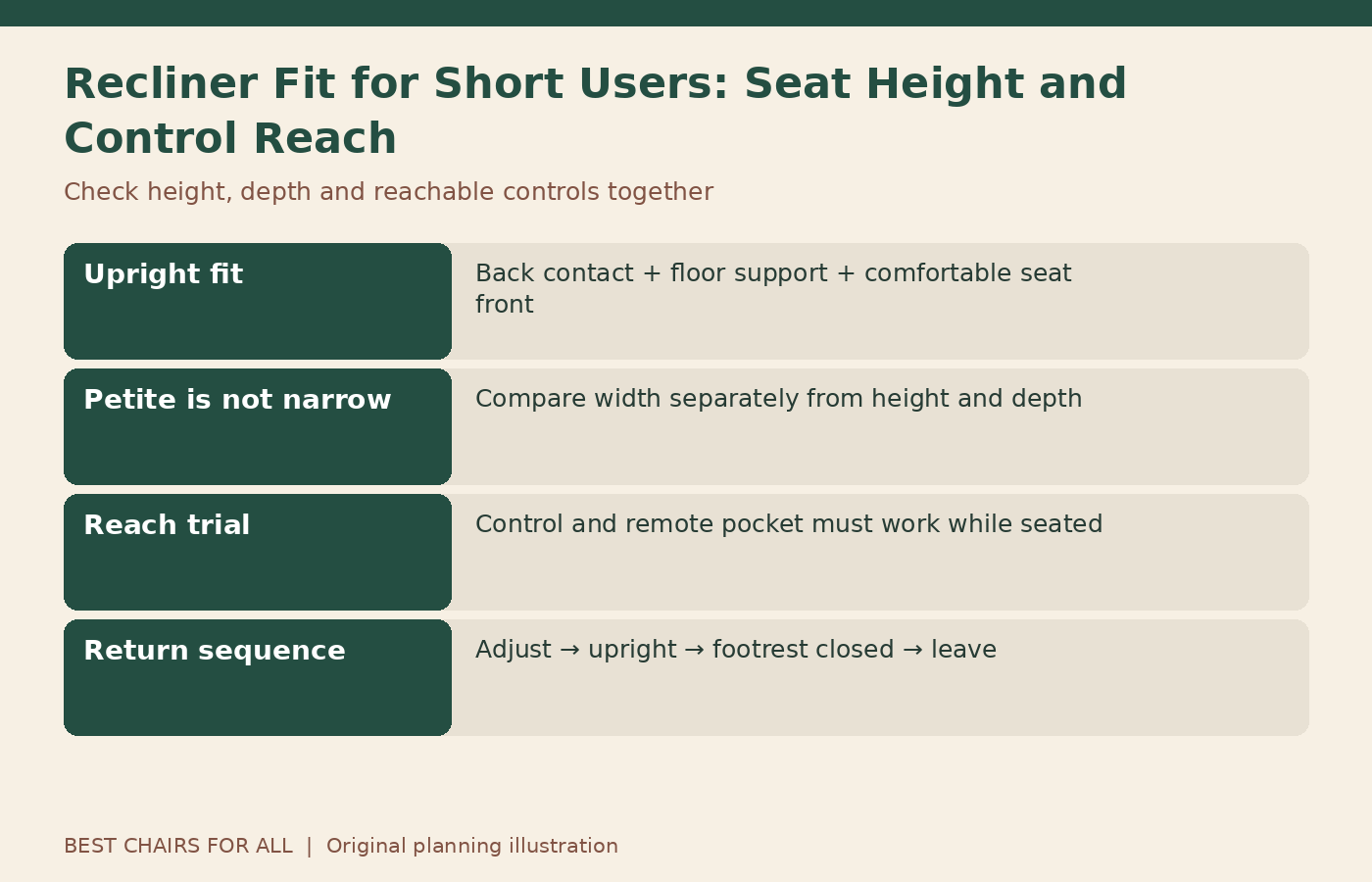
Measure your lower legs and seated reach, then use a repeatable showroom trial. This guide provides a reach-and-return worksheet that covers entering the chair, adjusting it, and returning to normal sitting. It is a furniture-fit method, not a clinical transfer assessment or a guarantee that a particular seat height suits every shorter person.
Record the measurements that standing height misses
On a firm chair with feet supported, record floor-to-back-of-knee height, the horizontal distance from the seated body to the back of the knee, seated hip width, and seat-to-top-of-head distance. Use your usual indoor footwear and note the method. If a helper measures, make sure the tape is not following upholstery curves or a sloping thigh.
Pride’s sizing FAQ separates seat height, depth, width, and backrest height. That is especially useful where a person needs a shorter seat without needing a narrow one. A wide-petite configuration can serve a different body shape from a small narrow chair. Ask for each dimension rather than treating all petite models as scaled-down copies.
Understand loaded seat height
The catalog’s seat-height figure may be measured on an unoccupied cushion. Where the user actually sits depends on cushion compression, seat contour, and the position of the body. Ask the seller how the measurement was taken. Compare the empty chair’s specification with the occupied trial rather than expecting the number alone to predict floor contact.
A cushion that compresses comfortably for one person may feel firmer or sit higher for another. Avoid promising a precise amount of settling after purchase. If the display chair fits but the proposed order uses a different cushion package, identify that difference before buying. A hoped-for break-in period is a weak basis for accepting a substantial height mismatch.
Check depth before deciding the chair is too high
Sit comfortably back with the footrest closed. If your feet do not rest as intended, notice whether the seat front reaches too far under the knees. An overly deep seat can cause forward sliding even when the height specification looks suitable. Moving forward may restore floor contact while removing the support of the back cushion, which changes the whole sitting position.
La-Z-Boy Australia’s fit guide connects seat height and depth with upright foot support. Use that combined check. Do not select solely by the lowest seat in the store; a low but deep chair may still be a poor match. Compare another seat shape or size that addresses the limiting dimension.
Use a reach-and-return worksheet
Write six actions down the page: approach, sit comfortably back, reach the control, open or adjust, return upright, and leave the chair. Next to each, record what happens without rushing. Note whether you lean, slide, twist, or ask another person to retrieve the remote. The worksheet creates a concrete description of the difficulty rather than a vague statement that the chair feels too big.
Give each candidate a separate sheet with its full item code and control type. If you try the same style as a manual and powered chair, treat them as separate trials. Operating effort and reach can differ even when the upholstery looks identical. Stop a trial if the action feels unsafe and ask the provider for an appropriate alternative or assessment.
Inspect where the controls actually sit
Side buttons can be hidden by a deep arm or positioned behind the natural elbow line. A remote may be easy to hold yet difficult to retrieve from its pocket. A manual handle can require a reach that changes as the chair reclines. Try the controls from the normal comfortable sitting position, not from a forward lean that you would not want to repeat daily.
Ask about manufacturer-approved left-side controls, alternative handles, or remote holders where available. Do not assume every collection supports those options. Get the exact configuration in writing and confirm whether it changes the item code. Avoid improvised wiring, third-party remote substitutions, or tying controls to moving upholstery without the manufacturer’s approval.
Assess arm height and head support
Arms that sit too high may encourage raised shoulders; arms that feel too far apart may reduce comfortable elbow contact. These are observations to record, not reasons to impose one numerical arm-height target. Check whether the arms remain useful when you reach for a book or operate the control. A narrow seat does not automatically provide appropriately placed arms.
The head cushion can also sit too high for a shorter torso, leaving it behind the crown rather than the intended neck or head area. Test adjustable headrests throughout their allowed range and compare a different back shape if necessary. A taller overall chair may fit a shorter user when its interior geometry works, while a low-backed model may still misalign a fixed bolster.
Compare petite and petite-wide specifications
A useful example appears in Pride’s Tranquil specification sheet, which lists size variations with separate seat dimensions. Its small and petite-wide entries illustrate that width can change while depth and seat height remain similar. Verify the current exact model with the retailer rather than using a brochure as a promise of present availability.
The lesson is to build a dimension matrix with height, depth, width, and back height in separate columns. If a petite chair is too narrow, do not automatically move to a much deeper standard seat. Ask whether another size combination exists. If a wide seat is needed, check control reach across the arms and the overall room footprint too.
A hypothetical seat comparison
Suppose Candidate A lists a 19-inch seat height and 22-inch seat depth, while Candidate B lists 18 inches high and 18.5 inches deep. A shorter user sits forward in A to contact the floor, losing back support. In B, the same person can sit comfortably back and reach the controls. Those observations make B worth further checks even before considering upholstery or extra motors.
Another user with different proportions may prefer a third geometry. The invented numbers are not universal thresholds for short adults. What matters is the repeatable observation and the explanation: the depth-and-height combination allows the intended upright position. Keep the trial conditions consistent, including footwear and any manufacturer-approved support that is part of the planned setup.
Recheck the fit when reclining
A chair can fit upright and shift the user differently as the seat tilts or moves. Try your normal reading and resting positions, following the manufacturer’s operating sequence. Notice whether the back remains comfortable, whether the head cushion changes position, and whether the controls remain reachable. Record any need to slide the body or lean to find a button.
Check the footrest’s intended support pattern with the model manual. Some designs allow the heels beyond the main pad; others use a shaped extension. A shorter user should not assume that every extension is beneficial. The issue is where the calves and heels contact the support and whether the complete chair remains comfortable through the positions you expect to use.
Evaluate manual closing effort honestly
Some manual footrests require the user to press inward using the legs in a specified sequence. Try that action with showroom guidance. If it requires an awkward movement from the comfortable sitting position, record the problem and compare alternatives. Do not force the mechanism, stand on the footrest, or accept pain as evidence that you simply need more practice.
A power recliner may address the effort required to close the leg support, but it does not automatically correct seat depth or headrest alignment. Separate these problems on the worksheet. If the need concerns assistance with standing or sitting, a lift chair requires its own guided suitability assessment rather than being treated as a universal upgrade for a shorter user.
Avoid unapproved height and depth fixes
Risers, loose blocks, added boards, and improvised platforms can change a chair’s stability and moving geometry. Do not use them to compensate for a poor fit unless the manufacturer explicitly approves the arrangement for that model. A pillow behind the back also changes depth, head support, and arm reach; it should not be assumed to solve the problem without a full repeat trial.
If a support or modification is related to a disability, medical condition, or care plan, seek individual guidance from the appropriate professional and provider. The useful furniture-shopping action is to identify what does not fit and ask for an approved configuration. Altering a powered or lift mechanism at home is outside that fit process.
Include the room and delivery route
A petite seating surface does not always mean a small exterior chair. Wide arms or a large moving base can still require substantial floor space. Obtain upright width, full reclined depth, rear clearance, and side clearance for swiveling or rocking. Tape those dimensions on the floor and check normal walking routes with the chair in the position likely to be used most.
Plan the outlet and cord route for powered models. Measure door openings and turns, and ask about the largest delivered component. Do not assume a chair marketed as small will pass every doorway assembled. Keep access and operating-space checks on a separate page so a successful body-fit trial does not obscure a delivery problem.
Confirm the configuration before ordering
Save the final dimensions, worksheet, cushion package, control location, and exact item code. Add a plain explanation of why the choice works: comfortable back contact upright, useful floor support, reachable control, and manageable return to sitting. Ask the retailer for current return and restocking terms and resolve any remaining fit uncertainty before committing to custom upholstery.
After delivery, repeat the same actions and compare the installed chair with the showroom record. Contact the retailer if the configuration or fit differs meaningfully. Keep the manual accessible to anyone assisting the user. A suitable shorter-user recliner is defined by the completed everyday sequence, not merely by a petite tag or an unusually low seat-height number.
Something unclear or out of date? Send a correction with this article’s title and the detail to check.
Sources, research & corrections policy ↗