For a nursery recliner, cord safety and moving-part safety are connected. The room must keep the supply lead, charging cables, children and pets outside the chair’s operating mechanisms while leaving adults a clear route to approach and stand.
Check the product before planning the cord
Start with the exact model and production label. The CPSC’s July 17, 2025 recall for specified Babyletto Kiwi electronic recliners concerns a USB module that can overheat and spark. Its remedy tells owners of affected units to stop using the recalled recliners and obtain the official repair kit. Simply unplugging a charging cable is not the published remedy, and a tidy room cannot correct a recalled component.
Compare all identifiers in the notice, including SKU and batch information. Do not infer affected status from upholstery color alone, or assume a current manual Kiwi is the same electrical product as an older electronic version. Ask the manufacturer if the label is missing or the production range is unclear.
Map the supply and every accessory lead
List the chair’s power supply, any approved connected accessories and separate phone or lamp cables. A short lead can pull taut when the chair swivels; an excessive loop can migrate toward the base. Follow the exact manual’s routing and swivel restrictions rather than making a universal cable-length rule. Keep connectors dry and accessible without reaching through a linkage.
Choose a location with a suitable outlet and the manufacturer-approved supply arrangement. Do not pinch a cable under the base, trap it against furniture or run it through a footrest mechanism. Avoid improvising adapters or adding an extension arrangement that the instructions do not permit. If a cord is damaged, stop using the electrical function and seek the specified service advice.
Make an empty-chair observation plan
The current Babyletto product information distinguishes motion features, which is why the room check must cover each function the actual chair has. With children and pets kept away, observe permitted glide, swivel and recline from outside the movement area. Never place a hand behind the back or underneath the footrest to feel for a gap while the chair moves.
Keep blankets, loose clothing, toys and storage baskets away from linkages. A remote control or push button can initiate movement even when the person beside the chair is distracted. Store controls as the instructions require and supervise children around the furniture. Do not interpret a low-speed motor as protection against trapping.
Plan for growing access
A newborn cannot reach a floor cable, but a crawling child may do so later. Recheck the setup when mobility and room use change, after cleaning and after visitors move the chair. Keep the baby’s sleep space separate; NIH Safe to Sleep warns against infant sleep on armchairs, including with an adult. Cord management does not change that boundary.
Topic checklist
| Checkpoint | What to record and why it changes the decision |
|---|---|
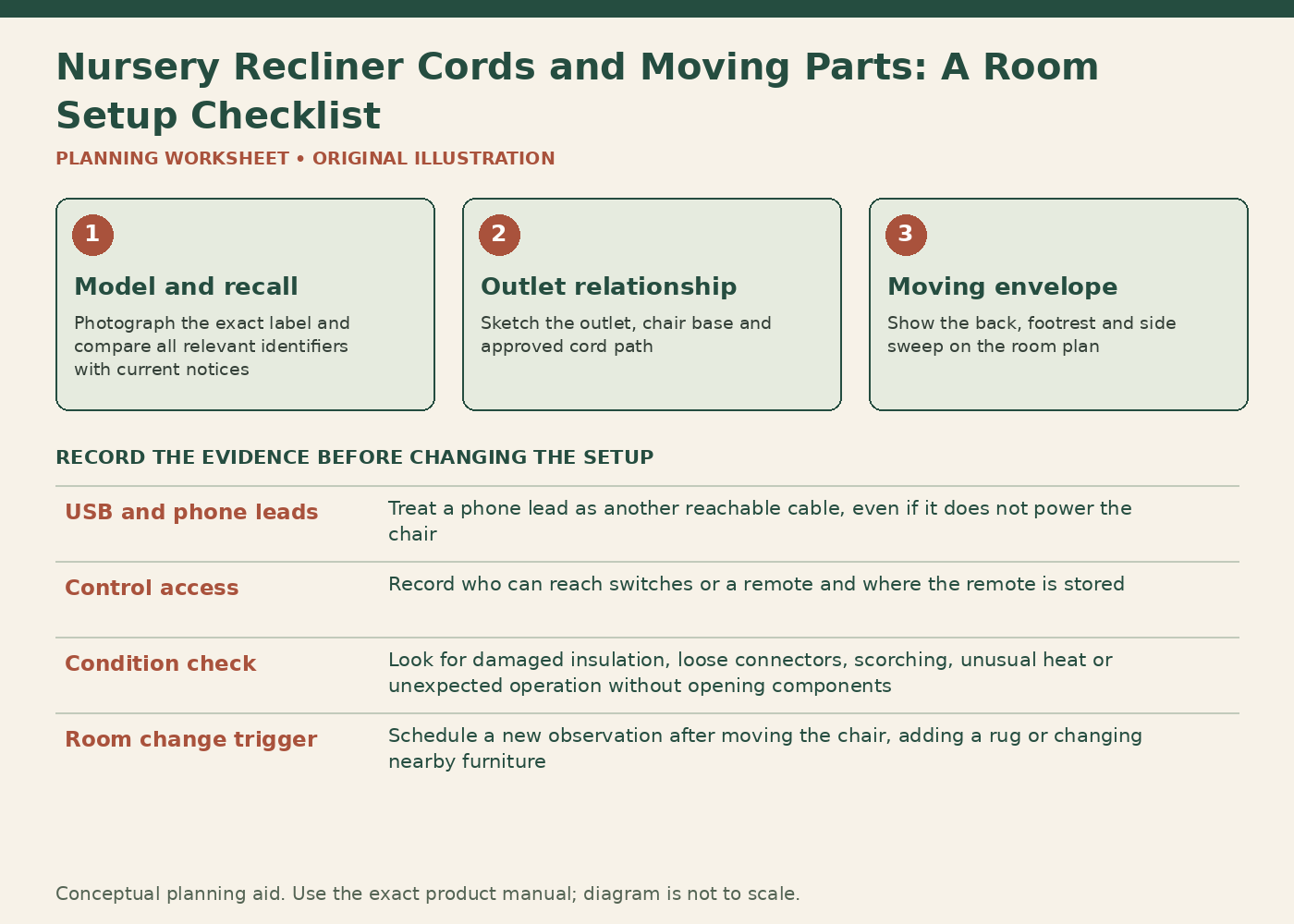
| Model and recall | Photograph the exact label and compare all relevant identifiers with current notices. Record any manufacturer response. Do not mark “safe” merely because a web search found no familiar image; unresolved identity requires follow-up. |
| Outlet relationship | Sketch the outlet, chair base and approved cord path. Identify where the lead could become taut or trapped during permitted motion. Ask the manufacturer about routing before substituting a longer lead or different transformer. |
| Moving envelope | Show the back, footrest and side sweep on the room plan. Include the adult’s ordinary approach. Keep other people outside that envelope when movement is being checked; do not use fingers as a clearance gauge. |
| USB and phone leads | Treat a phone lead as another reachable cable, even if it does not power the chair. Place and store it outside the mechanism and children’s access. A charger built into an armrest still requires model-specific operating instructions. |
| Control access | Record who can reach switches or a remote and where the remote is stored. Do not rely on verbal instructions to a young child as the only control measure. Follow any manufacturer locking or storage provisions exactly. |
| Condition check | Look for damaged insulation, loose connectors, scorching, unusual heat or unexpected operation without opening components. Stop and seek service when a fault is suspected. Do not keep cycling the chair to see whether the problem clears. |
| Room change trigger | Schedule a new observation after moving the chair, adding a rug or changing nearby furniture. Check whether the supply has been pushed toward the base. Keep the routine understandable to every adult who uses the room. |
Worked example: use the result, not just the number
An owner places a powered nursery recliner beside an outlet and neatly coils surplus cable behind the base. The setup looks organized while upright, but the coil lies in the area used by the moving chair. The correct conclusion is not that the cable needs a tighter tie. The routing must be revised according to the manual so the cable stays clear throughout permitted operation.
Before doing that, the owner discovers that the product label resembles one listed in a recall. The priority changes to comparing the complete identifiers and following the published remedy if affected. A routing improvement does not supersede a stop-use notice. The worksheet therefore keeps separate entries for product eligibility, approved wiring arrangement and physical room clearance. Each needs an answer; completing one does not automatically complete the others.
Make a cable map with distinct functions
Draw the power outlet, the approved transformer, the chair connection and any USB charging cable as separate elements. Label which cable powers the recliner and which powers another device. A phone lead can be unplugged while a powered chair remains connected; a chair can be disconnected while a separate lamp lead still crosses its path. Treating every wire as one vague “cord” makes it easier to miss a hazard.
Mark the chair’s movement around that map. A swiveling seat can rotate relative to a fixed supply, and a footrest can expose or close a gap beside a cable. Ask the manufacturer what motion restrictions and routing apply to the exact version. Do not test the available cable length by pulling the chair until the lead becomes taut. The planned position should comply with the instructions before operation begins.
Read the recall as an identification and remedy task
The CPSC Kiwi notice identifies particular production colors, SKUs and batch numbers, with the batch label under the footrest. It directs consumers with affected units to stop using the recalled recliners and contact Babyletto for the free repair kit. Read that affected-unit table directly, because a product name or approximate purchase year is not enough to establish whether a chair is included.
If the location of a label is awkward, contact the manufacturer about safe identification rather than reaching into the footrest mechanism while it is powered or moving. Keep photographs of the full label and the official response. Do not substitute a generic replacement USB module, transformer or cable for the specified recall remedy. The notice documents an overheating hazard; it does not authorize an improvised electrical repair by the owner.
Use an observer without putting anyone in the mechanism
An observer should stand where the entire relevant side of the chair is visible and remain outside every moving part. The operator follows the manual. Before any motion, confirm no child, pet, toy or blanket is beneath or behind the chair. Stop movement if a cable approaches a pinch area, the supply shifts unexpectedly or something contacts the chair. Do not reach in to rescue a cable during operation.
A successful empty-chair observation checks that arrangement at that time; it does not validate a modified mechanism or replace the manufacturer’s clearance requirements. Repeat the relevant check after moving the chair or changing adjacent furniture. If the position cannot provide the specified routing and movement, relocate the chair or ask the manufacturer about an approved alternative. Keeping the footrest permanently wedged against furniture is not a safety control.
Write a caregiver handoff that names the stop conditions
Give another adult the location of the manual, the exact chair identity and any unresolved service issue. Explain which controls operate movement and where cables must remain. Include a simple rule that the floor and mechanism area are checked before operation, especially after cleaning or children’s play. Do not make the handoff depend on noticing a cable hidden behind the back.
Name concrete reasons to stop use: visible cord damage, scorching, sparking, abnormal heat, unexpected motion, a trapped object or an unresolved recall match. Seek the manufacturer’s specified response. Do not repeatedly operate the chair to see if a fault recurs, cover a hot supply with a blanket or open an electrical housing. A well-organized room makes routine observation easier, but the condition of the product and the applicable safety notice still determine what can be used.
A room review should also include items that are added temporarily. A visitor may plug in a phone, push the chair toward the wall or drape a blanket over the arm. Explain the cable route and movement area before someone uses the chair. After furniture is moved for vacuuming, restore its documented position and check the lead again. Do not assume the original installation remains intact simply because the outlet and chair have stayed in the same room.
Official references and document checks
The linked documents below were researched for this article on November 6, 2026. Manufacturer instructions, available configurations and safety notices can change. Consult the document for the exact product in front of you; references to another market or an older revision provide context and do not establish compatibility for your chair.
- CPSC: Babyletto Kiwi electronic recliner USB recall
- Babyletto Kiwi Recliner and Swivel Glider, current model specifications
- NIH Safe to Sleep: Ways to Reduce Baby’s Risk
- Pottery Barn Kids: Babyletto Kiwi dimensions and care
Something unclear or out of date? Send a correction with this article’s title and the detail to check.
Sources, research & corrections policy ↗