Measure the full delivery route for a nursery chair, including packaging and turns. A chair that fits its final room can still fail at a narrow doorway, stair landing or elevator entrance, and assembled dimensions may not describe the carton that arrives.
Ask what will actually arrive
Obtain carton dimensions, carton weight, number of packages and the dimensions of any manufacturer-approved separate sections. Babyletto’s product page distinguishes the current chair’s assembled size and shipping information. Ask the retailer to confirm the actual SKU and packing arrangement on the order. A removable back shown in another model’s video is not permission to disassemble this chair.
Find out whether the carrier carries the item boxed, unboxes it at the entrance or performs assembly in the room. The Babyletto shipping page distinguishes parcel, Room of Choice and White Glove services. The included handling and stair limits matter as much as the furniture dimensions; do not assume “delivery” includes upstairs carrying or packaging removal.
Measure clear openings
Measure the narrow usable opening with the door in the position available to the delivery team. Include projecting handles, trim and door stops. Measure height as well as width. For stairs, record the clear width between handrails, ceiling and overhang heights, and the landing dimensions where the chair must turn. Do not remove a handrail or door without the appropriate arrangements and assessment.
An elevator needs its door opening, interior dimensions and space to turn outside. An entry vestibule may have two doors too close together to maneuver a long carton even when both openings are wide enough. Walk the route from the carrier’s access point to the nursery, recording every restriction in order.
Distinguish a diagonal from proof of a turn
Pottery Barn’s furniture delivery guide includes overall and diagonal dimensions and asks buyers to assess the whole route. A diagonal can help describe an angled entry, but it is not a guarantee that a bulky three-dimensional chair can rotate through two adjoining tight spaces. Send the route drawing to the delivery provider for difficult turns.
Account for the handlers’ working room and the need to protect the furniture. A cardboard outline can illustrate an upright footprint, but it cannot prove a heavy chair can be safely tilted overhead or carried around a rail. Avoid planning a delivery that depends on compressing upholstery or forcing a carton against a wall.
Agree on the failure plan
Before ordering, ask who is responsible if access is inadequate, what redelivery or return charges apply, and whether an access survey is available. Record building access reservations, parking arrangements and service-elevator requirements. Remove loose obstacles and protect the route as agreed with the provider. Do not attempt a last-minute powered-mechanism disassembly to rescue a failed delivery.
Topic checklist
| Checkpoint | What to record and why it changes the decision |
|---|---|
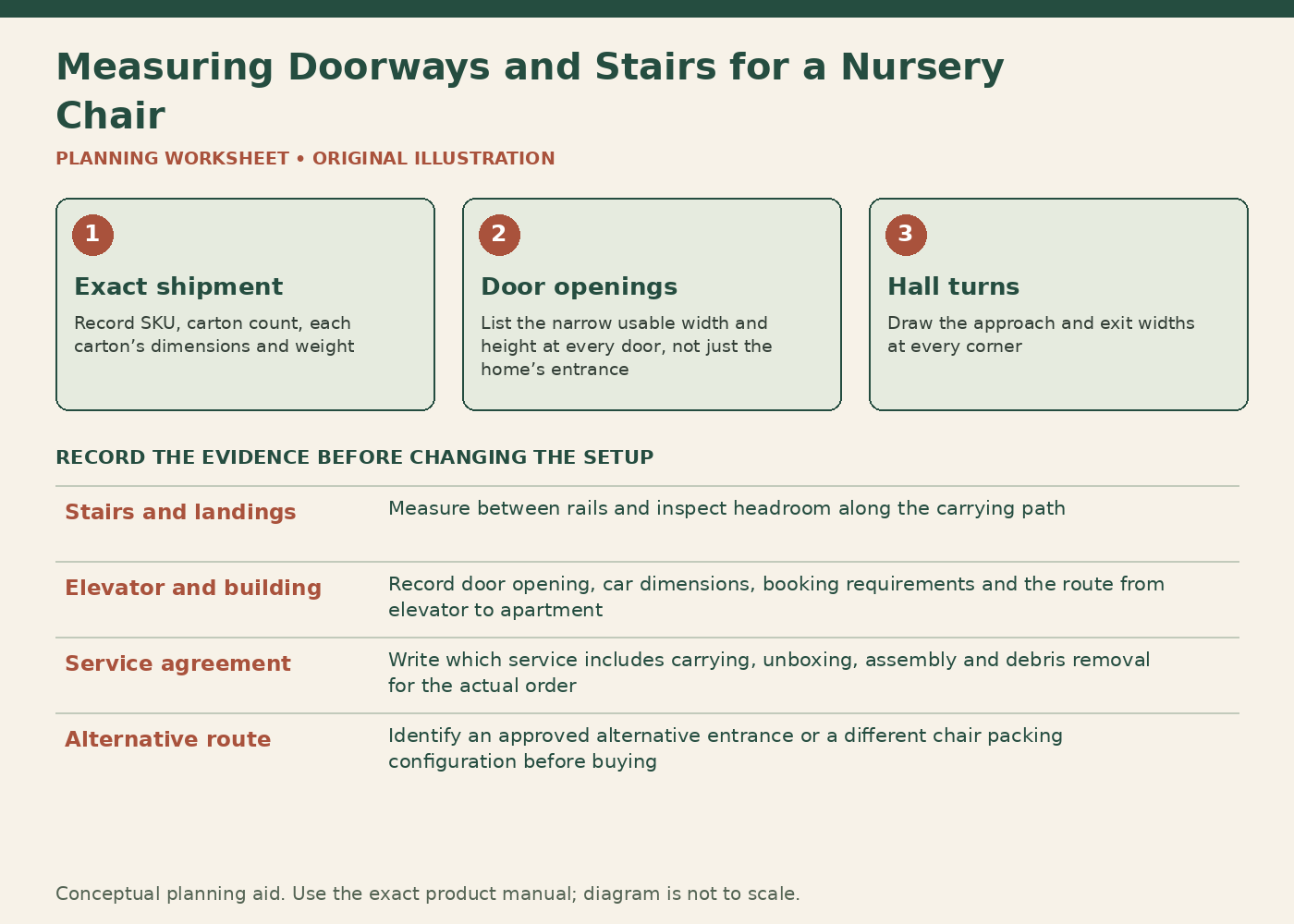
| Exact shipment | Record SKU, carton count, each carton’s dimensions and weight. Note the source and confirmation date. An assembled product width is not a carton width, and an optional base may travel separately from the chair. |
| Door openings | List the narrow usable width and height at every door, not just the home’s entrance. Include door hardware and the room immediately beyond. Record whether a delivery provider has approved any proposed door-removal arrangement. |
| Hall turns | Draw the approach and exit widths at every corner. Include radiators, built-in cupboards and other fixed projections. A chair may clear one straight opening and still lack enough space to rotate into the next corridor. |
| Stairs and landings | Measure between rails and inspect headroom along the carrying path. Note turns and landing depth. Send photographs to the delivery provider rather than assuming the stair width alone determines whether the package can pass. |
| Elevator and building | Record door opening, car dimensions, booking requirements and the route from elevator to apartment. Check what freight handling the building permits. A passenger elevator’s floor area alone does not establish access for a tall boxed chair. |
| Service agreement | Write which service includes carrying, unboxing, assembly and debris removal for the actual order. Confirm stair limits directly. Separate optional upgrades from included service so delivery-day expectations match the purchase. |
| Alternative route | Identify an approved alternative entrance or a different chair packing configuration before buying. Do not rely on window hoisting, rail removal or an improvised lift. Ask about access surveys and failed-delivery terms while choices remain open. |
Worked example: use the result, not just the number
A hypothetical chair is listed as 29 inches wide and a nursery door measures 30 inches clear. That comparison looks promising, but the chair arrives in a carton that is 32 inches across its narrowest useful orientation. The assembled width did not answer the delivery question. The buyer needs the provider’s agreement about permitted unboxing and the dimensions of the item in the form that will actually travel.
Now add a 90-degree turn immediately inside the door. Even a 29-inch unboxed width cannot prove the chair will negotiate the corner because depth, height and available rotation space also matter. The worksheet sends both the package information and the route drawing to the carrier. If access remains uncertain, select a different chair or arrange a professional access survey before paying for a delivery that depends on guesswork.
A route survey should read like a sequence
Number the route restrictions from outside to inside: entrance, vestibule, hall corner, stair flight, landing, upper hall and nursery door. For each location, record usable width, height and turning space with the actual doors and rails in place. A table of isolated doorway widths misses the order of the obstacles. A chair may need to rotate at a point where there is insufficient approach space to achieve the needed orientation.
Include fixed overhead objects, projecting ceiling features and the narrow side of a staircase. Take photographs looking both toward and away from a tight turn. Label them to match the plan. A delivery provider can then understand how one restriction relates to the next instead of receiving a photograph of a tape measure with no indication of the surrounding route.
Separate assembled, packed and approved transport dimensions
Make three rows for the chair: assembled dimensions, packaged dimensions and any manufacturer-approved transport configuration. Fill only the rows for which you have written information. If the back is removable, ask how its attachment works, whether electrical leads are involved and whether the delivery service performs that step. A video of a similar chair does not establish what may be removed from yours.
A useful hypothetical comparison is a chair measuring 29 by 38 by 41 inches assembled, with a carton wider than the nursery door. If the carrier must deliver it boxed, the carton is the governing object at that opening. If the carrier agrees to unbox it, the relevant dimensions change, but protection, handling access and the following turn still need review. Do not silently remove packaging from your calculation while ordering a service that does not include unboxing.
Confirm stair and elevator service before order placement
The researched Babyletto shipping policy describes differences between Room of Choice and White Glove delivery, including what happens to packaging and assembly. Check the current policy and checkout terms for the order, and confirm the building-specific situation with the provider. A general service description cannot guarantee access up an unusually tight stair.
For an elevator, obtain the clear opening and the car’s internal width, depth and height. Include the lobby turn, any second door and building restrictions on furniture deliveries. Booking a service elevator does not solve a carton that cannot pass through its entrance. For stairs, describe flights and landings accurately rather than calling a split staircase “one floor.” Ask how unsuccessful access is handled and who pays any return or redelivery charges.
Use mockups to find questions, not promise delivery
A lightweight rectangle matching the upright footprint can help visualize a hall turn. It cannot reproduce the height, three-dimensional profile, center of mass or handling requirements of a heavy chair. Treat a successful cardboard exercise as a reason to ask a better question, not as proof that two people can carry the furniture through the route. Do not conduct improvised heavy lifts while pregnant or caring for a baby.
Send the package dimensions, approved transport arrangement, labeled plan and photographs to the provider. Request written confirmation or an access survey when the fit is close. If the answer depends on a window, balcony or removal of fixed building features, arrange a qualified service and required permissions separately before purchase. A different chair with documented smaller transport sections can be the more practical solution than a delivery plan built around unsupported assumptions.
On delivery day, compare the package label with the order before planning any unpacking. Photograph visible shipping damage and preserve the packaging while following the seller’s damage-report process. Let the delivery team assess the agreed route; do not pressure them to force a package through a doorway because a catalog measurement looked close. If the item cannot pass, use the documented failed-access arrangement. Keeping the access measurements, service agreement and order identifiers together helps distinguish a wrong shipment from an access problem and makes the next decision more straightforward.
Official references and document checks
The linked documents below were researched for this article on November 6, 2026. Manufacturer instructions, available configurations and safety notices can change. Consult the document for the exact product in front of you; references to another market or an older revision provide context and do not establish compatibility for your chair.
- Babyletto Kiwi Recliner and Swivel Glider, current model specifications
- Babyletto shipping and delivery services
- Pottery Barn: Furniture measuring and delivery guide
- NIH Safe to Sleep: Ways to Reduce Baby’s Risk
Something unclear or out of date? Send a correction with this article’s title and the detail to check.
Sources, research & corrections policy ↗