Choose a dining chair with the older adult who will use it, testing the exact chair at the actual table whenever possible. Age alone does not determine seat height, depth, arm needs, or ease of movement. A useful chair supports the person’s preferred dining position and allows their usual approach, sitting, and standing routine without unexpected movement. If there are mobility, transfer, pain, or pressure concerns, an occupational therapist or another appropriate clinician can help assess the fit.
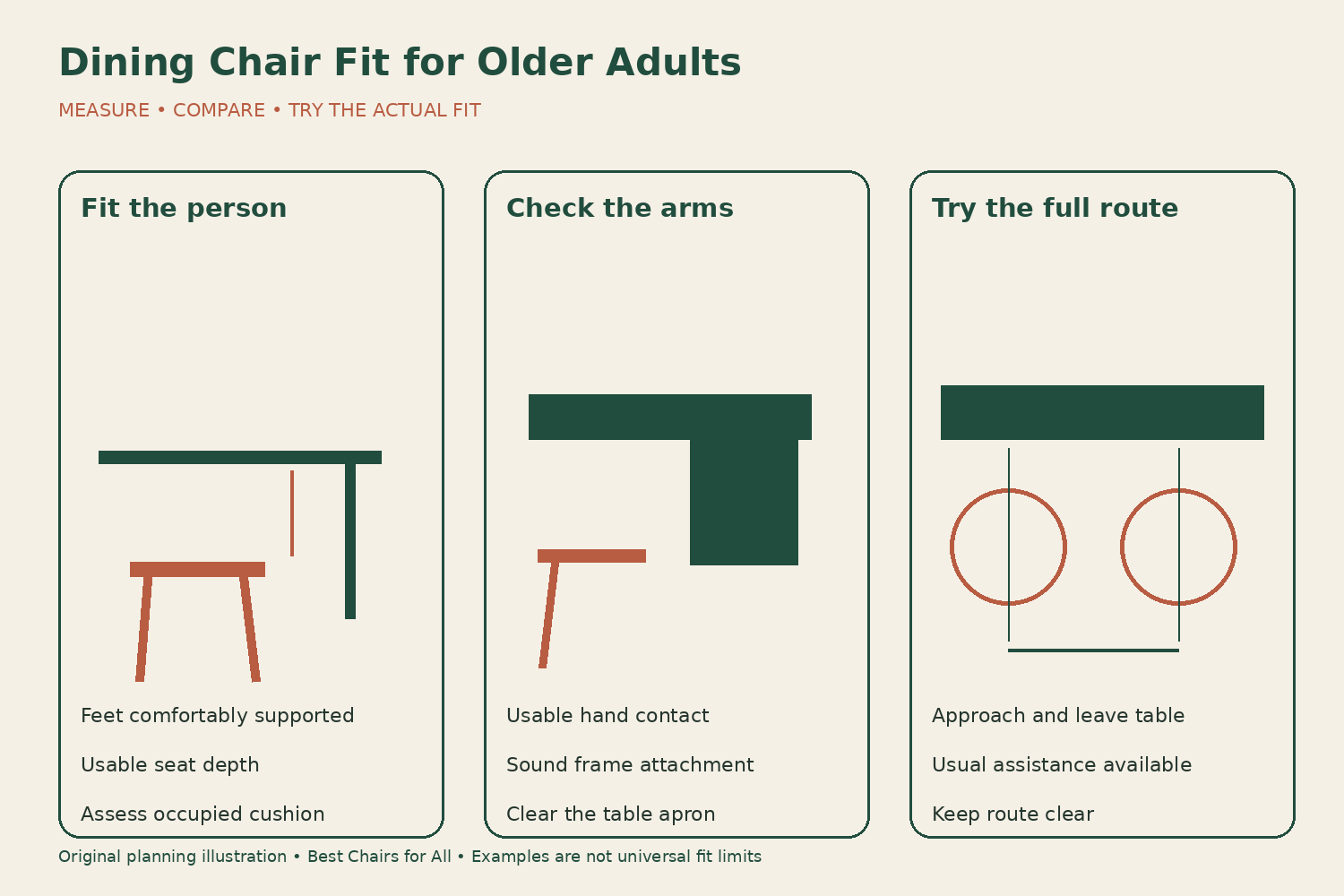
Begin with the person and the dining routine
Ask what is difficult about the current setup. Is the seat low once the cushion compresses? Are the feet unsupported? Does a table apron catch the arms? Is the chair too heavy to move? Does the person have to turn in a narrow gap? Write the specific difficulty down before searching for a chair marketed as “senior friendly,” a phrase that does not establish an assessed fit.
Include the person’s preferences. Familiarity, a comfortable back, a usable handhold, and the ability to join the table independently may matter more than matching a furniture set. Invite the person to compare chairs directly rather than selecting on their behalf from a general list of age-related features. Keep any assistance they normally use available during a supervised trial.
Distinguish a routine preference from a clinical need. Persistent pain, difficulty transferring, recurrent falls, or a prescribed seating arrangement should not be solved by an unassessed dining-chair purchase. A professional can help determine whether the table, flooring, chair, or assistance routine needs attention. Product marketing cannot make that judgment.
Compare occupied seat height
Seat height matters in relation to both the person’s legs and the eating surface. Ontario Health atHome’s chair-selection guidance emphasizes a seat height that still allows the feet to rest comfortably on the floor, along with appropriate armrests and seat support. This is a reason to test the whole seated relationship rather than simply buying the tallest chair available.
Measure the seat while considering how its cushion behaves under the user. An unoccupied thick cushion can settle lower than expected, while a hard seat stays at its manufactured height. Do not assume an advertised cushion thickness provides that amount of useful lift. Record the chair’s stated height and the person’s observed occupied position separately.
At the table, check whether the change in height reduces room beneath the apron or raises the person too close to the eating surface. A seat that seems easy to leave away from the table may still create an awkward dining posture. Test a normal place setting and the route in and out of the actual table opening.
Look at depth and the front edge
The person should be able to use the back without the seat forcing pressure behind the knees. A chair can have an attractive upright back and still be too deep for its user. If the person moves forward to find foot support, notice whether the back then becomes unreachable. Do not attribute every sitting difficulty to a need for more padding.
Ask for usable seat depth rather than relying only on the chair’s total front-to-back measurement. A thick back cushion or curved shell changes the available seat area. Try the specific upholstery configuration, since a wood-seat version and a padded version of the same design may not place the sitter in the same position.
Avoid an improvised stack of cushions as a substitute for assessment. Loose cushions can change height, depth, arm relationship, and stability at the same time. If an accessory is being considered, check that it is suitable for the chair and person and obtain professional advice where individual seating needs are involved.
Assess arms as both support and clearance
Sturdy arms can be useful to someone who normally uses them while rising. AHRQ’s home-safety checklist identifies firm chairs with sturdy armrests as providing support when getting up. That does not mean every dining armchair is suitable. The arm’s height, width, shape, projection, and connection to the frame all matter.
Have the intended user evaluate the hand contact and arm position during their usual routine, with appropriate assistance if needed. The arms should not force a shoulder position the user finds uncomfortable or sit so far away that they are difficult to reach. Do not conduct an improvised strength test by loading one arm or rocking the chair.
Measure arm height against the table’s underside and apron. Some armed chairs cannot tuck under a table, leaving the person farther from the place setting or narrowing the room’s walking route. Test the chair in both its dining and stored positions. A supportive feature that prevents suitable table access needs a different chair-table combination, not a promise that the person will adapt.
Check stability without creating a test hazard
Inspect the empty chair for loose or missing fasteners, cracked components, damaged joints, and worn floor protectors. Follow the manufacturer’s assembly and maintenance instructions. If the chair has unexplained movement or visible structural damage, remove it from use and seek appropriate service. Do not ask the person to sit on a suspect chair to confirm whether it is safe.
Try the normal sitting and standing sequence only with a sound chair and the assistance normally needed. Notice whether the chair moves unexpectedly on that floor. A swivel, caster base, or rocking form creates a different experience from a fixed frame. These features require individual evaluation rather than being classified as universally helpful or universally unsuitable.
Check the floor surface as well. A rug edge, grit, slope, or slippery protector can affect the setup. Do not remove approved glides, add makeshift anti-slip materials, or modify the legs without appropriate guidance. Any change that affects movement or stability deserves careful consideration alongside the user’s needs and the chair’s instructions.
Include the room and route
The National Institute on Aging’s room-by-room fall-prevention guidance emphasizes the home environment and the value of professional home-safety advice. At the dining table, inspect the approach route, lighting, cords, and clutter as part of the chair decision. A well-fitting chair cannot correct a blocked or difficult route by itself.
Leave the person’s usual walking aid accessible according to their established routine and professional advice. Do not position it where another diner must climb over it or where the person must reach awkwardly for it. The trial should include arriving at the table and leaving it, not just remaining seated after someone else has arranged everything.
Check nearby furniture and doors while the chair is occupied. A sideboard, refrigerator, or inward-opening door can reduce the space for movement. If the only way to leave is to ask multiple diners to move, record that limitation. A different seating position may work better even when the chair itself is unchanged.
Compare maintenance and handling
Consider who moves the chair for cleaning and meals. A heavy chair may remain steady but be difficult to reposition; a lighter chair may be easier to handle but behave differently during the user’s routine. Neither weight alone is a stability rating. Compare the manufacturer’s intended use and the observed movement on the actual floor.
Choose a care routine the household can carry out. Fixed upholstery, removable covers, exposed wood, and combinations require different cleaning. Keep the correct material instructions and avoid making the seat damp or slippery immediately before use. A surface advertised as easy to clean still needs its own approved method.
Ask about replacement floor protectors and hardware. Inspecting these small components can be a useful part of household upkeep, particularly if the chair’s movement changes. Keep the model number and service information available so a worn part can be identified correctly rather than replaced with an unrelated component that changes the chair’s height or contact with the floor.
Use a person-specific trial record
Record the user’s name or initials, usual footwear, table position, and any normally used assistance. Add the chair model, occupied seat observations, depth fit, arm reach, table clearance, and floor behavior. This is a shopping record, not a medical assessment. Its purpose is to preserve specific observations and questions for the seller or clinician.
Write down what the person says in their own terms: “feet do not rest comfortably,” “arm is hard to grip,” or “chair is difficult to pull in.” Avoid replacing those descriptions with unsupported labels such as “therapeutic” or “fall proof.” If a trial creates fatigue, discomfort, or uncertainty, stop and seek relevant advice rather than repeatedly rehearsing a difficult movement.
Compare more than one position at the table if the room allows. A clear end position may make an existing chair easier to use, while another position may have a troublesome table leg or apron corner. Record the entire setup that succeeds so the chair is not later moved into a less suitable opening during a gathering.
Recheck after the chair arrives
Confirm that the delivered chair matches the evaluated model, seat height, arms, and base. Assemble it as directed and verify that it is sound before use. Retain return information until the user has had a reasonable opportunity to assess the fit under normal conditions, within the seller’s terms. A similar-looking substitution deserves a new trial.
Revisit the setup when footwear, flooring, cushions, mobility, or assistance needs change. A chair selected at one time does not permanently resolve every seating need. The practical goal is a comfortable, usable dining place chosen with the person, supported by specific measurements and professional assessment when individual needs call for it.
Keep frequently used dining items within the person’s comfortable reach so a good chair fit is not undermined by the place setting. Ask which objects they use regularly and arrange the trial accordingly; a chair demonstration with an empty table omits that part of everyday use.
Something unclear or out of date? Send a correction with this article’s title and the detail to check.
Sources, research & corrections policy ↗