Stadium chair hooks and straps are different attachment systems, and neither is universally compatible with every bleacher. A hook engages a particular bench edge or underside; an attachment strap follows a specified route around the bench. The right choice depends on the chair’s instructions, the bleacher’s profile, and the venue’s permission. Do not choose by assuming that one attachment name always means stronger or safer than the other.
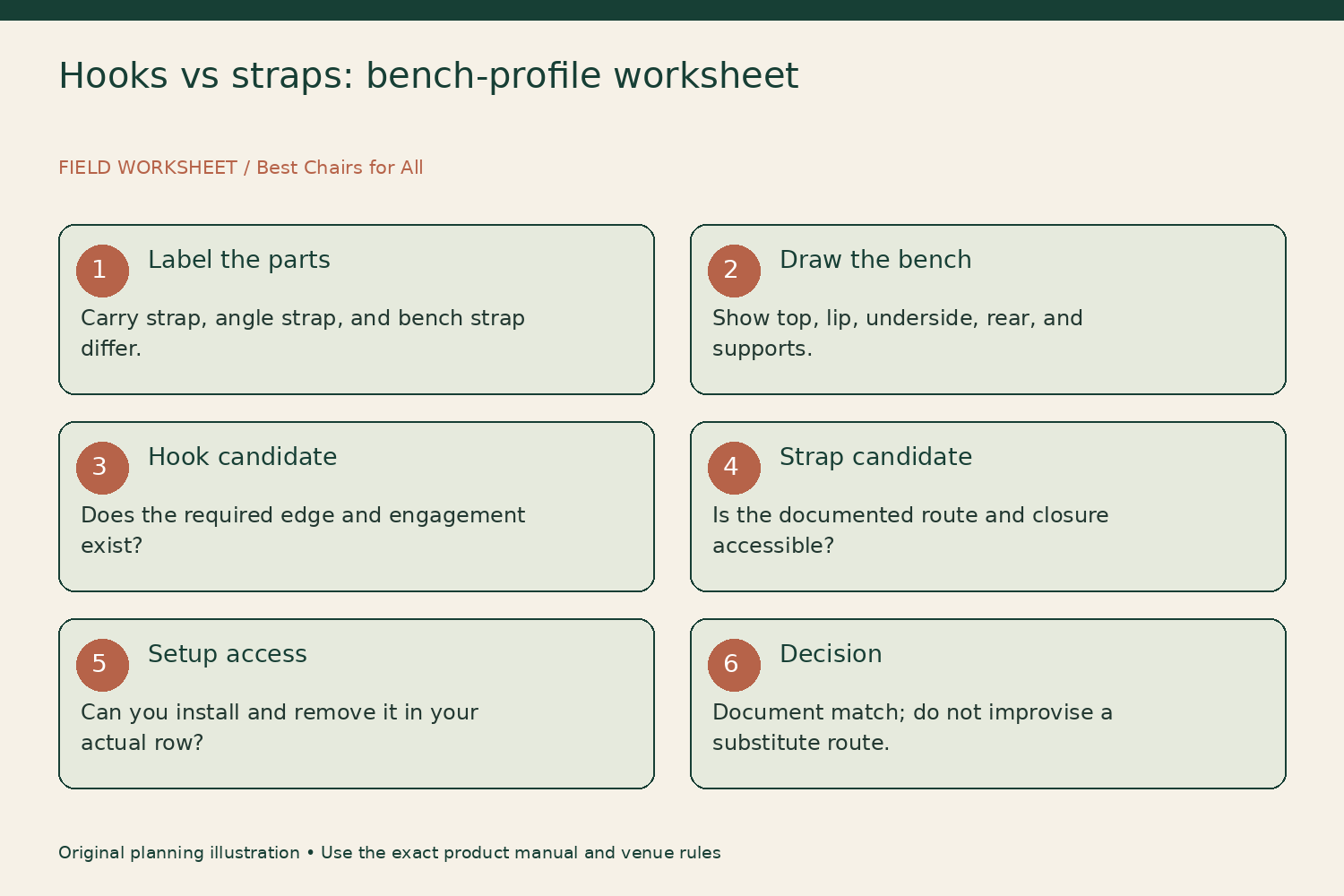
Begin by distinguishing a bench attachment from a carrying strap and a backrest adjustment strap. They can all appear on one seat but serve different purposes. This guide provides a bench-profile worksheet and a documented comparison of actual product descriptions. It explains the questions to resolve before purchase without inventing a universal hook dimension, strap tension, or improvised way to secure a chair to stadium property.
Identify the three jobs straps can perform
A carry strap supports the folded chair during transport. A side adjustment strap may control the angle between a soft seat and its backrest. A bench attachment strap is intended to connect the seat to the bench in the manner shown by the manufacturer. Follow the parts diagram rather than deciding from where a strap happens to hang when the seat is open.
Label each strap on a photograph before using an unfamiliar chair. Include buckles, stitched anchor points, and any hook-and-loop sections. If a listing simply says ‘adjustable straps,’ ask which job they perform. The phrase does not establish that the chair includes a bleacher attachment. Likewise, backpack straps do not become bench straps when a chair lacks the attachment you expected to find underneath it.
Understand what a hook requires
A hook needs access to the edge or underside it is designed to engage. The GCI Big Comfort Stadium Chair with Armrests describes a rotating L-hook specifically for open-front bleachers. That wording is more useful than a broad claim that it fits stadiums: it identifies a bench characteristic that you can check before bringing the chair.
A closed riser, decorative fascia, thick edge, support bracket, or attached seat can interfere with hook access. Do not assume that a metal hook may be bent wider or rotated into an unintended position to work around the obstruction. Ask the chair maker for its permitted bench dimensions and an attachment diagram. If the documented engagement cannot be achieved, choose another permitted seat rather than making a partial connection look convincing.
Understand what an attachment strap requires
A strap needs an accessible path and the closure arrangement specified by its maker. The Logo Stadium Seat listing at Academy identifies a hook-and-loop closure strap for connecting that seat to a bleacher. This is a retailer’s description of a named model, not a substitute for its full instructions. Before purchase, obtain the routing diagram and any limits on bench depth or shape from the manufacturer.
A continuous front panel or closely positioned support may make a wraparound route impossible. A very deep bench can also require more strap length than a product provides. Do not extend an attachment with cord or a spare luggage strap unless the chair manufacturer expressly approves that arrangement. The original buckle, webbing, anchor points, and routing belong to a complete design; replacing one changes more than the distance around the bench.
Draw the bleacher profile
On paper, draw a side view of the bench top, front edge, underside, rear edge, and nearest support. Mark what is open and what is blocked. Add measured thickness and depth when the venue permits measurement or supplies dimensions. Photograph the same profile if possible. A top-down photograph of a long bench rarely shows the feature that decides whether an attachment can engage.
Next add the attachment route from the chair’s manual to the drawing. For a hook, mark its intended bearing point and required access. For a strap, mark its route, buckle location, and accessible closure area as documented. Leave missing information blank and ask the manufacturer to resolve it. Do not invent an acceptable engagement depth or tension simply to complete the sketch.
Use a three-bench comparison
Consider three hypothetical benches. Bench A has an accessible open front and underside. Bench B has a full-height closed front panel. Bench C has a shallow top with a support directly beneath the proposed chair position. These descriptions do not establish compatibility on their own, but they show why the same attachment can face different obstacles at different facilities.
For each bench, complete two questions: can the documented attachment physically reach its intended location, and may it be used there? Bench A might offer access but still be at an event prohibiting portable backrests. Bench B might prevent one hook design while also blocking a wraparound strap. Bench C might have room at another ticketed position but not yours. Ask about the actual seat location rather than the stadium in general.
Check the chair instructions, not just a product label
The VEVOR stadium seat instructions for KZ-SS001, KZ-SS002, and KZ-SS003 illustrate why model identity matters: the document shows different seat arrangements and directs users to secure the attachment before sitting. Read the original diagrams for your model and request the current manual from the supplier. A general online transcription may omit a visual detail central to installation.
Compare the received chair with the manual before leaving home. Confirm that the hook or attachment strap is present, undamaged, and matches the drawing. If the instruction sheet describes a different model, resolve it with the seller. Do not use a photograph of a neighboring product in the same catalog as installation guidance. Similar upholstery can hide a different frame or underside arrangement.
Inspect the particular attachment
For a hook, look for visible bending, cracking, looseness at its mount, and interference with the intended rotation or storage position. For webbing, inspect the documented load-bearing length, stitching, closure, and buckle for obvious damage or missing parts. These are visual checks, not proof tests. Keep a damaged chair out of use and ask for the specified replacement and fitting procedure.
Do not test an attachment by leaning far back, rocking the chair, or pulling hard enough to deform it. Follow only the pre-use check the manufacturer provides. If the manual gives no clear way to confirm correct engagement, ask for one. The goal is repeatable installation according to the design, not a personal demonstration that an uncertain connection survives one forceful attempt.
Separate attachment from backrest angle
An attachment helps position the seat as described by the maker; it does not automatically authorize every reclining position in a crowded row. A soft backrest with side straps can still change the space it occupies behind the bench. A rigid back can also project into another spectator’s area. Record the permitted open footprint and the venue’s clearance rules separately from the attachment choice.
Do not tighten a side adjustment strap around the bench merely because the bottom attachment does not fit. That strap may be intended only to control the seat-to-back angle. Conversely, do not use a bench strap to pull a recliner into an angle the frame does not support. When several straps are present, a labeled parts diagram is the simplest way to keep their roles clear.
Consider setup in an occupied row
Think through the documented installation sequence before the event. Can you reach the closure without invading another person’s seat, entering a restricted area, or blocking the aisle? Can the chair be removed in the same way after the event? A system that is easy to fit to an empty practice bench may be awkward in a crowded section with limited underside access.
Ask the venue when and where you may set up the chair. Keep detached straps and carrying handles from trailing into walking areas, following the chair’s instructions for storage. Do not fasten the chair to rails, guard structures, another spectator’s equipment, or a venue-installed backrest unless the manufacturer and venue explicitly permit that exact arrangement. An available metal bar is not automatically a suitable attachment point.
Make a purchasing decision without ranking by name
Use columns headed hook candidate, strap candidate, and permitted simple cushion. Add rows for venue admission, bench profile match, attachment instructions, installation access, open footprint, carried shape, and replacement-part support. Record evidence rather than assigning arbitrary points for metal or webbing. A hook can be a poor match for a closed bench, while a strap can be a poor match where no permitted routing path exists.
A cushion may be the appropriate result when neither attachment system is documented for the location. It provides a different function and should not be described as equivalent back support. If your main need is a backrest, ask about venue-installed rentals or other seating options. The useful outcome is a permitted, understood arrangement rather than forcing a preferred chair to work at every event.
Keep the bench-profile sheet for future visits
Store the drawing, chair model, manual link, and venue response together. Add the event date because facility arrangements can change. When attending a new venue, reuse the worksheet format but research the new bench and policy. Do not carry forward a ‘fits bleachers’ conclusion from one facility to another without checking the attachment geometry and event rules again.
The decisive distinction is practical: hooks need their specified engagement, straps need their specified route and closure, and both need an approved chair-and-bench arrangement. Identifying the actual hardware and bench profile makes that decision far clearer than choosing a material or relying on a generic stability claim. If a necessary dimension or instruction is missing, obtain it before the chair becomes part of your game-day plan.
Something unclear or out of date? Send a correction with this article’s title and the detail to check.
Sources, research & corrections policy ↗