A backpacking stool is worth considering when your main need is a quick perch and you do not need a backrest. A backpacking chair earns its extra structure when leaning back is a meaningful part of your camp routine. Compare the exact packed packages before assuming the stool saves weight or space: the simplest looking seat is not always the lightest, shortest or easiest to carry.
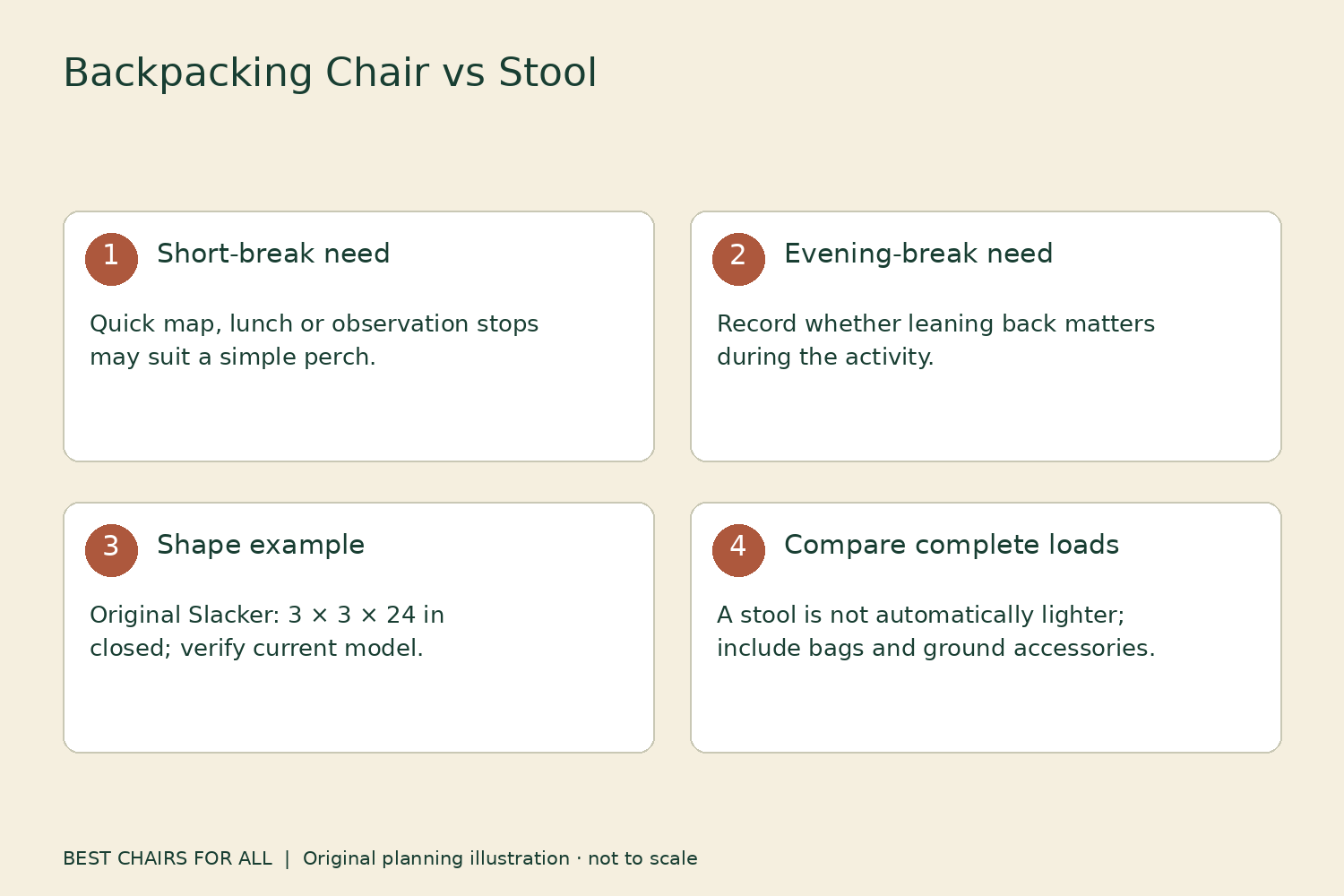
The decision also depends on how you sit. A narrow tripod seat, a broad low sling and an upright folding seat place the body differently. None can be evaluated adequately by the word “portable.” Use the short-break and evening-break exercises below to decide what support you will use, then check that the resulting package fits your loaded backpack.
Start with the sitting you actually do
List your usual seated moments on a walking trip. A ten-minute lunch, a pause for birdwatching, sorting equipment and reading at camp are different tasks. Write beside each whether you usually lean against a backrest, sit forward, or stand frequently. This is a record of preference, not an assessment of posture or a medical recommendation.
If most pauses are brief and you prefer to remain upright, a stool can be a practical tool. If you spend an hour at camp with a book, a backrest may be the part of the chair you value most. Avoid deciding by a hypothetical expedition with a completely different routine. The seating system must earn its place on the walking trips you actually take.
A third option is to carry no elevated seat, or to use a purpose-made sit pad where appropriate. That option changes support, insulation and ground contact; it is not equivalent to a stool. Include it only if you are comfortable with that style of break. Do not rely on finding a suitable log or rock at every campsite, and do not disturb sensitive ground to construct a seat.
What a backrest changes
A chair offers a surface behind you, but its height and angle vary. A low scoop chair may support the lower and middle back while leaving the head unsupported. A taller back can add weight and packed length. Try the actual model before treating “with backrest” as a complete comfort specification.
A stool normally leaves the torso unsupported. That can be acceptable for a short task and less appealing for a long pause. Do not buy a stool with the plan to lean it against a tree unless its instructions explicitly allow that use. External objects change the support arrangement and can damage the seat or create a tipping situation.
REI’s camp chair guide distinguishes stools from scoop and other chair designs. Use those categories to understand the options, then compare the actual seat shape. A triangular stool and a rectangular stool can feel different even without a backrest. Narrow edges, seams and the position of the legs deserve a normal sitting trial.
Packed length can reverse the apparent winner
The TravelChair Original Slacker is listed with a closed size of 3 by 3 by 24 inches and a weight of 1.9 pounds. Its long narrow form is the important lesson here. A stool can make a slim package while still being longer than many disassembled pole-frame chairs.
The Helinox Chair Zero page lists a packed weight of 531 grams for the linked version. This is a specific manufacturer’s example showing why “stool must be lighter than chair” is unreliable. It is not a recommendation to buy either item or a claim that every Chair Zero variant has the same package.
Compare like measurements. A bare stool weight and a chair weight with its bag are not perfectly matched figures. Record the stated convention, then add accessories you need. If you own both candidates, weigh complete packed systems on the same scale. For a purchase, ask for missing information rather than quietly assigning the bag a guessed weight.
Measure support and reach together
Sit in the intended footwear, with the seat fully opened and on ground allowed by its instructions. Check whether your feet reach a comfortable position and whether the seat edge presses against you. A higher stool can put you above a low backpacking chair while offering much less surface to shift around on.
Try the task you expect to do, such as holding a map or organizing a small bag. Keep heavy packs and sharp tools off your lap during the initial fit trial. If the seat requires you to keep repositioning to avoid an uncomfortable seam, write that down. A low published weight does not make that issue disappear during a longer break.
Do not evaluate support by leaning a stool back onto fewer legs or rocking a fixed chair. Use each as designed. A tripod may always establish three ground contacts, but that does not prove it is stable on every surface or during every reach. The support area and the position of your load still matter. Follow the manufacturer’s capacity and use restrictions for that model.
Two breaks, one comparison record
Run a short-break simulation first. Pack the seat where you would carry it, retrieve it, set it up, sit briefly and put it away. Note whether access requires emptying the backpack or removing other equipment. A seat that is cumbersome to retrieve may be left packed during the very short pauses that motivated buying it.
Then try an evening-break simulation in a place permitted by the instructions. Sit for the kind of ordinary activity you expect at camp, without forcing yourself to endure discomfort. Notice whether you use the backrest if one is present, how often you change position, and whether you can stand normally. Stop whenever the seat or your movement feels unsuitable.
| Question | Stool | Chair |
|---|---|---|
| Accessible in the loaded pack? | Try actual retrieval | Try actual retrieval |
| Setup understandable? | Inspect opening and locks | Inspect frame and seat attachment |
| Short task comfortable? | Record seat-edge contact | Record seat-edge contact |
| Longer pause supported? | Record need for a backrest | Record whether backrest is used |
| Standing manageable? | Normal movement only | Normal movement only |
| Complete packed system fits? | Measure all components | Measure all components |
This record deliberately keeps access and comfort separate. A chair can win the evening trial and lose the packing trial. A stool can be effortless to deploy yet fail the longer activity you value most. Decide which observations correspond to essential needs and which are preferences. Do not turn an essential failure into a passing average by adding unrelated good scores.
Ground and accessories belong in the load
A narrow foot can sink into soft soil. A larger base or model-specific accessory may address that issue, but you must verify compatibility and permitted use. Do not assume every backpacking chair accepts the same ground sheet or that three stool legs eliminate sinking. Inspect the surface where all supports will land before sitting.
If an accessory is essential for the ground you commonly encounter, count its mass and bulk from the beginning. A chair advertised as exceptionally light may become a different carried system after you add a bag and ground support. That can still be worthwhile, but the honest comparison includes the equipment you would actually pack.
Keep accessories attached or stored as directed so they do not become loose pieces to lose at a rest stop. A missing foot can make a compact seat unusable. For trips through sensitive habitats, use appropriate durable surfaces and follow local camping guidance rather than moving vegetation or digging individual supports into place.
Inspect the load-bearing fabric
On both stools and chairs, the seat fabric is part of the structure. Examine the points where it meets the frame, particularly reinforced corners and seams. A little wear in a storage pocket is different from a split in the seat or a torn pole pocket. Do not rely on repair tape to re-establish a structural load rating.
Check the folding mechanism or pole connections before every trip. A stool can be mechanically simple while still depending on a central joint, straps or locks. A chair can have more components without being difficult to inspect if you know its intended setup. Learn the inspection points from the specific manual rather than counting parts as a substitute for evaluating condition.
Consider replacement support when selecting gear for repeated trips. A compatible seat, foot or approved repair may keep a sound frame useful. Ask about the exact version and provide a model label when seeking parts. Support availability is valuable information, but it does not authorize improvised changes or establish that a worn seat is safe to keep using.
Make the choice at the pack, then at camp
For a stool, the strongest case is a short-break routine where quick access, a manageable folded shape and acceptable unsupported sitting all align. For a chair, the strongest case is a routine where the backrest provides enough value to justify its actual package. There is no need to impose a universal weight allowance on every walker.
Do not use a backpacking stool as a stepping platform or a support for luggage simply because it has a capacity label. A seating capacity describes the intended occupied use; it does not authorize concentrated standing loads or using the product as camp furniture for another purpose.
Before buying, mark a proposed storage position in the loaded pack and confirm the dimensions. After borrowing or trying a candidate, keep one sentence about the most important observation: “I wanted a backrest after dinner,” or “I used the stool at every short stop.” Those concrete experiences make a better decision than category assumptions. Choose the system you will carry and use within its instructions, with the support you actually want.
Something unclear or out of date? Send a correction with this article’s title and the detail to check.
Sources, research & corrections policy ↗