As an Amazon Associate, we earn from qualifying purchases. Read our affiliate disclosure. Amazon buttons open searches for matching listings; they do not confirm seller, configuration, price or stock.
For a shorter user, seat depth matters as much as height
The best office chair for short people must let the user reach the backrest while keeping the feet supported. A low cylinder alone does not make a deep seat suitable. Our shortlist is Herman Miller Aeron Size A, Steelcase Series 1 ordered with a low cylinder, and Haworth Soji ordered in its low-position configuration with a sliding seat. These are specific builds, not a claim that every listing under those model names is petite-friendly.
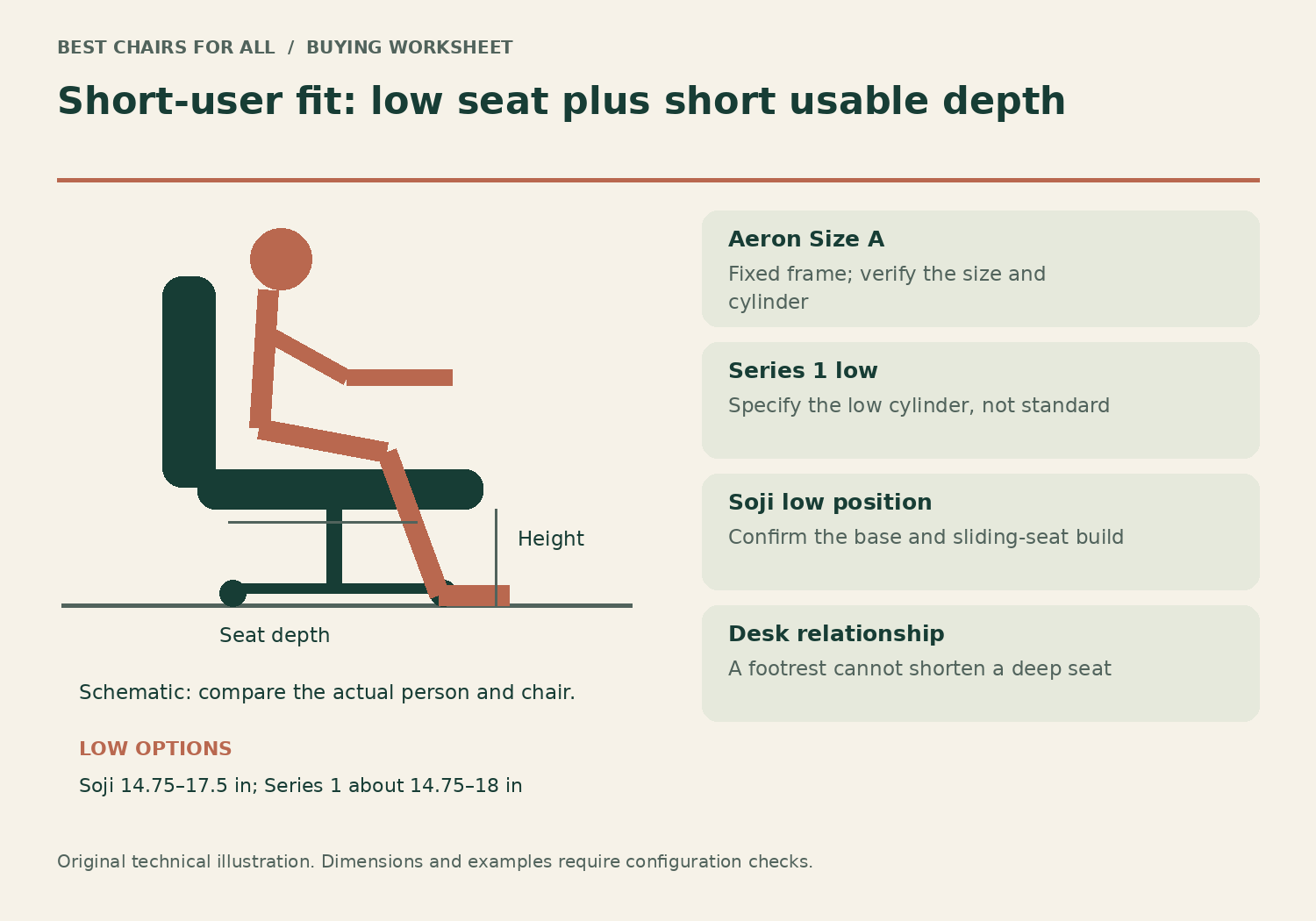
The comparison is based on official documentation checked online on November 6, 2026, without hands-on fit testing. Published heights can vary with measurement method, caster, cylinder and cushion compression. Use the figures below to screen candidates, then verify the exact configuration with the seller and try the chair. Your standing height alone cannot determine the right seat because people with the same height have different leg and torso proportions.
| Candidate configuration | Published height screen | Depth screen |
|---|---|---|
| Aeron Size A, cylinder per product sheet | 14.4–19.3 inches in cited sheet | 16.4-inch fixed depth in sheet |
| Series 1 low-cylinder chair | 14.75–18 inches in cited 2020 guide | Approximately 15.5–18 inches functional |
| Soji low-position build with slider | 14.75–17.5 inches in North American book | 16.25–18.75 inches on US adjustable model |
Three chairs to investigate by configuration
These dimensions are screening references, not interchangeable laboratory measurements. The Series 1 source itself lists a 17.75-inch upper functional-depth value in its table and 18 inches in the diagram. Aeron has fixed frames and has changed across generations. For Soji, low-position ordering and seat-depth options should be confirmed together rather than assuming the standard web-store chair includes both.
Model specifications and ordering details were checked against Herman Miller Aeron US product and options, Herman Miller Aeron dimensional product sheet, Steelcase Series 1 US product and options, Steelcase Series 1 dimensional specification guide, Haworth Soji US specifications, Haworth North American seating specification and price book. These manufacturer documents support the configuration notes in this comparison; retrieved November 6, 2026.
1. Herman Miller Aeron Size A
Best for: a smaller fixed frame with a low documented height.
Size A is the relevant Aeron candidate here. The cited manufacturer sheet lists a 16.4-inch seat depth and a 14.4–19.3-inch height range. These are size-specific figures, not measurements that apply to B or C or every cylinder in every generation.
Because the mesh seat has a fixed perimeter, there is no slider to rescue an unsuitable depth. Compare the front edge, back contact and arm option on the actual size A chair. Verify current-generation dimensions and ordered cylinder directly, particularly when buying used or refurbished inventory with an older Aeron name.
Product Details
| Brand | Herman Miller |
|---|---|
| Size | A, small frame |
| Seat depth | 16.4 inches in cited sheet |
| Seat height | 14.4–19.3 inches in cited sheet; confirm cylinder |
| Seat adjustment | Fixed depth |
Pros
- Smaller frame rather than only a lower cylinder
- Low documented screening range
Cons
- Fixed seat depth
- Model generation and cylinder must be confirmed
Shortlist it for a real size A trial with a clear return route if the frame shape does not suit you.
2. Steelcase Series 1 with low cylinder
Best for: a short sliding seat with a specified low cylinder.
Series 1 offers a useful pairing: a low-cylinder option and a functional seat-depth slider. The cited guide shows a 14.75–18-inch low height range, while functional depth is approximately 15.5–18 inches, with a table-versus-diagram rounding difference at the upper end.
Do not buy the standard 16.5–21.5-inch build assuming low means the same thing. Record the actual cylinder on the order, and verify both arms and back style. The shorter functional seat is valuable only if the lumbar support and arm pads also meet the user comfortably.
Product Details
| Brand | Steelcase |
|---|---|
| Low cylinder height | 14.75–18 inches in cited 2020 guide |
| Functional depth | Approximately 15.5–18 inches; confirm build |
| Order condition | Low cylinder explicitly required |
Pros
- Low-cylinder ordering option
- Short minimum functional depth
Cons
- Special configuration may affect returns
- Older guide values need current order confirmation
Best investigated when a sliding seat is important and the seller can document the low build.
3. Haworth Soji low-position adjustable-seat build
Best for: a low upholstered-seat configuration ordered deliberately.
Haworth's North American specification book describes a 14.75–17.5-inch low-position range for Soji. The adjustable US seat is listed at 16.25–18.75 inches deep. Together they offer a worthwhile comparison for someone wanting a low cushioned task chair.
This is not the standard web-store seat-height range of 16.4–21 inches. Ask a Haworth dealer to confirm low-position base, seat slider, arms and caster together, including availability and return eligibility. A fixed-seat option or a standard cylinder would change the main reasons for choosing this build.
Product Details
| Brand | Haworth |
|---|---|
| Low-position height | 14.75–17.5 inches in cited North American book |
| Seat slider | Specify adjustable-seat configuration |
| Order condition | Confirm low base, cylinder, arms and caster |
Pros
- Low-position catalog offering
- Adjustable-depth upholstered seat available
Cons
- Dealer configuration may be needed
- Low height does not guarantee narrow arm spacing
Choose only after the full low-position adjustable-seat specification is confirmed, not from the generic Soji title.
Take three body measurements in work footwear
First record a comfortable supported seat height using a stable chair with your ordinary work shoes or slippers. The feet should have full support while the seat edge stays clear of the backs of the knees. Measure from floor to the sitting surface, understanding that an upholstered chair compresses under load. This gives a useful reference when comparing published minimum heights.
Use the step-by-step guide to fit an office chair for a short person when testing whether the lowest seat setting, desk height, and foot support work together.
Second record the distance from your supported back to the crease behind the knee. A seat should leave clearance there rather than using the knee as a stop. If your existing chair is too deep, place a temporary reference against the back to understand the required usable distance, without treating that as a permanent furniture modification. Measure the sitting area, not the overall distance from the chair’s rear to its front casters.
Third record where your elbows rest when shoulders are relaxed and hands approach the keyboard. If the arm pads cannot move inward enough, a wide chair may still force the arms away from the body even when the seat is low. If pads cannot lower or retract, they may stop approach to the desk. All three relationships need to work together.
A worked example: a 15-inch reference seat at a tall desk
Suppose a reader finds that a sitting surface around 15 inches high supports their feet comfortably. Their fixed desk places the keyboard at 29 inches, substantially higher than the relaxed working hand position available at that seat height. Buying the lowest possible chair may solve foot contact while preserving a poor keyboard relationship. The desk is part of the problem.
This reader has two practical layout paths to investigate. One is a lower keyboard surface with sufficient thigh clearance, allowing a lower chair position. Another is a higher chair position aligned with the existing keyboard plus a stable footrest. Which works depends on the desk, the user’s proportions and whether the seat remains comfortable at the higher setting. A footrest is useful for feet, but it does not shorten a deep seat.
Now compare the chair builds. Soji’s low-position range reaches 14.75 inches in the cited book, and the Series 1 low option also reaches 14.75 inches in the cited guide. Aeron Size A’s sheet lists 14.4 inches at the low end. These are promising candidates for this example, yet none changes the 29-inch keyboard height. The final purchase should be part of a workable arrangement rather than a race for the lowest number.
The petite-fit purchase worksheet
Fill this out for each exact listing. Ask the seller to confirm the model, cylinder and usable depth in writing. If a listing only gives overall height or a broad recommended user-height range, it has not answered the fit question. Save the configuration confirmation with the receipt, especially when ordering through a dealer or marketplace.
| Your requirement | Seller confirmation | Pass condition |
|---|---|---|
| Lowest useful sitting height | Exact low-cylinder build and caster | Feet supported at the working setting |
| Short enough seat | Functional depth reference and slider | Back contact without knee-edge contact |
| Close arm support | Pad height and inward travel | Relaxed shoulders, elbows near torso |
| Desk access | Arm clearance and thigh opening | Keys reachable without perching |
Why size A, low cylinder and small chair are different ideas
Aeron Size A changes the frame dimensions, including its fixed seat depth. Choosing it is not simply lowering a medium Aeron. A reader can be near a size-chart boundary and still dislike the front frame or width. Try the actual size and back-support option if possible. Do not assume the larger frame is a safer purchase because it seems more generous.
A low cylinder on Series 1 changes the height range, while its seat-depth slider addresses a separate dimension. The low option sacrifices some upper range compared with the standard cylinder. This matters if a taller household member shares the desk or if the chair must also reach another work surface. Record both ends of the range rather than only the lowest setting.
Soji’s low-position offering is described in its North American specification book, alongside configuration details. It may require dealer ordering rather than a standard quick-ship choice. Ask whether the chosen low base, caster and seat slider are available together, what the return terms are, and whether a custom build is excluded. A configuration that exists in a catalog is not necessarily sitting ready to ship from every retailer.
Armrests, lumbar height and headrests need their own fit check
Shorter legs do not necessarily mean a short torso, and the reverse is also true. After clearing seat height and depth, check where the lumbar support meets your back. A pad that remains too high at its lowest position can be intrusive even when the feet reach the floor. A broad claim that a chair fits users above a certain height does not replace that contact check.
Arm spacing can be particularly revealing. A seat may be wide enough to accommodate many people but place its arms too far apart for a smaller torso. Move the actual pads inward and back where the design permits, then try typing and mousing. If you have to widen the elbows to find the pads, consider a different arm configuration or an armless arrangement with a suitable work surface.
A headrest is usually a later decision. First establish that the seat and desk work. A headrest that cannot move low enough or retract can push the head forward, and a tall back may meet a shorter user differently than the product photograph suggests. Avoid buying an aftermarket attachment until the chair model, compatibility and effect on ordinary typing are understood.
How to trial a short-user chair without guesswork
Use a normal task and your normal footwear, not a showroom pose with heels barely reaching the floor. Sit fully back, adjust depth and then check foot support at keyboard height. Lean back only within the manufacturer’s intended range. Notice whether the front seat edge stays unobtrusive and whether you can return to the keys without sliding forward.
The OSHA chair selection guidance explains why seat height, depth, back contact and foot support should be considered together. It specifically recognizes foot support when a work surface prevents lowering the chair. Those principles support an individual fit check rather than a claim that one petite chair fits every short adult.
If shopping remotely, secure an assembled-return route before ordering a special cylinder. Keep the carton and photograph the configuration label. Choose Aeron A for a smaller fixed frame, Series 1 low when its short slider and lower height suit the user, or Soji low for an upholstered-seat alternative whose options can be confirmed. A seller unable to verify the decisive dimensions should not receive the benefit of an optimistic assumption.
Something unclear or out of date? Send a correction with this article’s title and the detail to check.
Sources, research & corrections policy ↗