Nursery chair seat height should be checked with the intended parent sitting in the chair, not selected from adult height alone. Cushion compression, seat depth, footwear, arm position and the effort needed to stand all affect the practical fit.
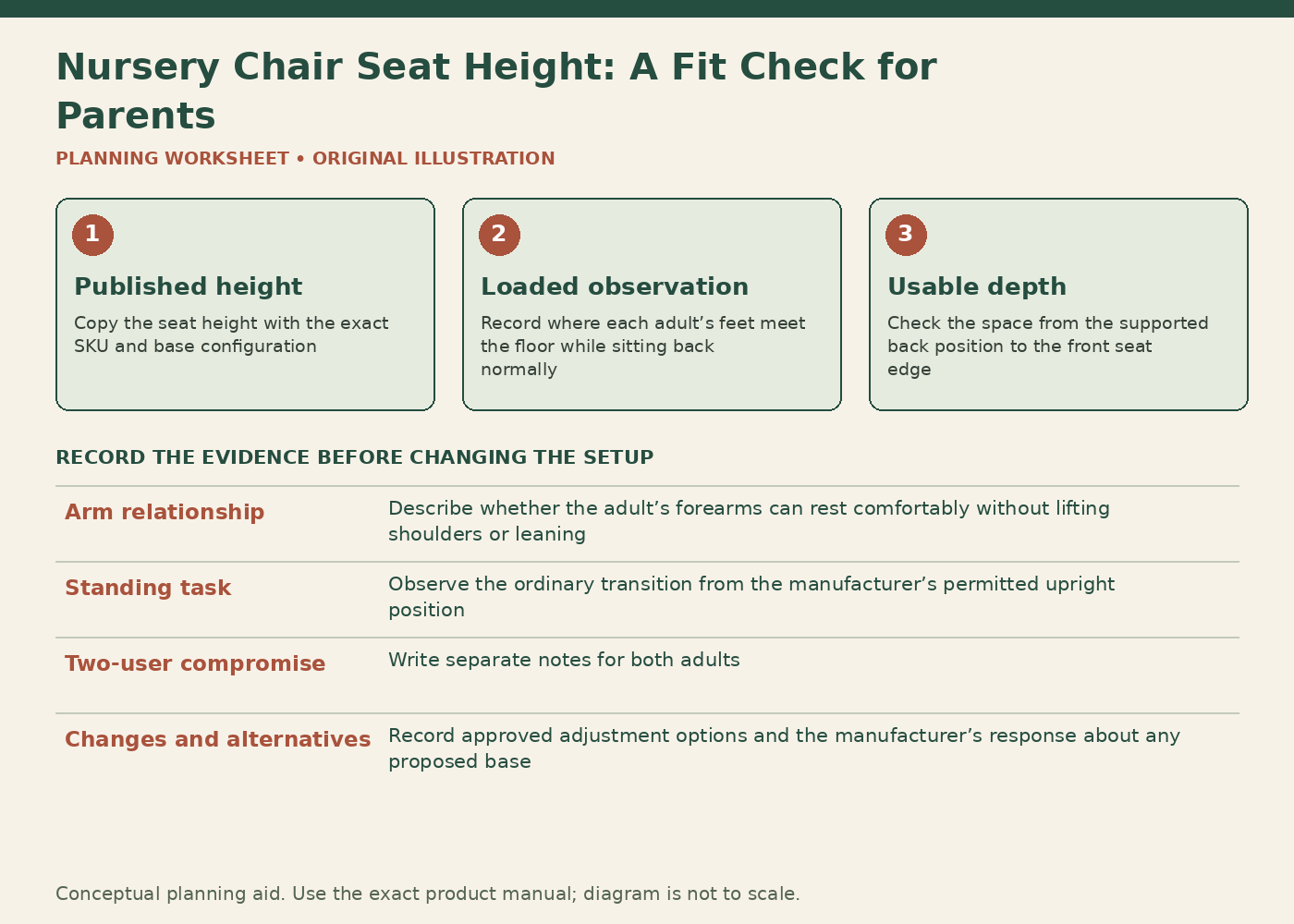
Measure the loaded seat, then observe the person
A published seat height is a useful starting point, but the user sits on a cushion that may compress. Measure the unoccupied seat using the manufacturer’s reference, then note the supported sitting position with the person’s usual footwear. Babyletto lists seat height and seat depth separately for the current Kiwi. Those dimensions answer different questions: a high enough seat can still be too deep for an adult to sit back with feet supported.
Do the fitting trial without a baby. Sit back normally, observe whether both feet are supported, and check whether the seat edge presses uncomfortably behind the knees. Avoid turning this into a universal knee-angle prescription. Comfort and ordinary movement matter, and people with special support or recovery needs should discuss chair choice with their clinician.
Connect height with depth and arms
A person may slide forward to reach the floor in a deep seat, losing contact with the back support. Another adult may find the same chair shallow or the arms too low. Record each experience separately. Check whether the arms support a relaxed position for the intended awake caregiving task without forcing raised shoulders or a sideways lean.
Ask each adult to sit down, return the chair to its specified upright position and stand using their usual safe method. A soft cushion may feel appealing during a short sit but make standing more demanding. Do not add furniture risers, improvised platforms or aftermarket base modifications unless the manufacturer specifically approves that configuration.
Try the routine before purchasing
Compare the exact model and base option being ordered. A retailer sample may differ from the current version, as illustrated by the different configuration descriptions in Pottery Barn Kids’ Kiwi listing and the manufacturer’s current page. Save the product label or SKU beside the measurements. An apparently small height difference can come from a different base rather than inconsistent measuring.
A separate ottoman is a foot support for the permitted seated routine, not a guarantee that entry or standing will be easy. Check where it goes when the adult needs to rise and whether it obstructs the room route. If both parents will use the chair, decide which requirements both can meet without moving bulky furniture each time.
Avoid sleep-based fit criteria
Choose a nursery chair for awake adults. A reclined position that feels easy to doze in does not create a safe place to sleep with a baby. NIH Safe to Sleep warns against infant sleep on an armchair, including with an adult. Keep the baby’s separate sleep space available and plan what to do when the caregiver becomes tired.
Measurement and comparison worksheet
| Checkpoint | What to record and why it changes the decision |
|---|---|
| Published height | Copy the seat height with the exact SKU and base configuration. Identify whether the listing includes a cushion or optional base. Do not compare a bare-frame measurement with an upholstered sitting height as though they describe the same surface. |
| Loaded observation | Record where each adult’s feet meet the floor while sitting back normally. Describe dangling feet, forward sliding or pressure at the seat edge if present. These observations explain the problem more clearly than the person’s total height. |
| Usable depth | Check the space from the supported back position to the front seat edge. Note whether a decorative pillow changes that relationship. Do not assume that adding a thick pillow is approved or suitable for the chair’s movement and intended use. |
| Arm relationship | Describe whether the adult’s forearms can rest comfortably without lifting shoulders or leaning. Keep any trial object light and perform the initial fit check without a baby. A wide seat alone does not establish useful arm support. |
| Standing task | Observe the ordinary transition from the manufacturer’s permitted upright position. Note control reach and whether the chair moves unexpectedly. Pain, dizziness or recovery-related concerns should be discussed with the appropriate clinician before relying on that chair. |
| Two-user compromise | Write separate notes for both adults. Identify shared requirements and any acceptable preference differences. A single average height between two people is not a fitting method, especially when their leg length or mobility differs. |
| Changes and alternatives | Record approved adjustment options and the manufacturer’s response about any proposed base. If basic fit remains poor, compare another chair. Do not make an adult seat taller with loose blocks or unverified replacement feet. |
Worked example: use the result, not just the number
Imagine two parents trying a hypothetical chair advertised with a 20-inch seat height and a deep cushion. The shorter parent can touch the floor only by sliding away from the back. The taller parent reaches the floor easily but finds the arm support too low. Ordering a lower version might help the first person’s feet while making the second person’s standing task harder.
The worksheet therefore records three issues: usable depth for one person, arm relationship for the other and standing effort for both. The next comparison should include a shallower chair and a different arm arrangement, rather than sorting products by seat height alone. These are illustrative observations, not a prescription for a particular dimension. If one parent has a recovery restriction or needs physical assistance, the clinician’s guidance becomes part of the fit trial before the chair is used for caregiving.
Create a two-person fit sheet instead of an average
Give each intended adult a separate column. Record the shoes or slippers used, whether they can sit against the back, where their feet rest and where the front cushion edge meets the legs. Add arm comfort, control reach and ordinary standing effort. Ask the person to describe the limiting feature precisely: “feet lose support when I sit back” is more useful than “too big.”
Compare the columns only after both trials. If one adult prefers a firmer cushion and the other prefers softer upholstery, that may be a preference tradeoff. If one cannot reach the floor in their supported position, the problem may involve usable depth as well as height. Averaging the adults’ total heights cannot reveal this. People of similar height can have different leg and torso proportions, and two people with the same foot contact can have different movement needs.
Measure with clear reference points
For a published example, Babyletto’s current Kiwi manual-model page gives a 20.5-inch seat height and a 22-inch seat depth. It also lists an arm-rest-to-seat height of 8 inches. These figures describe a particular listed model; they are not target dimensions for parents. Record them in separate fields so a height comparison does not conceal a depth or arm mismatch.
When measuring a showroom sample, note whether your tape is at the front edge, center or another point on a sloping cushion. Identify whether it is loaded or unloaded. Avoid claiming a precise occupied height from an uneven cushion surface without describing the method. An observation such as “heel supported while sitting back” may be more repeatable and useful than a compressed-cushion number measured inconsistently. Use the same method when comparing the next chair.
Evaluate the entire entry and exit sequence
Begin with an empty, upright chair placed according to its manual. The adult should use the chair only within their usual safe abilities, without a baby or a weighted substitute. Check whether controls can be reached without an awkward twist, whether the footrest fully returns as instructed and whether an ottoman has to be moved before standing. Notice whether the moving seat makes the ordinary approach feel unpredictable.
This is an equipment comparison, not a strength test. Stop if the trial causes pain, dizziness or uncertainty. For recovery restrictions, balance difficulties or a need for physical assistance, bring those concerns to the relevant clinician before relying on the chair. A salesperson’s claim that a low seat is universally easier for feeding does not establish that it will support safe entry or standing for this person. Do not raise a glider on furniture blocks to solve a fit problem.
Separate accessories from the underlying fit
A small included lumbar pillow changes how far forward a person sits and can change the relationship to the arms. Compare the chair in the manufacturer’s intended arrangements and record which one you used. Do not assume a stack of pillows is an acceptable correction, especially if it makes the seat unstable or interferes with controls. A feeding support accessory has its own instructions and should not be treated as a substitute for adult seat fit.
An ottoman can support feet while sitting, but it occupies floor space and must not block a normal exit. It does not correct a chair that is too deep to sit back comfortably or too low for the user’s ordinary standing task. Try a candidate with different seat geometry before committing to additional furniture. Keep the final decision linked to what each parent actually observed, with any clinician guidance documented separately from upholstery preferences.
Official references and document checks
The linked documents below were researched for this article on November 6, 2026. Manufacturer instructions, available configurations and safety notices can change. Consult the document for the exact product in front of you; references to another market or an older revision provide context and do not establish compatibility for your chair.
- Babyletto Kiwi Recliner and Swivel Glider, current model specifications
- Pottery Barn Kids: Babyletto Kiwi dimensions and care
- NIH Safe to Sleep: Ways to Reduce Baby’s Risk
- CPSC: Babyletto Kiwi electronic recliner USB recall
Something unclear or out of date? Send a correction with this article’s title and the detail to check.
Sources, research & corrections policy ↗