A glider and a rocking chair can both provide gentle motion for an awake adult, but their mechanisms and occupied space differ. Choose by checking the exact movement, the parent’s fit and the room’s usable envelope rather than assuming either category is automatically smaller or more comfortable.
Understand what moves
A traditional rocker travels on curved runners: the contact point with the floor changes as the chair rocks. A glider moves its seat through a linkage above a base. Some gliders also swivel, and some add a reclining back and extending footrest. These are separate features. A stationary base does not mean the back, arms and occupant stay within its footprint. Babyletto’s current Kiwi page describes its glide, swivel and manual recline, illustrating why a single word such as “glider” is insufficient.
Compare the motion with the chair empty first and then with each intended adult sitting normally, without a baby. Notice whether the movement feels controllable, whether feet can meet the floor comfortably and whether returning to an upright position is straightforward. No motion type guarantees a particular baby will settle or sleep better.
Compare the occupied envelope
The rocker needs room for the runners and the full backward and forward arc. The glider needs room for its moving upper body; swivel adds a side sweep, and recline adds a different rear and front envelope. Measure these functions separately. Pottery Barn Kids’ Kiwi specification sheet distinguishes upright dimensions, fully reclined dimensions and wall clearance. Those numbers describe that listing and must not be transferred to every Kiwi revision or another brand.
A room can accommodate a chair’s upholstery and still fail the practical test when its footrest crosses the walking route. Tape out the proposed envelope, including the position occupied by an ottoman when someone uses it. Leave the crib and other furniture in their actual positions during planning.
Separate preference from operating effort
A rocker may feel familiar and have no power cord, but its runners can be awkward beside a table or on an unsuitable surface. A glider can offer an upholstered high back, yet that does not establish usable seat depth or easy standing. A manual recliner requires its specified operating action; a powered one needs the correct supply and cord management. Ask each adult to try the controls and normal entry and exit.
If the adults have different proportions, rank the requirements they share: reachable floor, usable arms, appropriate depth and enough room to rise. A removable decorative pillow is not a solution to every mismatch. Any additional support should remain compatible with the seat and the caregiving routine.
Treat infant sleep as a separate decision
The chair is a place for an awake caregiver, not a sleep destination for a baby. NIH Safe to Sleep specifically warns against infant sleep on couches and armchairs, including when an adult sleeps there too. Plan a separate appropriate sleep space before concentrating on chair accessories. A chair advertised for feeding or soothing is still adult seating.
Measurement and comparison worksheet
| Checkpoint | What to record and why it changes the decision |
|---|---|
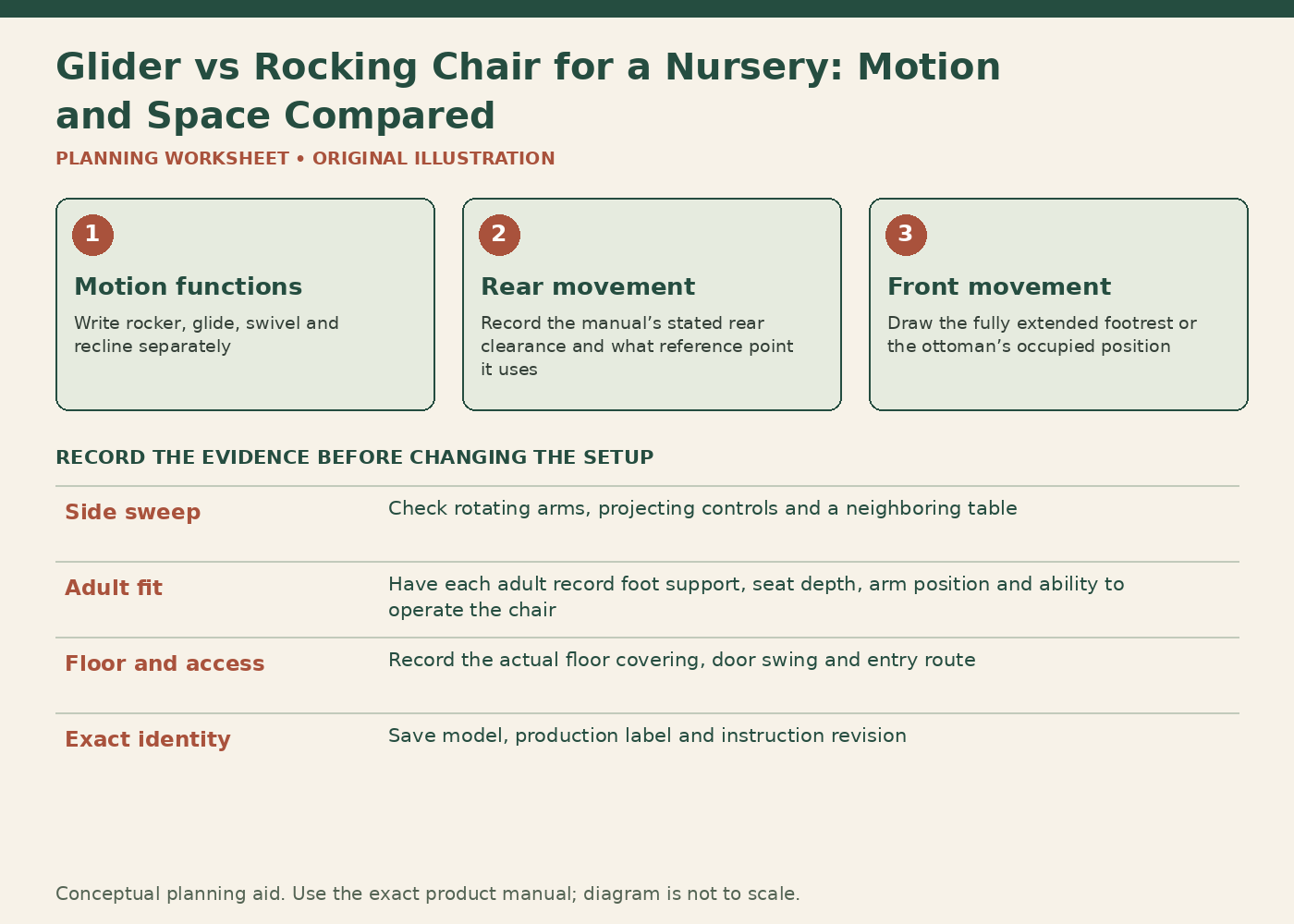
| Motion functions | Write rocker, glide, swivel and recline separately. Mark which functions the exact version has and which you expect to use. A showroom sample with power recline does not establish the operation of a manual version ordered later. |
| Rear movement | Record the manual’s stated rear clearance and what reference point it uses. A tape measurement from the base can differ from a measurement from the upholstery. Obtain clarification before placing the chair beside a wall or window. |
| Front movement | Draw the fully extended footrest or the ottoman’s occupied position. Add the adult’s feet in the ordinary routine. Keep the route to the room entrance visible on the drawing rather than assuming all open floor remains walkable. |
| Side sweep | Check rotating arms, projecting controls and a neighboring table. A swivel base can stay in one place while the chair’s arms sweep into another object. Place chargers and drinks outside that movement and a child’s reach. |
| Adult fit | Have each adult record foot support, seat depth, arm position and ability to operate the chair. Name the uncomfortable feature. A broad rating such as “soft” does not distinguish a cushion preference from a seat that is too deep. |
| Floor and access | Record the actual floor covering, door swing and entry route. Confirm the manufacturer’s placement requirements. Do not assume that a rug will correct instability or that a chair can be safely wedged into a tight corner. |
| Exact identity | Save model, production label and instruction revision. If buying used, review current recall information. This is especially relevant to powered models with electrical components; do not infer recall status from a familiar product name. |
Worked example: use the result, not just the number
A hypothetical fixed-back glider has an appealing small base, but its arm passes into a dresser’s drawer space when it swivels. A rocker in the same corner clears the dresser while upright but strikes the wall through its rear arc. Neither wins merely because of its category. The useful decision is to move the dresser, choose a different chair configuration or use another location.
On the worksheet, label these results “side sweep conflict” and “rear arc conflict.” Then compare revised layouts with the same room dimensions. Do not average the two problems into a general comfort score. If the preferred glider adds recline, return to the drawing and add the extended configuration before ordering. The extra feature changes the room requirement even if the upright width stays the same.
A comparison that keeps five decisions separate
Make a two-column comparison with the actual rocker and actual glider you can buy. The first row is the support surface: runners or a base. The second is the permitted motion: rocking, gliding, swivel and recline. The third is the way motion is controlled: feet, a manual release or a powered control. The fourth is the footprint during use, including the user and any ottoman. The fifth is the route through the room. A winner in one row should not silently receive credit in the others.
For example, a rocker without a separate footrest can have fewer objects on the floor. That does not prove its rear arc fits next to a wall. A glider with a compact circular base can look smaller in a floor plan, but the upholstered back may sweep farther than the circle. A recliner can eliminate a separate ottoman, yet its extending footrest may occupy the same route the ottoman would have blocked. These are geometric relationships to verify, not inherent rankings of the two categories.
Use a room comparison with a consistent boundary
Draw the room boundary first: walls, door swing, crib, dresser and anything fixed in place. Choose the same intended sitting location for both candidate chairs. For each one, add its upright outline using the exact dimensions. Then draw the permitted moving envelope in another color. Do not give one candidate the benefit of a moved dresser while comparing the other in the original cramped corner. If rearranging furniture is acceptable, make a separate revised drawing and apply it to both.
As an illustrative exercise, give a hypothetical rocker an upright depth of 34 inches and a maximum occupied envelope of 46 inches measured in a verified demonstration. Give a hypothetical glider a 36-inch upright depth and a 44-inch moving envelope. The rocker looks shallower in a catalog but needs two more inches in this specific motion comparison. Those are invented teaching dimensions, not product specifications or recommended clearances. The point is to compare equivalent configurations. Add swivel or recline to one candidate and you must repeat the comparison with the additional envelope.
What a showroom trial can and cannot answer
A showroom can help you compare the feel of motion, arm shape, cushion depth and control effort. It can also reveal a mechanism that is audible in a quiet space. Visit with the exact model list and take notes immediately after each trial. Ask permission before measuring or photographing labels. Check that the displayed base and recline mechanism match the ordered variant, particularly when a family name includes several versions.
A short trial cannot predict long-term fabric wear, durability, infant response or every noise the mechanism may develop. Do not translate a quiet five-minute demonstration into a claim that the chair will remain silent. Likewise, “I could stand easily” is the trial user’s observation in that arrangement, not a promise for a different parent recovering from birth or using different footwear. Keep subjective notes separate from documented dimensions so a compelling first impression does not erase a failed clearance check.
Ownership differences that matter after the nursery
Look at where the chair might be used later. Runners remain visible and need suitable floor contact. A gliding base and linkage may need inspection or service according to the manual. A powered recliner adds supply and control components, so keeping model information and access to service matters. A chair moved to a living room still needs the same operating clearance; changing rooms does not remove its rear or front travel.
If storage is part of the plan, ask about the assembled dimensions and permitted disassembly before buying. An upholstered back that appears detachable may have model-specific locks or electrical connections. Keep the moving and transport tasks within the manual. Compare warranty coverage and replacement-part availability directly instead of assuming a simpler-looking chair can always be repaired at home. The preferred choice is the candidate whose documented operation fits the room and whose actual seat fits the intended adults.
Official references and document checks
The linked documents below were researched for this article on November 6, 2026. Manufacturer instructions, available configurations and safety notices can change. Consult the document for the exact product in front of you; references to another market or an older revision provide context and do not establish compatibility for your chair.
- Babyletto Kiwi Recliner and Swivel Glider, current model specifications
- Pottery Barn Kids: Babyletto Kiwi dimensions and care
- NIH Safe to Sleep: Ways to Reduce Baby’s Risk
- CPSC: Babyletto Kiwi electronic recliner USB recall
Something unclear or out of date? Send a correction with this article’s title and the detail to check.
Sources, research & corrections policy ↗