As an Amazon Associate, we earn from qualifying purchases. Read our affiliate disclosure. Amazon buttons open matching-model searches; verify the seller, exact version and checkout total.
Choose adjustable fit without expecting a treatment
There is no single best recliner chair for every back problem. Pain can have different causes, and a chair that feels supportive to one person can aggravate another person’s symptoms. Treat this as a furniture comparison built around seat fit, usable adjustment and easy position changes. Consult your clinician about persistent or worsening symptoms and any restrictions that affect sitting or getting up.
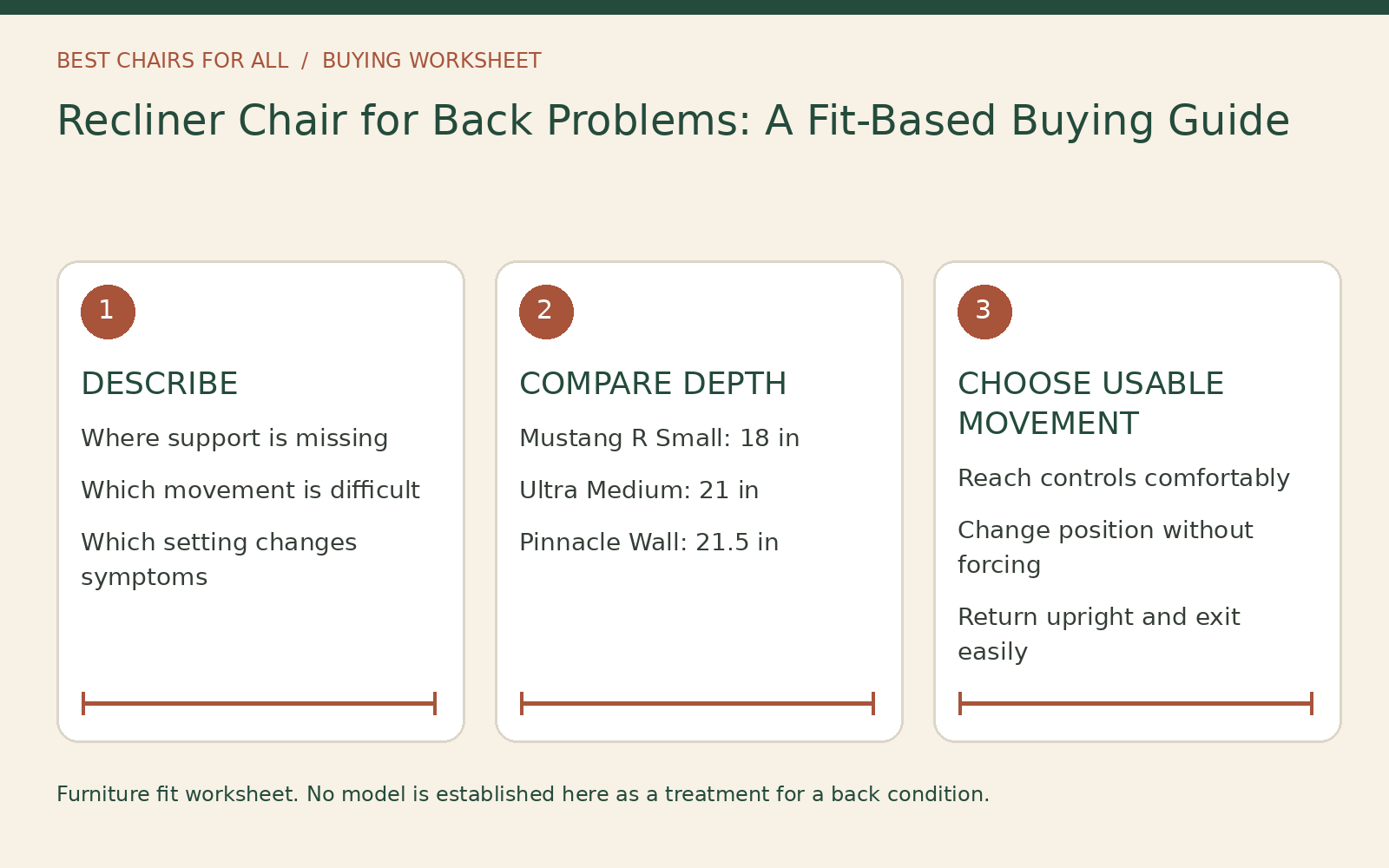
Pride VivaLift Ultra Medium is the adjustable candidate, Fjords Mustang R Small is the shallower-seat alternative with a movable footstool, and La-Z-Boy Pinnacle Wall is the simpler manual chair. None is recommended as a cure for sciatica, a disc problem, stenosis or another diagnosis. The useful buying artifact is a symptom-and-fit observation sheet you can take to a showroom and, if needed, discuss with your physical therapist.
This is a research-based buying guide, not a hands-on test. We compared the linked manufacturer specifications and current product documentation on November 6, 2026. Recommendations reflect the fit and ownership tradeoffs below; published dimensions do not establish personal comfort, long-term durability or a medical outcome.
Chairs worth comparing for this use
1. Pride VivaLift Ultra PLR-4955M
Best for: For independently controlled support.
Ultra Medium deserves a trial when you want to change the back angle without automatically making the same change to the feet. Its powered lumbar and headrest also let you investigate support placement more precisely than a fixed back.
The medium Ultra has independent back and footrest movement, power headrest and lumbar, tilt, lift assistance, lithium battery backup, three heating pads and lower-back air massage. Small and large versions have different seat and clearance dimensions. Start with the lumbar setting low and make small changes for preference, following the manual. More projection is not inherently better. If the pad lands above or below the area you want to support, the fit may be wrong despite the wide adjustment list. Keep heat and massage off while comparing basic support. See the model-specific source linked below.
Product Details
| Brand | Pride Mobility |
|---|---|
| Capacity | 400 pounds |
| Seat dimensions | 22.5 W × 21 D inches |
| Seat height | 19.5 inches |
| Overall width | 39 inches |
| Rear clearance | 15 inches |
Pros
- Independent back, footrest, headrest and lumbar controls
- Lift assistance available if individually appropriate
Cons
- Adjustable lumbar does not establish pain relief
- 21-inch seat depth may encourage sliding in some users
Choose this if a usable combination emerges without forcing the posture and you can operate the controls comfortably. The existence of a motor is less important than whether its movement helps your particular fit.
Pride VivaLift Ultra PLR-4955M specifications and source details
2. Fjords Mustang R Small
Best for: For a shallower seat and separate leg support.
Mustang R Small offers a distinct geometry rather than another broadly padded lift chair. Its published 18-inch seat depth makes it worth trying if deeper recliners leave you sitting forward to keep the feet supported.
The Mustang R Small is a recliner-and-footstool design with an adjustable head pillow and manually released headrest angle. Fjords offers it in leather and selected fabrics. The footstool is separate, so leg support does not depend on a powered footrest. The separate ottoman lets you investigate leg placement independently, but introduces another item to step around. The adjustable head pillow and manually adjustable headrest angle should be tested against your natural head position. A compact upright body does not tell you the full reclined footprint. See the model-specific source linked below.
Product Details
| Brand | Fjords |
|---|---|
| Overall dimensions | 31 W × 31.7 D × 39.7 H inches |
| Seat height | 19.2 inches |
| Seat depth | 18 inches |
| Base | 360-degree swivel |
| Footstool | 19.5 W × 18.5 D inches |
Pros
- Shallower manufacturer-listed seat depth than the other candidates
- Separate footstool allows leg support to be placed independently
Cons
- Swivel movement may be unwanted for someone who needs a fixed base
- No powered lift assistance
Consider this when basic dimensions matter more than powered features. If you need a stationary platform for transfers, obtain individual advice rather than assuming its swivel base will suit.
Fjords Mustang R Small specifications and source details
3. La-Z-Boy Pinnacle Wall Recliner 016512
Best for: For simple manual adjustment.
Pinnacle Wall is the straightforward candidate for someone who likes a conventional padded chair and can comfortably use its handle. The back can recline without activating the legrest, giving a useful adjustment despite the manual mechanism.
The manual Pinnacle Wall Recliner has a side handle and an independently reclining back. Its base does not rock. The maker lists three locking legrest positions; this is a different chair from the Pinnacle rocker, swivel glider and powered versions. Its stationary base avoids the added motion of a rocker, but the seat is 21.5 inches deep. Compare the occupied depth with a chair that currently works for you. The model has a fixed padded back contour rather than a separately powered lumbar adjustment. See the model-specific source linked below.
Product Details
| Brand | La-Z-Boy |
|---|---|
| Overall dimensions | 33 W × 38.5 D × 41 H inches |
| Seat dimensions | 19 W × 21.5 D inches |
| Seat height | 18.5 inches |
| Fully extended | 66 inches |
| Wall clearance | Approximately 7 inches |
Pros
- Stationary base and clear manual handle
- Independent back motion without compulsory legrest deployment
Cons
- Manual opening and closing effort need an actual trial
- A fixed contour cannot be moved to match every back
Buy this when the contour itself fits and normal entry and exit are comfortable. It is not an inferior choice simply because a powered model offers more controls, nor is it a proven therapeutic seat.
La-Z-Boy Pinnacle Wall Recliner 016512 specifications and source details
The observation sheet: describe the problem precisely
Make a page with columns for chair, position, support contact, effort and symptoms. Under position, use upright, legs raised and a moderate recline. Describe what you notice in plain language: lower back loses contact, head is pushed forward, pressure behind knees, difficult to reach handle, or hard to return upright. This is more useful for comparison than writing “bad back chair” beside every model.
If symptoms appear or worsen, stop the trial rather than forcing an endurance test. Note the setting and movement that triggered them. A clinician may find a specific description useful, while a furniture salesperson can use it to suggest a different size or mechanism. Do not ask a salesperson to diagnose why a nerve or joint hurts.
Record the chair after the cushions have supported your weight, not only the unoccupied seat dimensions. Softer padding can change the effective seat height and how easily you move forward to stand. The appropriate comparison is the whole occupied chair in a normal routine. A material label or foam-density number cannot establish that result in advance.
Start with seat depth before buying more lumbar support
If the seat is too deep, you may slide forward to reach the floor. That movement can leave the lower back away from the backrest. Increasing a lumbar adjustment may then make the problem feel more pronounced rather than fixing the underlying mismatch. Compare a different size or shallower seat before concluding that you need the largest possible lumbar pad.
The three nominal depths here are meaningfully different: Mustang R Small lists 18 inches, Ultra Medium 21 inches and Pinnacle Wall 21.5 inches. Those figures are not a ranking of comfort. They are reasons to try chairs that are genuinely different, especially when you already know that a very deep sofa does not suit you.
A small loose cushion can be a preference accessory, but it changes the available depth and may shift the head and arm positions. Ask whether the manufacturer approves any accessory you intend to use. Avoid building a precarious stack of cushions or altering the chair’s internal support. A suitable base fit should carry most of the work.
Adjustment should make changing position easier
Test the movement that usually troubles you. For one person this may be raising the legs; for another it may be finding the handle or returning upright. A dual-motor chair can separate the leg and back motion, but the controller still needs to be reachable. A manual chair may be simpler if the handle is comfortably placed and operating effort is reasonable.
NIAMS advises people living with back pain to change positions and move around when sitting for a prolonged period, while following their healthcare provider’s advice. That is a reason to assess how easily you leave the chair, rather than choosing a deep recline that discourages every movement. The article does not set an individual exercise schedule or sitting limit.
Do not judge lift assistance from an empty demonstration. Where mobility is a concern, a qualified professional should assess whether the movement suits the user and how to place any walking aid. A lift chair is a particular mechanism; it does not automatically remove the need for strength, balance or individualized transfer guidance.
Separate ordinary comfort from medical claims
A marketing phrase such as orthopedic, zero gravity or therapeutic does not tell you whether a chair has been studied for your condition. Even a device classification for stand assistance should not be turned into proof that a seat treats back pain. This guide recommends comparing geometry and functions, not buying a clinical outcome.
Seek medical advice for new or persistent back pain and for associated symptoms. NIAMS identifies concerns including back pain after an injury, trouble urinating, leg weakness or numbness, fever and unintended weight loss. Sudden serious neurological or bladder/bowel changes warrant urgent assessment rather than a new furniture order. Use local emergency care if symptoms are severe or rapidly developing.
Heat and vibration are comfort extras in this comparison. They are not substitutes for diagnosis or prescribed care. If you have reduced sensation, circulation concerns or another condition affecting heat use, ask your clinician and follow the chair’s instructions. A feeling of warmth during a trial should not distract you from a seat that is fundamentally too deep or difficult to leave.
A low-risk showroom and purchase plan
Bring the shoes you normally wear indoors and your fit notes. Ask for the exact model and size, then repeat the same short sequence in each chair. Avoid comparing one chair upright and another deeply reclined. If you have already been given positioning advice, bring it so the dealer can identify mechanical compatibility without interpreting the medical condition.
Check the return policy for the actual upholstery and size. Custom orders may have restrictive terms, while a stocked configuration may offer a practical home trial. Record delivery and collection charges, because a physically difficult return is part of the real purchase risk. It is reasonable to leave the showroom without buying if none of the basic shapes fits.
For a remote purchase, prioritize published dimensions, accessible manuals and a reachable service provider. Ask about replacement controls and authorized repairs before you depend on the chair. Check current recalls using the exact model label; do not rely on a general statement that all manual or all powered recliners are safe. A successful purchase supports ordinary rest without asking you to tolerate a consistently awkward fit.
Take useful fit notes home
Keep the showroom observation sheet even if you decide against every candidate. A record that shallow seat depth helped, a fixed head cushion intruded or a handle required painful reaching can narrow the next comparison. It is more useful than remembering that one brand felt luxurious. If you discuss the purchase with a clinician, bring those concrete observations and the manufacturer drawing. The resulting furniture decision should respect advice already given for your condition, while remaining honest about what the chair specifications establish: dimensions, movement and controls, rather than a promised change in symptoms.
Research sources
Sources were checked November 6, 2026. Configuration, stock and prices may change. Pride Ultra manufacturer size and function guide; Fjords Mustang R manufacturer sheet; La-Z-Boy Pinnacle Wall specifications; NIAMS diagnosis, treatment and steps to take; NIAMS back-pain symptoms and causes; CPSC current specified powered-seating recall.
Something unclear or out of date? Send a correction with this article’s title and the detail to check.
Sources, research & corrections policy ↗