As an Amazon Associate, we earn from qualifying purchases. Read our affiliate disclosure.
For children who game at a desk, start with a child-sized task chair rather than a scaled-down racing silhouette. Our shortlist is IKEA ÖRFJÄLL for a simple padded seat for ages eight and up, VIMUND for adjustable depth and a built-in foot support for ages eight and up, and GUNRIK for its lower seat range and more extensive growing-room adjustments. These are real children’s desk chairs, not licensed gaming props; their useful feature is sizing that can suit a child’s workstation.
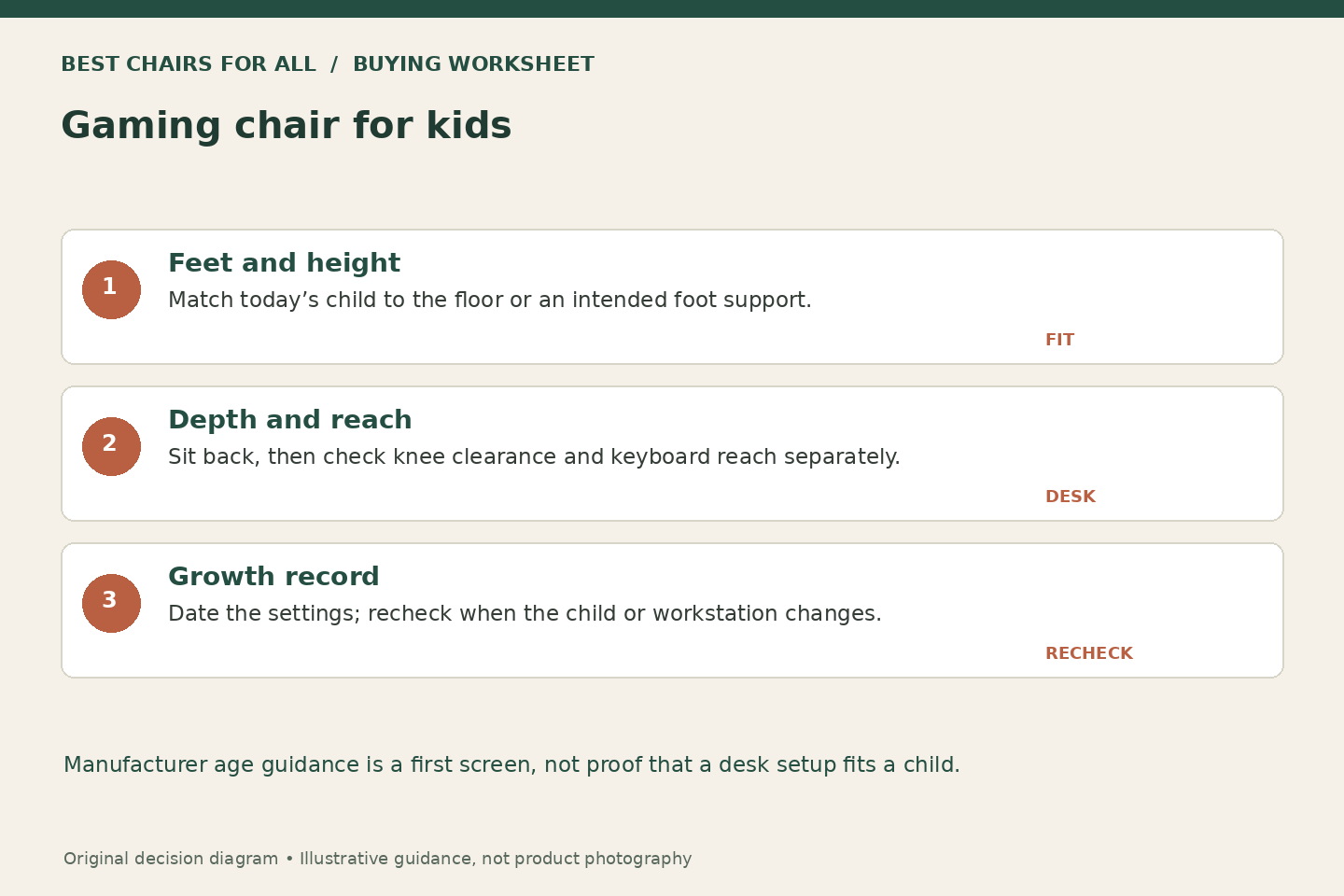
This guide concerns supervised desk gaming and homework. It does not recommend infant seating, nap furniture, or a chair for every child regardless of age. We checked the current US manufacturer pages and the official US recall search online on November 6, 2026. We have not performed child-safety testing or hands-on comfort tests. Follow each model’s current age guidance, assembly instructions, and adjustment limits; an age label alone does not prove that a particular desk setup fits.
The child-sized shortlist
| Model | Manufacturer age guidance | Useful adjustment | Observed US price |
|---|---|---|---|
| IKEA ÖRFJÄLL child’s chair | 8 years and older | 15–19¼-inch seat height | $69.99 |
| IKEA VIMUND turquoise | 8 years and older | Height and depth; foot support | $119.99 |
| IKEA GUNRIK turquoise | 3 years and older | 11⅜–18½-inch seat height | $199.99 |
Prices are manufacturer snapshots from the research date, before tax or delivery. GUNRIK’s age guidance is not a recommendation that a three-year-old should use a computer or remain seated for prolonged play. This comparison helps a caregiver choose furniture within a manufacturer’s intended use, then confirm the actual child’s fit and supervision needs.
ÖRFJÄLL: a straightforward chair for an older child’s desk
The ÖRFJÄLL child’s desk chair listing specifies a seat 15⅜ inches wide by 13⅜ inches deep, with height adjustable from 15 to 19¼ inches. IKEA recommends it for children eight years and older and lists a tested load of 243 pounds. Its padded seat and separate padded back make it a simple option when the child already fits the desk height and does not need a built-in foot platform.
The shorter seat is the central reason to consider this model over an adult gaming chair. A child may be able to reach the backrest without having a long cushion extend into the backs of the knees. That matters more than a tall headrest that never reaches the intended part of the body. Check the actual child sitting in normal indoor footwear, rather than estimating from the age of a child in a product photograph.
The tradeoff is limited adaptation. It does not provide VIMUND’s depth adjustment or dedicated foot support. If the desk requires a higher seat setting and the child’s feet no longer have stable support, the initial low chair price does not settle the setup. You may need a suitable separate foot support or a different desk-and-chair combination. A thick seat cushion changes the effective seat height and should not be the default way to make an adult desk work.
Choose ÖRFJÄLL for a comparatively simple station where the published seat size is close to a chair the child already uses comfortably. Avoid buying it solely because the child is eight. Age eligibility and dimensional suitability are different questions. If a showroom trial shows that the child slides forward every time they use the mouse, investigate reach and desk height before assuming a more elaborate chair would solve it.
Check matching IKEA ORFJALL child desk chair listings on Amazon (paid link) (search results; verify the exact model and seller).
VIMUND: adjustable depth plus a place for the feet
VIMUND’s official US page describes adjustable seat height and depth, a flexible backrest, and an integrated footrest. The stated seat-height range is 15–20⅛ inches, with a listed seat width of 16⅛ inches and seat depth of 14⅝ inches. IKEA recommends it for children eight years and older. Its removable cover is machine washable according to the product care instructions; check the actual label for the selected chair.
The foot support is the meaningful distinction for a child using a desk that sits higher than a small child’s table. It gives another place to rest the feet when the seat must rise to meet the work surface. The depth adjustment also allows a caregiver to adapt the relationship between the backrest and seat edge as the child grows. The manufacturer’s single listed seat-depth dimension should not be mistaken for a fully documented minimum-to-maximum range.
Pressure-sensitive caster brakes are part of the design. IKEA says the chair stays in place when the user stands and releases when the user sits. Do not treat those casters as defective merely because an empty display chair resists being pushed, and do not replace them with unapproved wheels to defeat the function. Ask IKEA about the correct intended behavior if the chair does not move as documented for your child.
VIMUND is the first model to try when foot support and depth are the unresolved problems. It is not automatically better for a younger child, because its age guidance remains eight and up. Nor does the removable cover make every component washable. Remove and clean only the parts identified by the instructions, and allow the cover to dry as directed before putting the chair back into use.
Check matching IKEA VIMUND turquoise listings on Amazon (paid link) (search results; verify the exact model and seller).
GUNRIK: a lower adjustment range for a different fit problem
The GUNRIK manufacturer page gives an 11⅜–18½-inch seat-height range and a seat-depth adjustment of 12¼–16½ inches. It states a tested load of 220 pounds, adjustable seat and back height, and current age guidance of three years and older. The page also gives a suggested child-height range of 45–72 inches. Consider those facts together, because the minimum age does not override the dimensional guidance.
Its lower seat setting is relevant if a child’s current chair sits too high even before the desk interaction is considered. Adjustable back height and seat depth create more opportunities to place support where it is usable as the child’s proportions change. Its armrests can also matter at a desk: confirm how they move and whether they prevent the child from getting close enough to the work surface in the intended configuration.
GUNRIK costs more than the simpler alternatives, and its base still occupies a substantial area. IKEA lists overall width at 22⅞ inches and depth at 24¾ inches. Those dimensions can crowd a narrow desk bay even when the seat itself fits. Try rolling or repositioning the chair through the normal entry path and check the floor space around the child’s feet. Adjustable furniture still has a fixed physical footprint.
Choose it when the low seat range or wider depth adjustment solves an identified need. Skip the premium if the child already fits a simpler chair and the additional controls will remain unused. Keep any small parts and tools away during adult assembly, and demonstrate the allowed adjustments once the chair is complete. A child should understand which parts are controls and which parts are structural supports.
Check matching IKEA GUNRIK turquoise listings on Amazon (paid link) (search results; verify the exact model and seller).
A caregiver’s growth-and-fit record
Make a dated card with four observations: feet, seat edge, back support, and hands. Under feet, note whether they rest on the floor or an intended support. Under seat edge, note whether the child can sit back without the front pressing behind the knees. Under back support, record whether the backrest meets the child rather than sitting far behind them. Under hands, record whether the keyboard and mouse can be reached without reaching the whole torso forward.
Add the chair settings and a simple photograph of the setup from the side, keeping the image private. The record is more useful than predicting how many years a chair will last. Repeat the check when the child grows noticeably, changes desks, or starts using a different device. A small laptop placed far back on a deep desk creates a different reach problem from a separate keyboard near the front edge.
For example, a child who reaches the keyboard only when sitting on the front of the cushion may have a desk-reach problem, a depth problem, or both. First bring the input devices into a reachable position, then check the seat depth. Do not immediately raise the chair if that simply removes foot support. Working through one relationship at a time lets the caregiver identify the change that actually helps.
Why we would skip a large adult racing chair “to grow into”
Growing room is valuable only when today’s usable range includes the child. A long seat, high armrests, and an oversized head pillow can all miss the intended contact points. Placing several pillows around the child makes the setup less repeatable and can hide poor fit. Buying a chair with a documented smaller range is a more direct approach than buying the biggest-looking model on the assumption that extra volume equals extra years.
Decorative speakers and lights also complicate an otherwise simple children’s station. They may introduce power leads, audio adapters, and controls that do not help fit. If you add such equipment separately, route cords away from movement paths and follow the equipment instructions. Keep drinks away from electrical components and inspect furniture for damage. A chair should be used for sitting, not for climbing to reach shelves or as a moving toy.
Check recalls by exact model, especially when buying used
Before buying secondhand furniture, identify its model or article number and consult the US Consumer Product Safety Commission recall database and the manufacturer’s recall information. Search again if a model label or production detail changes. Our research does not establish that any model is permanently recall-free, and a missing search result is not a safety certification. If a chair is recalled, follow the official remedy instead of improvising a repair.
Inspect a used chair for a complete label, instructions, missing fasteners, damaged adjustment parts, and signs of modification. Ask the manufacturer for the correct manual if necessary. A cheap chair with no identifiable model can be a poor bargain because you cannot confidently check intended age, adjustment limits, or replacement parts. Do not attempt gas-lift disassembly as a home repair. Stop using furniture that is unstable or has a broken mechanism.
Choose for the child sitting at the desk today
For a child eight or older who fits its seat, ÖRFJÄLL is the uncomplicated starting point. VIMUND deserves a trial when foot support and seat depth need attention. GUNRIK is the more adjustable option when its lower range addresses a measured need and the whole footprint fits the room. All three should be checked with the child present and the real keyboard or controller in use. A sensible fit today is more valuable than a gaming label or a promise of years of future growth.
Something unclear or out of date? Send a correction with this article’s title and the detail to check.
Sources, research & corrections policy ↗