A wingback chair has projecting sides around the upper back. A club chair is generally a substantial upholstered armchair with an enclosing seat and a lower profile, although manufacturers interpret the style in different ways. The practical choice is between the individual chairs’ back shapes, seat dimensions, arms, and room presence rather than two standardized furniture sizes.
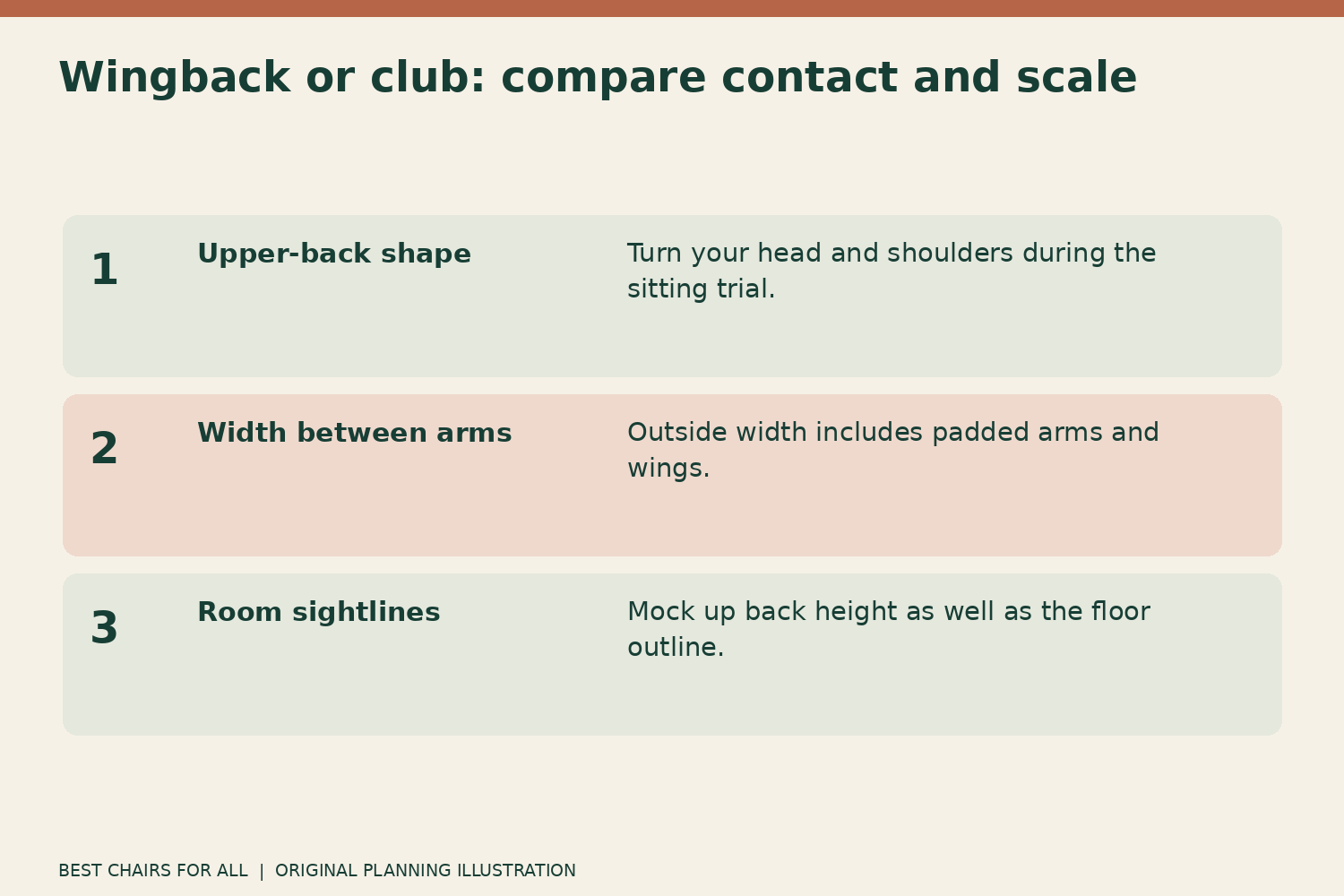
Wingbacks often make a strong vertical feature in a reading corner. Club chairs often preserve a more open sightline across a conversation area. Either can be comfortable or awkward for a particular person. Compare where the upholstery meets your shoulders and head, how much usable width remains between the arms, and whether the chair fits the intended placement.
Identify the shape before assuming the function
A wing is a side projection from the back, usually near the shoulder or head area. It can be broad and enveloping or shallow and mostly decorative. Look at front, side, and overhead views if available. A photograph from one angle can make wings appear larger or smaller than they are and hide the back’s actual slope.
The IKEA STRANDMON product page provides a clear contemporary wing-chair example, with a high back, side wings, padded arms, and separate seat dimensions. Its form explains the label, but it does not establish how every wingback fits or what all wingback chairs measure.
A club chair commonly places more visual emphasis on the seat and arms than on a tall upper back. Yet modern examples may use track arms, sloping sides, or a tight back instead of traditional rolled shapes. Ethan Allen’s Kellan club chair, for instance, uses sloping track arms and a tight back. Leather is an available material choice, not a requirement for every chair carrying the club label.
Compare head and shoulder contact
For a wingback, sit fully against the back and notice where the wings begin. They should not force your shoulders inward or require an uncomfortable head position. Turn to speak to someone beside you, look toward a lamp, and return to your book. A wing that feels pleasant while facing forward can be intrusive during ordinary sideways movement.
Do not assume a tall back provides a usable headrest. The highest part may sit behind the wrong point of your head, or a decorative curve may push you forward. Try the chair in the posture you intend to use. If you need to recline, confirm that the back angle and upper cushion actually support that position.
For a lower club chair, evaluate whether the absence of upper-back contact suits your activity. It may be agreeable for conversation or upright reading, while someone who wants to lean back for long periods may prefer another shape. Avoid adding a tall unstable pillow to simulate a backrest the chair does not have.
Do not confuse outside width with usable width
Thick arms and wings consume outside space without necessarily enlarging the seat. Measure the clear width at cushion level and again at the point where your knees or elbows would meet the sides. A broad chair can still feel narrow, while an open shape can feel generous within a smaller overall footprint.
As a documented dimensional comparison, the STRANDMON page lists 32¼ inches overall width and 19¼ inches seat width. The Kellan page lists 36 inches overall width. These are examples of individual models, not a finding that club chairs are wider as a category. Obtain the Kellan’s exact usable-seat information if considering that model rather than inferring it from the overall figure.
If you curl up to read, test both width and depth with your legs in the intended position. Rolled arms may provide a soft resting surface but take up knee space. A wingback’s upper enclosure may be comfortable while its lower seat remains too narrow. Judge each contact area separately instead of awarding the entire silhouette one comfort verdict.
Check seat height and depth together
A low club chair can feel lounge-like but require more effort to leave for a particular user. A tall wingback can still have a relatively low seat. Overall height does not describe the sitting height. Record the floor-to-seat measurement, usable depth to the back support, and what happens when the cushion compresses under normal use.
Sit back with feet supported in your ordinary footwear. Check whether the front edge presses behind the knees or whether you slide forward to reach the floor. Then read several pages with the book you usually use. A chair that fits your lower body can still leave its arms too high, too low, or too far apart for comfortable reading.
When comparing two chairs, keep the trial conditions consistent. Use the same book, the same intended footrest arrangement, and similar time to settle into each cushion. Write down specific observations such as “left wing touches shoulder when turning,” rather than relying on a brief impression that one chair is cozier.
Decide how the back should work in the room
A wingback’s vertical silhouette can anchor a corner or balance a tall bookcase. It can also interrupt a view across an open room or visually divide nearby seating. Stand at the room entrance and sit in the neighboring seats when assessing the effect. The view from the chair is only one of the room’s important sightlines.
A lower club chair may preserve that openness, but broad arms can make its footprint feel substantial. Two club chairs opposite a sofa can create a strong horizontal band of upholstery. If the room is small, compare visible legs, arm thickness, and the space beneath the frame rather than assuming that a low chair will disappear visually.
Use cardboard to suggest the back height above a taped floor outline. This is particularly useful when comparing a high wingback with a low club chair that has similar width and depth. A plan drawn only from above cannot show how differently they affect a window, a doorway view, or conversation across the room.
A placement worksheet for three common rooms
This original worksheet helps convert style preference into a placement decision. It does not prescribe a universal winner. Choose the scenario nearest your room, then test the listed question with the actual chair dimensions. If the answer depends on a missing measurement, keep the decision open until the seller supplies it.
| Room situation | Wingback question | Club-chair question |
|---|---|---|
| Reading corner beside shelves | Do wings obstruct the lamp or shoulder movement? | Does the lower back suit the reading posture? |
| Pair of chairs opposite a sofa | Do tall backs interrupt views from adjacent areas? | Do broad arms leave enough usable walkway? |
| Chair near a low window | How much glass does the back obscure? | Can the chair remain clear of curtains and controls? |
Add the approach route to each scenario. A chair placed diagonally may look balanced but project farther into a walkway than expected. Rotate the taped outline to match the proposed angle and measure the new outer corners. Leave space for the person using the chair, including their legs and the ordinary movement required to stand.
Consider motion separately from style
Some wingbacks swivel or recline, and some club chairs do too. Those functions introduce different clearances and maintenance requirements. A swivel base hidden beneath upholstery does not reduce the turning envelope to the base diameter; the arms and back still sweep through space. A reclining version needs the exact manufacturer’s operating clearances.
Ethan Allen’s living seating buying guide distinguishes stationary seating from other chair functions. Use that kind of functional distinction alongside the style label. Choose the motion you need first, then confirm that the selected wingback or club-chair version offers it in the desired size and upholstery.
During a trial, check how you operate the chair and whether nearby furniture would interfere. Keep hands and loose items clear of mechanisms. Do not infer a safe clearance from a showroom arrangement, where furniture may have been placed for display rather than for your room’s everyday use.
Compare upholstery and maintenance honestly
A leather club chair and a fabric wingback create a material comparison as well as a shape comparison. Separate those issues. Leather finish, fabric fiber, weave, cushion construction, and the manufacturer’s cleaning directions matter more than the style name. A wingback can be leather; a club chair can be fabric.
Check frequent contact points. Wings may collect hair products where a reader rests their head, while broad club-chair arms can receive frequent hand contact or serve as an improvised perch. Follow the intended use and do not assume arms are extra seats. Look for accessible care information and ask whether replacement cushions or covers are available.
For a secondhand chair, identify the model and inspect the frame, cushion condition, odor, and upholstery before making a style decision. A sagging club chair or damaged wingback can feel very different from its original design. Budget for professional assessment when repair needs are unclear; attractive proportions do not compensate for an unstable frame.
Choose the chair that passes the activity trial
Favor a wingback when its upper enclosure feels comfortable, its back height suits the room, and the wings do not obstruct ordinary movement. Favor a club chair when its lower profile and arm arrangement suit the intended activity and circulation. Treat these as decision conditions, not rules about which style belongs in a traditional or modern room.
Before ordering, keep a short record of usable seat measurements, occupied observations, the taped placement, exact upholstery care, and delivery constraints. Ask any unanswered question against the specific model number. A well-fitted club chair and a well-fitted wingback can both make excellent living-room seats; the best choice is the one whose particular shape works for the person and the placement.
Something unclear or out of date? Send a correction with this article’s title and the detail to check.
Sources, research & corrections policy ↗