Recliner seat depth is the usable distance from the sitting position against the back cushion to the front edge of the seat. Choose it by checking your upright fit first, then confirming that the fit remains comfortable when the chair reclines. A deep seat may look generous but leave a shorter user perched forward; a shallow seat may feel easy to enter but provide less thigh support for another person.
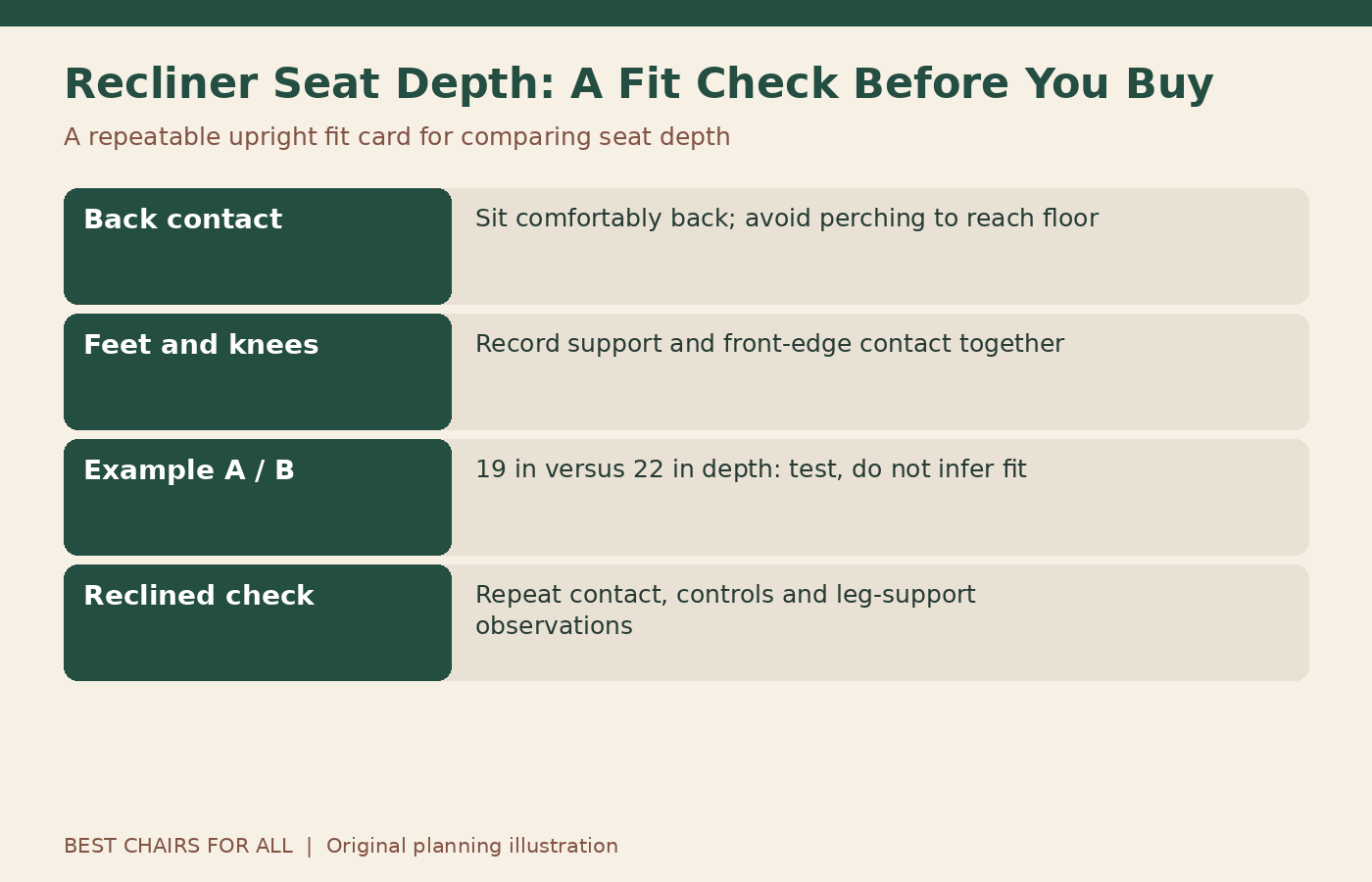
There is no single correct seat-depth number for everyone of a particular height. Leg proportions, cushion compression, back shape, and preferred sitting position all affect the result. Use measurements to narrow the shortlist and a repeatable seated trial to make the decision. The worksheet below turns a vague feeling of too deep into observations a retailer can act on.
Distinguish seat depth from overall depth
Overall depth measures the chair’s exterior front to back in a specified position. It includes the back construction and other parts that are not usable sitting surface. Seat depth describes the area available to the occupant, but manufacturers may use slightly different reference points. Compare dimension drawings rather than assuming every catalog number was measured in an identical way.
Pride’s sizing FAQ lists seat depth independently from seat height and overall size. Its size categories show why those dimensions need separate attention. A wider chair is not necessarily deeper, and a model marketed to taller users may change several measurements at once. Obtain the exact dimensions for the size and base you intend to buy.
Measure a starting point on a firm chair
Sit upright on a firm, stable chair with your feet supported and your usual indoor footwear. Have a helper measure the horizontal distance from the back of your seated body to the back of your knee. Keep the tape horizontal rather than following the curve of the thigh. Record the method and position so that a second measurement is comparable.
This is a starting observation, not a formula that produces a recliner purchase size. A padded recliner can let the pelvis settle deeper and can change the position of the back cushion under load. If you have an existing chair that feels comfortable, measure its usable seat depth too. Bring both figures and a description of what works about that chair to the showroom.
Check seat height at the same time
Depth and height interact. If a chair is too high for your lower legs, moving forward may bring your feet to the floor but take your back away from the cushion. That can look like a depth problem even when height is the main issue. Conversely, a very deep seat can prevent comfortable floor contact despite a reasonable published seat height.
La-Z-Boy Australia’s fit guide connects seat height and depth with upright foot support. During a trial, note whether your back stays comfortably supported while your feet rest where you want them. Do not judge seat depth while standing beside an empty chair, because the cushion’s loaded shape matters.
Use an upright fit observation card
Create six lines: pelvis comfortably back, back cushion contact, feet supported, front-edge contact, arm position, and control reach. For each, write Comfortable, Needs repositioning, or Not suitable. Add a short explanation rather than a numerical score. Front edge presses behind knees tells the retailer more than a comfort rating of six out of ten.
Start with the chair in its normal upright position and the footrest closed. Settle into the cushion without deliberately slumping or holding yourself rigid. Observe the position you naturally choose after a few minutes. If you repeatedly slide toward the front to reach the floor, write that down. It may be a fit issue worth resolving before testing reclining features.
Recognize a seat that feels too deep
Common observations include losing back-cushion contact when the feet are supported, reaching forward for the floor, or feeling the seat front behind the knees. These observations do not diagnose a medical problem; they show that the furniture may not suit your normal posture. Check whether a different size within the same collection changes depth, height, or both.
Do not assume the solution is a loose cushion stuffed behind the back. An added cushion changes effective depth, headrest alignment, arm position, and possibly the way the person uses the controls. If you intend to use a support, ask the manufacturer or provider whether it is appropriate and repeat the complete fit trial with it. Avoid making an unsuitable chair seem acceptable only through an untested improvisation.
Recognize a seat that feels too shallow
A shallower seat may leave a longer-legged person feeling that the thighs are insufficiently supported. It can also position the user differently relative to the back cushion and arms. Compare the feeling against an existing comfortable chair and note the specific area that lacks support. Do not choose a deeper seat merely because more upholstery seems more luxurious.
Test the deeper alternative upright before reclining. It may improve thigh contact while creating excessive reach to the floor or controls. The goal is a coherent sitting arrangement rather than maximizing one measurement. If neither depth works, another chair geometry may be more useful than moving to the largest size of the same model.
A hypothetical comparison with different proportions
Imagine two candidates with the same 20-inch seat-height specification. Candidate A lists 19 inches of seat depth; Candidate B lists 22 inches. A user finds that Candidate A allows comfortable back contact and floor support, while Candidate B requires moving forward. That observation supports choosing the shallower candidate for upright use, subject to the rest of the fit and room checks.
Now imagine another user who feels unsupported under the thighs in Candidate A and comfortable in Candidate B. The same catalog figures lead to a different result. These are invented examples, not universal depth targets. They demonstrate why a person’s standing height, a chair’s size label, or the word oversized cannot replace an actual seated comparison.
Recheck depth during recline
As the chair reclines, its seat may tilt or translate and the back may move relative to the occupant. Try the positions you will actually use for reading, television, or resting. Notice whether you must slide your body to maintain comfortable contact, whether the front edge becomes intrusive, and whether the head cushion still supports the intended area.
La-Z-Boy’s recliner guide encourages a personalized fit trial and distinguishes several recliner types. Use the exact mechanism you intend to order for that trial. A manual rocker and a powered wall recliner in a similar style may not produce the same body position as they move, even if their published seat depths look close.
Keep footrest length separate from seat depth
A tall person may be tempted to choose a deeper seat solely to move the heels farther onto the footrest. That can trade one fit problem for another. Footrest support, extended leg length, and upright seat depth are related but separate checks. Ask about the model’s intended heel position and any manufacturer-approved extension rather than using seat depth as a substitute for leg-support length.
Similarly, a shorter user should not have to sit at the front edge merely to reach a control or close a manual footrest. Evaluate the operating effort from the comfortable sitting position. If the action requires a repeated awkward shift, compare control types or another model. Record the difficulty without forcing the mechanism or assuming it will become easy after purchase.
Compare upholstery and cushion packages carefully
The seat’s effective depth depends partly on where you settle into the cushioning. A firm display seat and a softer ordered cushion package can feel different even when the frame dimensions match. Ask what cushion options are included in the model you tried and whether the manufacturer publishes any dimensional variation. Upholstery thickness and back-cushion construction may also influence the fit.
Avoid predicting exactly how much a new cushion will soften or compress. That depends on the product and use. If a salesperson says a chair will become shallower, deeper, or easier to fit after breaking in, ask for a more specific explanation and written return terms. A substantial fit problem should not be resolved by an unsupported promise about future cushion behavior.
A shared-chair decision worksheet
For a chair used by two people, make one fit card per person. Put the cards beside each other and identify whether the disagreement concerns height, depth, width, or controls. A powered headrest may help head position but cannot necessarily shorten the sitting surface. A larger weight capacity also does not determine whether either person has a comfortable seat-depth match.
Classify each candidate as works for both, works for primary user with accepted compromise, or unsuitable for shared use. Write the compromise in plain language. If the primary use involves assistance or a care plan, get individual advice about any proposed adaptation. The worksheet should make the tradeoff visible before the chair becomes a difficult item to exchange.
Take a decision packet home
Keep the exact product code, seat measurements, cushion package, upright observations, and reclined observations together. Include room dimensions and delivery access as separate checks. A chair that fits the body still needs to fit its operating space. Ask the retailer to confirm which numbers are nominal and which dimensions are important for the planned installation.
Before ordering, repeat the most relevant fit trial and verify return or restocking terms. At delivery, check the seated arrangement before surrounding the chair with accessories. If the new chair feels meaningfully different from the display model, document the configuration and contact the retailer promptly. A good seat-depth decision is supported by reproducible observations, not by a single number remembered from an online listing.
Something unclear or out of date? Send a correction with this article’s title and the detail to check.
Sources, research & corrections policy ↗