A dining chair is described by where it is intended to be used. A side chair is commonly an armless chair style, and many side chairs work perfectly well at dining tables. The terms overlap. To decide whether a particular chair belongs at your table, check its seat height, depth, width, back angle, base, and stated use instead of assuming either label guarantees a fit.
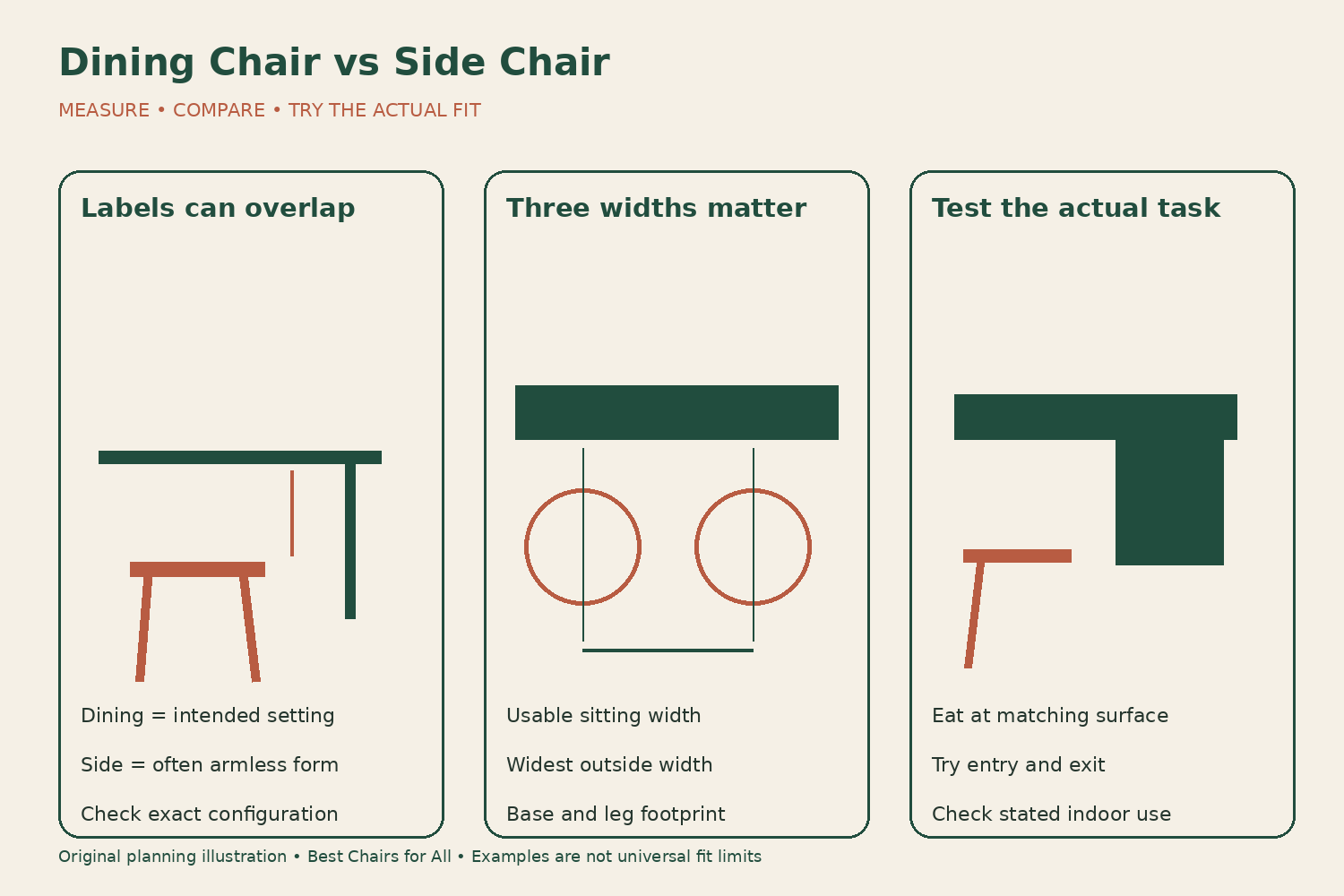
Why the names overlap
Furniture categories are browsing tools rather than a single dimensional system. A retailer might list an armless chair under dining, side, occasional, or guest seating. One manufacturer may offer the same shell with dining-height legs and a taller stool base. An attractive product name therefore tells you less than its specification sheet about how it will work in the room.
Herman Miller calls the Eames Molded Wood design a side chair, yet presents it as versatile seating with several base options and an optional attached seat pad. Its product sheet separates side-chair configurations from counter-height and bar-height stools. The family resemblance does not make their heights interchangeable.
A dining label does give you a reason to investigate table use, but it does not establish compatibility with your particular table. Some dining chairs are broad, some are low, some have arms, and some use a deep upholstered seat. Likewise, a side chair can be suitable for eating without being suitable for hours of desk work or for an outdoor patio.
Start with the seat-to-table relationship
Measure the table from the floor to the top and to the lowest continuous obstruction beneath it. An apron, drawer, or support can reduce the opening available to your legs. Write these as two different measurements. Then compare the candidate’s seat height with each number. A table’s overall height alone does not describe its usable knee opening.
Try the candidate at an equivalent surface height if you cannot bring it home. Sit as you would for a meal, with a plate and glass within reach. Notice whether you can rest comfortably near the table without lifting your shoulders, leaning excessively, or pressing your thighs against the apron. A few seconds of sitting away from any table cannot answer those questions.
For padded seats, distinguish the unloaded advertised height from the position once a person has settled into the cushion. Do not assume that adding a removable pad fixes a poor match. It can change the leg opening and how the back supports you. Evaluate the complete configuration you plan to use and confirm that any accessory suits the chair.
Compare usable depth with overall depth
Overall chair depth describes the furniture’s footprint. Usable seat depth describes the area available between the front of the seat and the back support. A curved shell, angled back, thick back cushion, or open frame can make those figures quite different. Ask which dimension a listing provides instead of assuming a photograph reveals the difference.
To assess a dining position, sit with your back in the position you naturally use and your feet supported. Check whether the front edge leaves room behind the knees. If you must slide far forward to reach the floor, the back may stop supporting you. If the seat feels too short, record that observation rather than assuming every chair with the same overall depth will behave similarly.
A lounge-oriented occasional chair can look like a side chair in a catalog while placing the sitter lower and farther back than is convenient for eating. Conversely, a relatively upright chair may work at a table without feeling inviting for reclining with a book. Buy for the activity that will actually happen, and treat secondary uses as separate trials.
Width has three different jobs
First, the usable seat width must suit the person. Curving sides and thick upholstery can narrow the area inside the published outside width. Second, the chair’s widest external part must fit beside its neighbors. Third, the base and legs must fit the table opening and floor area. One width number rarely answers all three questions.
Room & Board’s dining-chair guide specifically asks shoppers to consider the distance between table legs and the space between chairs and those legs. That is a useful reminder that tabletop length is not the whole fit. A wide table with closely placed legs may accept fewer chairs than its outer dimensions suggest.
An armless side chair can make side entry easier, but that does not automatically make it narrow. A flared back or splayed base can project beyond the seat. Measure the widest part and draw it in the planned position. If two different chairs are mixed, compare their actual envelopes rather than assuming their shared “side chair” designation means equal spacing.
Arms change access and storage
Armed dining chairs can provide a place to rest the forearms and may be preferred by some users during sitting or standing. They also require their own table-clearance check. Measure arm height at its highest point and compare it with the lowest edge the arm must pass. Test the approach path as well as the final tucked position.
A side chair without arms removes that particular interference but does not solve every access problem. The table legs, nearby wall, base shape, and chair weight still affect how someone enters and leaves. Ask the intended user to try the movement rather than deciding that an armless chair is universally easier or that arms are universally necessary.
At the ends of a rectangular table, you may want a different chair from the ones along the sides. That can be a practical choice as well as a visual one. Keep each position’s dimensions on the worksheet. An end chair that works between the table legs should not automatically be moved to a narrower side position for a larger gathering.
Check the base and movement
Look below the seat. Four legs, a sled base, a cantilever frame, a swivel, and casters create different interactions with the floor and table. A chair marketed as guest seating may roll when you expected it to stay still. A fixed dining chair may need to be pulled farther back than a swiveling design. Read the construction description before comparing appearance.
Check floor protectors and whether replacements are available for that exact frame. A small worn glide can matter more to everyday use than the category name on the invoice. Test movement on a representative surface if possible. Carpet, a rug edge, textured tile, and smooth wood do not offer the same conditions for pulling out a chair.
Keep motion and structural condition separate. A cantilever may be designed to flex; a loose joint in a rigid chair is a different issue. A swivel should rotate as intended without being treated as permission to rock on a base. Follow the manufacturer’s use and assembly guidance for the particular product, regardless of which room you place it in.
Read intended-use statements literally
Indoor use does not imply outdoor suitability, and household dining use does not establish suitability for a restaurant. A chair’s warranty or testing information may distinguish those settings. If you need a commercial chair, ask the manufacturer about that application explicitly. Do not infer an approval from a familiar design or from a retailer photographing the chair in a café.
The same care applies to stacking. Similar-looking side chairs may have different bases, bumpers, upholstery, or stack limits. Only stack a model when the manufacturer says it is stackable, following its instructions. A lightweight chair that can physically sit on another chair has not thereby become a safe storage system.
If the chair will be used by someone with a specific transfer or seating need, an in-person fit assessment matters more than the label. A qualified professional can help with needs beyond ordinary shopping checks. Do not treat a dining-chair category or an armless profile as an accessibility certification.
A two-use comparison worksheet
Write the primary job at the top: everyday dinner, occasional guest seating, or another clearly stated use. For each candidate, record seat height, usable depth, usable width, overall width and depth, arm height if present, and the type of base. Add the table’s underside height and the clear opening between its legs so the comparison stays connected to your furniture.
Create separate observation rows for eating reach, foot support, back contact, getting in and out, and moving the chair for cleaning. Use specific notes, such as “back hits the wall before I can stand” or “front legs contact the table base.” Those observations tell you whether to change the chair, the placement, or the room arrangement.
If the chair will serve a second purpose, perform a second trial. Sitting comfortably through a meal does not show that the same seat works for a long work session. Similarly, a pleasant guest chair by the window can place you too far from a table. Avoid averaging the two uses into one vague comfort score that hides a clear failure in the main task.
Make the final choice by configuration
Before ordering, confirm the exact base, upholstery, and height version in the cart. A product family may include a side chair, stool, armchair, and task-base version under closely related names. Keep the dimensional drawing that corresponds to your order, then check the delivered item against it before purchasing additional chairs.
Use the words “dining chair” and “side chair” to discover options. Let measured fit, intended use, and a realistic trial decide whether an option belongs at your table. The overlap between the labels is useful once you understand it: it expands the possibilities without replacing the practical checks that make a chair work.
Something unclear or out of date? Send a correction with this article’s title and the detail to check.
Sources, research & corrections policy ↗